Anthropic Warns: AI Makes Startup Failure Rates Higher, Not Lower

AI reduces development costs, but judgment is the scarcest ability for startups in the AI era.
Anthropic's Founders Playbook argues that while AI coding tools compress product development from weeks to days, they haven't reduced startup failure rates — they may actually amplify wrong directions faster. When execution costs approach zero, the most critical founder skill becomes judgment: judging whether demand is real, whether an MVP is truly validated, whether launch buzz equals retention, and whether automation creates technical debt. AI lowers development costs, not demand validation costs.
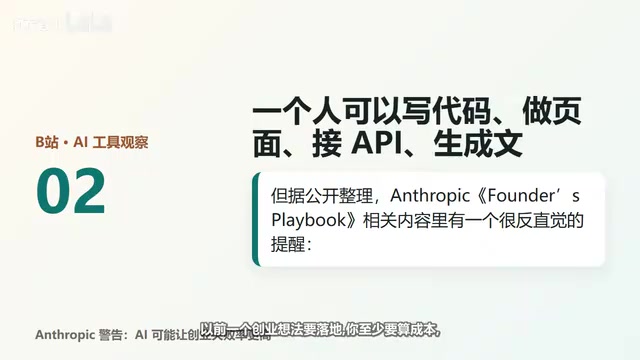
When AI coding tools compress product development from weeks to days, many assume the barrier to starting a company has been lowered. But Anthropic offers a counterintuitive reminder in its Founders Playbook: AI may not be reducing startup failure rates — it may be amplifying wrong directions faster.
Context: Anthropic is an AI safety company founded in 2021 by former OpenAI Research VP Dario Amodei and Daniela Amodei. It's also the developer of the Claude series of large language models. The Founders Playbook is a practical guide published for developers and founders building with the Claude API. Its core insights come from Anthropic's internal observations of hundreds of AI-native product teams. What makes this document unique is that it doesn't come from a traditional VC or business school perspective — it's a first-hand reflection from a company at the frontier of AI capabilities on the phenomenon of "AI-accelerated entrepreneurship."
This perspective deserves serious consideration from every founder building products with AI.
When Execution Becomes Cheap, Judgment Becomes the Scarcest Ability
In the past, many projects genuinely died at the execution stage — no one to write code, no one to design, no one to build a website, no one to handle cold starts. Today, Claude Code, Cursor, and various AI Agents compress what used to take weeks into days or even hours.
Technical Background: Claude Code is Anthropic's command-line AI coding assistant that can directly read and write local codebases, execute terminal commands, debug errors, and complete end-to-end development tasks. Cursor is an AI-native code editor built on VS Code, deeply integrated with large models like GPT-4 and Claude, supporting multi-file context understanding and natural language-driven code generation. The essence of these tools is the deep fusion of LLM code generation capabilities with development environments, enabling even non-professional developers to build fully functional CRUD web applications in hours. Behind this capability leap is the scaled application of the Transformer architecture in the code domain — models pre-trained on massive open-source code gain cross-language, cross-framework code reasoning and generation abilities.
But that's precisely where the problem lies. When execution becomes too cheap, what founders most easily overlook becomes the most critical thing — judgment.
A product that runs doesn't mean users actually need it. A page that looks complete doesn't mean the market will pay for it. An AI research report that reads convincingly doesn't mean the direction is valid.
Here's an example: You want to build an AI document tool. Within two days, you can have login, file upload, automatic summarization, conversational Q&A, and result export — all fully functional. AI can even help you write website copy and create demo videos. But the core questions remain unresolved: Did users have this pain point before? How do they currently solve it? Is this problem frequent enough to justify opening a new tool daily? Are they willing to pay?
AI reduces development costs, not demand validation costs.
Ideation Stage: Cheap Ideas Create Dangerous Illusions
At the ideation stage, the biggest risk is — ideas are too cheap.
In the past, turning a startup idea into reality required at least calculating costs, finding people, scheduling, and making technical decisions. This friction itself served as a natural filtering mechanism. Now you open an AI tool, and within minutes it generates a direction complete with market analysis, competitive comparisons, and business models. Every direction looks plausible.
This creates an illusion that opportunities are everywhere. But the real question isn't "can this idea be built?" — it's:
- Is this problem painful enough?
- Does it occur frequently enough?
- Are users currently spending time, money, or complex workarounds on it?
If these answers aren't clear, then no matter how polished the idea looks, it's still just an idea.
MVP Stage: Runnable Doesn't Mean Validated
AI makes prototyping extremely fast — you can quickly assemble a demo with Claude Code or Cursor. But the purpose of an MVP isn't to prove you can build a product. The purpose of an MVP is to validate your smallest assumption.
Methodology Background: The MVP (Minimum Viable Product) concept was systematized by Eric Ries in his 2011 book The Lean Startup, with core ideas rooted in Steve Blank's customer development methodology. Its essence is treating the startup process as a series of scientific hypothesis validations — founders first identify core assumptions (typically "users have a certain pain point and are willing to pay for a solution"), then build the lowest-cost product form that can validate that assumption, using real user behavior data to decide whether to "persevere" or "pivot." Before AI tools became widespread, the "minimum" in MVP was often constrained by development costs, forcing founders to make difficult tradeoffs. But when development costs approach zero, MVPs tend to inflate into feature-packed "complete products," thereby losing their original purpose of hypothesis validation.

Many people make a classic mistake here: once the prototype runs, they frantically add features — settings panels, dashboards, sharing, membership systems, automation. It looks more and more like a complete product, but users might not even want to perform the single core action.
What the MVP stage should actually do is compress the question to its smallest form, validating only one thing: whether users are willing to hand over their data, time, attention, or even payment for this outcome. Until this is validated, more features only mean greater deviation.
This is the easiest trap to fall into when building startups in the AI era — it's not that you can't build it, but that after building it too quickly, you mistake "it runs" for "it's validated."
Launch Stage: Surface-Level Buzz Doesn't Equal Real Demand
AI can help you write Product Hunt copy, tweets, cold-start emails, demo scripts, and even generate promotional materials for different channels. A launch can look incredibly polished and professional.
But a complete launch doesn't mean a complete feedback loop. The core metrics you need to watch are:
- How many people actually come back a second time?
- How many people are willing to leave their email?
- How many people proactively ask about pricing?
- How many people don't just say "that's cool" but actually incorporate it into their daily workflow?
What AI most easily amplifies is surface-level buzz — likes, shares, comments, and bookmarks all give founders strong psychological feedback. But what a project really needs to track is retention, repeated use, and willingness to pay. If there's only day-one excitement with no follow-up behavior, that's not a successful launch — it's just content that went viral once.
Scaling Stage: Automation Can Become Technical Debt
Many people assume that more AI Agents mean a leaner company and faster scaling. This is only half right.

Agents and automation can indeed help you handle customer service, analyze data, generate reports, and execute internal operations. But they also introduce new complexity.
Concept Extension: Technical Debt is a concept introduced by software engineer Ward Cunningham in 1992, using financial debt as a metaphor for the hidden costs accumulated when sacrificing long-term code quality for short-term speed — like borrowing money, you gain convenience in the short term, but must pay higher "interest" (maintenance costs, refactoring expenses) in the future. In the AI Agent era, technical debt takes on new forms: founders can quickly build automation workflows using low-code or natural language, but these workflows often lack clear error handling, permission boundaries, and observability design. As business scale grows, these "automation fragments"
Related articles
 Expert Opinions
Rethinking Scaling Laws: Parameters Are Not the Only Answer
Deep analysis of Scaling Law evolution from Kaplan to Chinchilla to the MoE era, exploring why blindly stacking parameters is a mistake, and how GLM-5.3 proves scaling has multiple knobs.
When AI Treats Humans as Subagents: Ro…
When AI Treats Humans as Subagents: Role Reversal and Hidden Risks in Human-AI Collaboration
Exploring the paradigm shift where humans become "subagents" in AI Agent architectures. Analyzes human node design in LangChain and AutoGen, and the risks of ceding control and cognitive atrophy.
 Expert Opinions
The Lazy Person's Productivity Theory: Why Being 'Lazy' Actually Drives Peak Performance
Explore the engineering philosophy behind 'lazy people are most productive': how constructive laziness drives automation, AI tools amplify efficiency, and systems thinking eliminates wasted effort.