Anthropologic: Reimagining Consumer Research with the 'Human Context Protocol'

Anthropologic uses its 'Human Context Protocol' to deliver fast, culturally grounded AI consumer research across 239 markets.
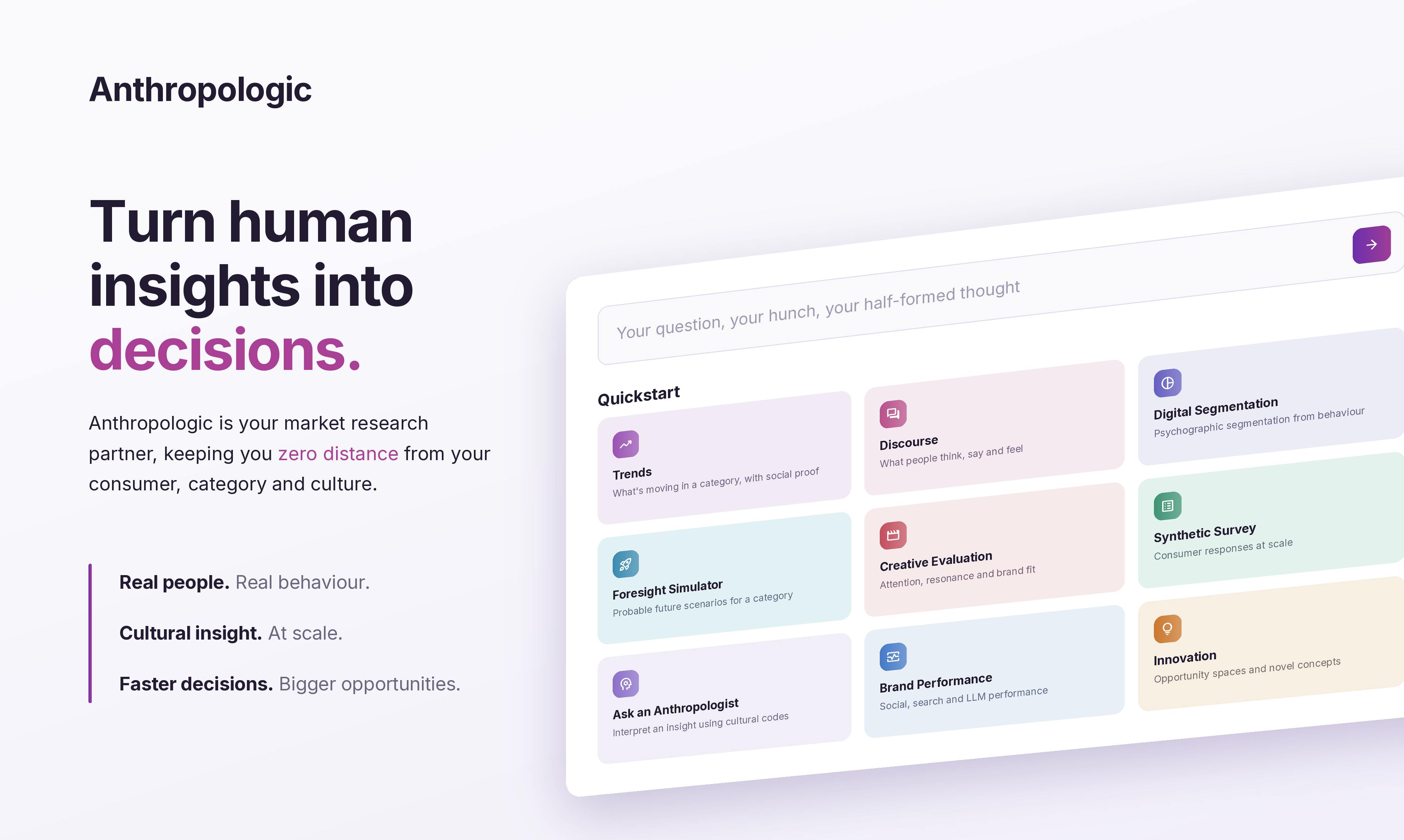
Anthropologic is an AI platform positioning itself as a 'zero distance consumer research' solution, targeting the gap between slow qualitative research, shallow social listening, and culturally blind LLM tools. Its core claim — the Human Context Protocol — promises to extract culturally contextualized consumer insights from across the web, spanning 9 workflows, 239 markets, and 100+ languages with minute-level response times. It reached #6 on Product Hunt on launch day, targeting brand marketers and product innovation teams. However, technical implementation details remain undisclosed, and data compliance, cross-language accuracy, and differentiation from standard NLP pipelines all warrant independent verification.
Traditional consumer research has long been stuck in a frustrating tradeoff: qualitative studies offer depth but are painfully slow, often taking weeks to yield conclusions; social listening tools are fast but surface-level, capturing sentiment without explaining it; and today's large language models produce fluent output but lack genuine cultural understanding. Anthropologic, which launched on Product Hunt and climbed to #6 on the daily leaderboard, is targeting exactly the gap between these three approaches.
The Fault Lines Between Three Research Paradigms
Anthrologic positions itself as a "zero distance consumer research platform" — a framing that amounts to a direct critique of the existing market research toolchain.
According to the product's own description, each dominant approach to generating insights has a distinct weakness: traditional research is "deep but slow," with rigorous studies requiring multiple rounds of recruitment, interviews, and data coding; social listening tools are "fast but shallow," able to track brand mentions and sentiment in real time but unable to explain the cultural drivers behind them; and LLM-based tools are "fluent but culturally blind," generating analyses that sound plausible but lack real grounding in the context of specific markets and communities.
In marketing and product innovation, these three capabilities — depth, speed, and cultural understanding — rarely come together. The team's bet is that this gap is itself a product opportunity worth solving.
Social listening as a methodology emerged from brands' need to track public opinion in real time. Leading tools like Brandwatch, Sprinklr, and Meltwater are built around scraping public content from Twitter/X, Reddit, Instagram, and similar platforms, then using sentiment analysis and keyword clustering to surface metrics like brand volume, sentiment ratios, and topic trends. The fundamental limitation of this approach is that it "counts" rather than "understands" — it can tell you how many people are complaining about a product, but not whether that frustration stems from a cultural expectation gap, a difference in consumption habits, or a competitor comparison effect. A structural weakness is also the uneven quality of language coverage: sentiment recognition is far more accurate in English than in smaller languages, which means cross-border brands consistently get lower-quality insights from non-English markets. Anthropologic's contrast with this paradigm targets precisely this pain point: explanatory power.
The Core Mechanism: Human Context Protocol
Anthrologic's central technical claim is what it calls the "Human Context Protocol." According to the product description, this protocol enables the platform to "read the entire internet" and surface truths about consumers, categories, and culture.
The stated goal of this mechanism is to transform massive volumes of public web content into culturally contextualized insights — not just keyword frequency counts at a statistical level. In other words, it aims to layer an understanding of audience motivations, cultural signifiers, and consumer psychology on top of large-scale data processing efficiency. That's precisely the weakness most commonly attributed to purely LLM-based approaches.
It's worth noting that the company has disclosed limited technical detail about how the protocol actually works. "Reading the entire internet" reads more like a capability claim than a technical white paper. For prospective users, the accuracy and reliability of this mechanism in real business scenarios remains something that can only be verified through hands-on use.
In technical terms, "reading the entire internet" typically maps to one of two implementation paths: large-scale web crawling combined with public datasets (such as Common Crawl) feeding into a pre-trained or Retrieval-Augmented Generation (RAG) architecture; or integration with third-party structured content libraries covering news, forums, reviews, and e-commerce comments. The core idea behind RAG is that when a language model generates an answer, it retrieves from an external knowledge base in real time to provide more current factual grounding — reducing the "knowledge cutoff" and hallucination problems of pure LLMs. If Anthropologic's Human Context Protocol is built on a similar architecture, the competitive differentiation lies not in the model itself, but in the quality and coverage of data sources, the design of the retrieval strategy, and the post-processing layer that maps retrieved content into "cultural insights." This is precisely why, without a technical white paper, it's difficult for outsiders to assess the company's actual competitive moat.
Scaled Insight Capabilities
Beyond the methodological narrative, Anthropologic supports its coverage claims with a specific set of numbers:
- Nine workflows: Spanning research, innovation, and foresight use cases;
- 239 markets: Covering virtually every major country and region globally;
- 100+ languages: Supporting content ingestion and analysis across language barriers;
- Minute-level response times: Research, innovation, and foresight questions answered within minutes.
This combination points to a product designed around "broad coverage + fast response." For multinational brands and global marketing teams, having a single platform that spans hundreds of markets and dozens of languages could theoretically compress the time and coordination costs that traditionally come with running research across multiple regions.
Who It's For and What Problem It Solves
Anthrologic is listed under Marketing, Artificial Intelligence, and Data & Analytics on Product Hunt, with a fairly clear target user profile: brand marketers, product innovation teams, and market researchers.
The scenarios it aims to replace or supplement are those that demand both speed and depth — new product concept validation, cultural due diligence before entering a new market, trend foresight, and similar use cases. These have traditionally relied on external research firms, with long timelines and high costs. If the "minute-level answers" hold up in quality, it would represent a genuine disruption to consulting-style research services.
Garning 104 upvotes, 39 comments, and a #6 ranking on its launch day suggests this direction resonated with the community. AI-powered research tooling is a clear trend, and Anthropologic's differentiation lies in not packaging itself as "yet another AI analytics assistant" — instead, it emphasizes cultural context as the harder dimension to crack.
Questions Worth Watching
As a newly launched product, Anthropologic currently offers more in the way of vision and capability claims than verifiable evidence of effectiveness. Several key questions remain open: What is the compliance posture around the data sources behind "reading the entire internet"? Can the accuracy of cultural insights across 100+ languages meet professional research standards? Is the "Human Context Protocol" a genuinely reusable methodology, or a conventional NLP pipeline dressed in marketing language?
For teams considering adoption, the rational approach is to start with a small-scale validation in a familiar market — using known answers to pressure-test the platform's output quality — before integrating it into a formal research workflow.
Data compliance is the dimension most easily overlooked yet highest in risk for products of this type. Large-scale scraping of public web content is far from legally straightforward: the EU's General Data Protection Regulation (GDPR) imposes strict requirements on processing data involving natural persons, and even publicly posted content may trigger compliance obligations if it can be linked to an individual's identity. The boundaries of the U.S. Computer Fraud and Abuse Act (CFAA) continue to evolve through cases like hiQ Labs v. LinkedIn. For enterprise teams using Anthropologic's outputs to inform commercial decisions, it's worth asking vendors directly before onboarding: Are the data sourcing agreements compliant? Is a Data Processing Agreement (DPA) available to sign? Does cross-border data transfer comply with local regulations in target markets? This isn't just a matter of legal risk management — it directly determines whether insights can be used in formal business contexts.
Related articles
LynnReal-Omni: 32B Unified Video Diffusion Model Goes Open Source with Multi-Task Coverage in Four Steps
LynnReal-Omni is a 32B unified video diffusion model on MiniMax H3, covering text-to-video, pose guidance, style transfer, restoration in 4 steps. Flash version generates 540p video in 377ms on one H100.

Anthropic Co-Founder: AI 'Kill Switch' May Need to Be Mandatory by Law
Anthropic's co-founder tells the BBC that AI 'kill switches' may need to be legally mandated. We analyze the industry logic, technical challenges, and the tension between regulation and innovation.

The AI Data Center Boom Is Colliding With Cities Scarred by Heavy Industry
The AI data center boom is clashing with post-industrial communities. Philadelphia's case reveals structural conflicts between AI growth, energy use, water, and environmental justice.