Antigravity Panel: Quota Monitoring & Cache Management Tool for Google's Cloud IDE

antigravity-panel provides a real-time quota and cache monitoring dashboard for Google Antigravity cloud IDE
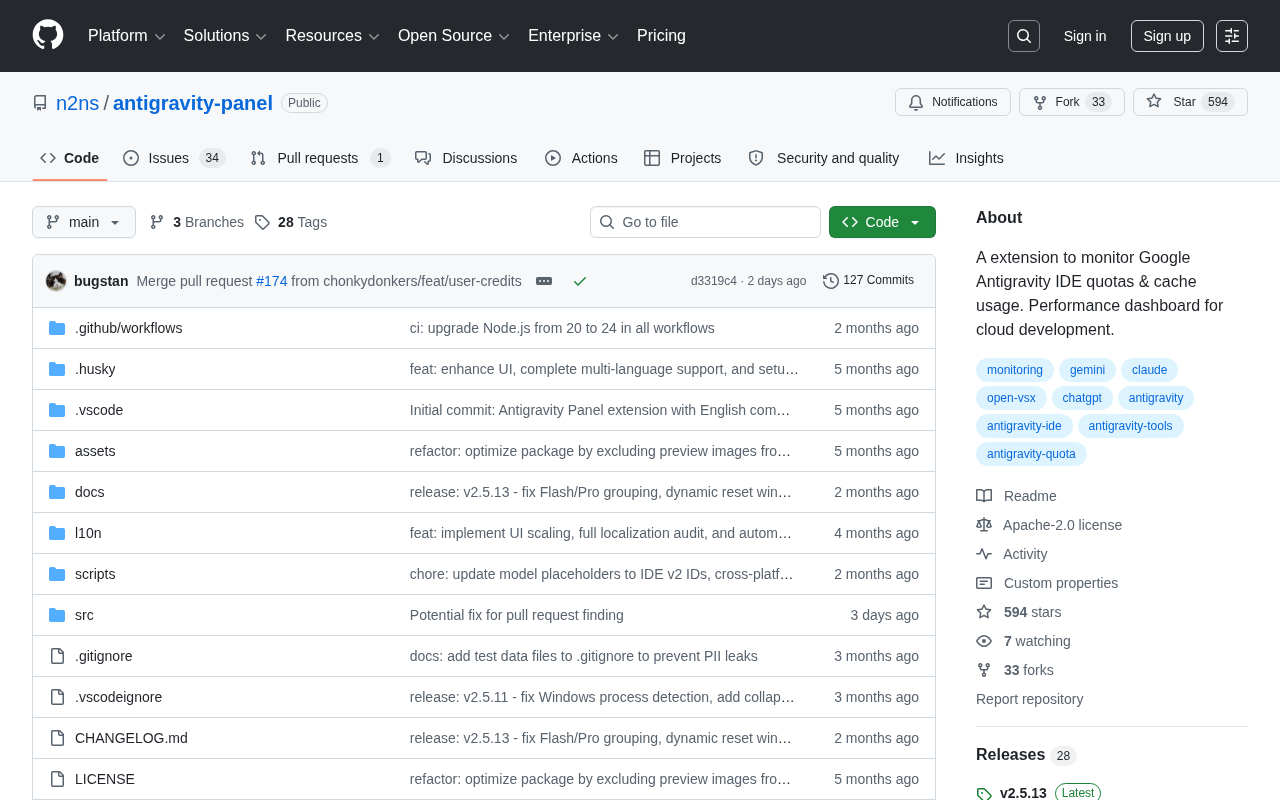
antigravity-panel is an open-source extension that provides a performance dashboard for Google Antigravity (formerly Project IDX) cloud IDE, addressing quota exhaustion and cache bloat issues developers face in cloud development. It supports real-time tracking of CPU, memory, and network quota consumption, analyzes cache usage and hit rates, and consolidates all metrics into a unified visual panel. Built with TypeScript, the project has earned 594 Stars on GitHub.
Project Overview
As Google rolls out Antigravity (formerly Project IDX) as a cloud-based development environment, more and more developers are migrating their daily workflows to cloud IDEs. Google Project IDX entered public beta in 2023 as Google's web-based full-stack cloud development environment, built on Google Cloud infrastructure with an editor experience powered by the VS Code open-source core. After rebranding to Antigravity in 2024, Google further strengthened its deep integration with the Gemini AI assistant, supporting one-click template initialization for mainstream frameworks like Flutter, Angular, and Next.js. Compared to competitors like GitHub Codespaces and Gitpod, Antigravity differentiates itself through native integration with the Google Cloud ecosystem and emulator support for mobile development (Android/iOS).
However, resource quota and cache management in cloud development environments remain persistent pain points for developers — hitting quota limits during peak coding hours, or experiencing sluggish environment responses due to cache bloat. These issues often strike without warning.
antigravity-panel is an open-source extension built to solve exactly this problem. It provides an intuitive performance dashboard for Google Antigravity IDE, enabling developers to monitor quota usage and cache consumption in real time for better cloud development resource management.
Core Features
Real-Time Quota Monitoring
Compute resources in cloud IDEs are not unlimited. Cloud IDE quota systems typically span two dimensions: compute resource quotas, including vCPU usage hours, memory allocation limits (Antigravity default workspaces typically provide 4-8GB RAM), and disk I/O rates; and network resource quotas, covering egress traffic, API call frequency, and more. Google sets a fixed monthly compute-hour cap for free-tier users — once exceeded, workspaces are forced into hibernation or throttled. This quota mechanism is fundamentally different from traditional local development, where resource consumption is bounded by hardware limits, while cloud IDE "ceilings" are determined by dynamic billing policies.
Google Antigravity imposes quota limits on each user's CPU time, memory usage, network bandwidth, and more. Developers may unknowingly run large build tasks, spin up multiple language servers (LSPs), or execute intensive tests, potentially exhausting their daily quota in a short time and disrupting development. antigravity-panel tracks these quota consumption metrics in real time, presenting current usage and remaining allowances through visual charts.
Developers no longer need to manually check the Google Cloud console to understand resource usage — all key metrics are integrated directly within the IDE, accessible at any time.
Cache Usage Analysis
Cache management in cloud development environments is often overlooked, yet it directly impacts IDE responsiveness and build efficiency. Cache Hit Rate is the core metric for measuring build system efficiency, representing the proportion of cache queries that successfully retrieve results from cache. In cloud development environments, the cache hierarchy is more complex: npm/yarn/pnpm dependency package caches, Gradle/Maven build artifact caches, Docker image layer caches, and language server index caches. A hit rate below 70% typically indicates significant redundant computation, directly increasing build times; meanwhile, unbounded cache growth (common in monorepo projects) consumes precious disk quota, creating another resource bottleneck.
antigravity-panel provides detailed cache usage analysis, helping developers identify:
- Which projects or dependencies consume the most cache space
- Whether cache hit rates are at healthy levels
- Whether there is stale cache data that needs cleaning
Unified Performance Dashboard
As a comprehensive performance monitoring panel, antigravity-panel consolidates quota, cache, and other performance metrics into a unified dashboard view. Developers can grasp the overall health of their cloud development environment at a glance and promptly identify potential performance bottlenecks.
Technical Implementation & Community Activity
The project is developed in TypeScript, maintaining technical stack consistency with Google Antigravity IDE's extension ecosystem. Google Antigravity's extension system is built on the VS Code Extension API, meaning developers can leverage the entire VS Code plugin ecosystem's development experience. TypeScript is the standard development language for VS Code extensions — Microsoft's official extension scaffolding (Yeoman generator) generates TypeScript projects by default, and the @types/vscode type definition package provides complete IDE API type declarations. TypeScript's static type system is particularly important when handling async API calls, event listeners, and data serialization in extension development, catching numerous runtime errors at compile time. Additionally, TypeScript compiles to JavaScript that runs directly in the Node.js extension host process without extra runtime dependencies — a critical performance guarantee for monitoring panels that require low-latency real-time refresh.
Based on GitHub data, the project has earned 594 Stars and 33 Forks, garnering significant attention in the cloud development community. Considering that Google Antigravity IDE itself is still in a rapid development phase, these numbers reflect strong developer demand for resource monitoring tools.
Use Cases & Target Users
Who Needs This Tool?
- Heavy cloud IDE users: Developers who use Antigravity extensively every day and for whom quota management is essential
- Team development leads: Those who need to understand overall team resource consumption patterns and optimize cloud development costs
- Performance-sensitive projects: Project teams with high requirements for build speed and IDE response time
A Signal of Cloud Development Ecosystem Maturity
The emergence of this project reflects that the cloud IDE ecosystem is maturing. Observability is a concept originating from control theory that has been widely adopted in the cloud-native space in recent years, typically comprising three pillars: Metrics, Logs, and Traces. This philosophy is now permeating from production environment monitoring into development environment toolchains. In traditional local development, developers rely on OS-native tools like Task Manager, htop, and Activity Monitor to perceive resource states; in the cloud IDE era, the underlying infrastructure is abstracted away, and developers lose direct visibility into physical resources.
What antigravity-panel does is essentially "push down" observability capabilities into developers' daily workflows, filling the inherent gap in resource transparency that cloud IDEs present. This trend aligns closely with the strategic direction of companies like DataDog and Grafana extending monitoring tools into the Developer Experience (DX) domain. When developers start caring about resource monitoring and performance optimization, it signals that cloud development has moved beyond the "early adopter" phase into the "productivity tool" stage.
Related articles
 Product Reviews
The Programmer's Desk Setup Guide: Building a Workspace That Feels Like Home
Discover how programmers build productive, comfortable workspaces. From multi-monitor setups to ergonomic design, explore the desk philosophy that drives focus and flow.
 Product Reviews
Qoder vs Cursor Real-World Comparison: Which $20/Month AI IDE Is Better?
Hands-on comparison of Qoder vs Cursor AI IDEs: Agent autonomy, human interaction count, and architecture decisions. Qoder needed only 2 interactions vs Cursor's 8.
 Product Reviews
Cursor Cloud Agent Demo: Eliminating Bottlenecks Across the Entire Software Development Lifecycle
Deep analysis of Cursor's Cloud Agent demo showing how cloud VMs, automated test artifacts, and a full-chain control plane systematically eliminate human bottlenecks across the software development lifecycle.