AntigravityQuotaWatcher: A Detailed Guide to Real-Time Google AI API Quota Monitoring

Real-time Google AI model API quota monitoring plugin helping developers manage call limits
AntigravityQuotaWatcher is an open-source quota monitoring plugin designed for Google AI models, developed in TypeScript with 2,282 GitHub Stars. It provides multi-dimensional real-time monitoring and visualization across RPM/TPM/RPD metrics, supports plugin-based architecture for integration into browser extensions, Node.js middleware, or CI/CD pipelines, and is suitable for individual free quota management, team collaboration coordination, and production environment alerting.
Project Overview
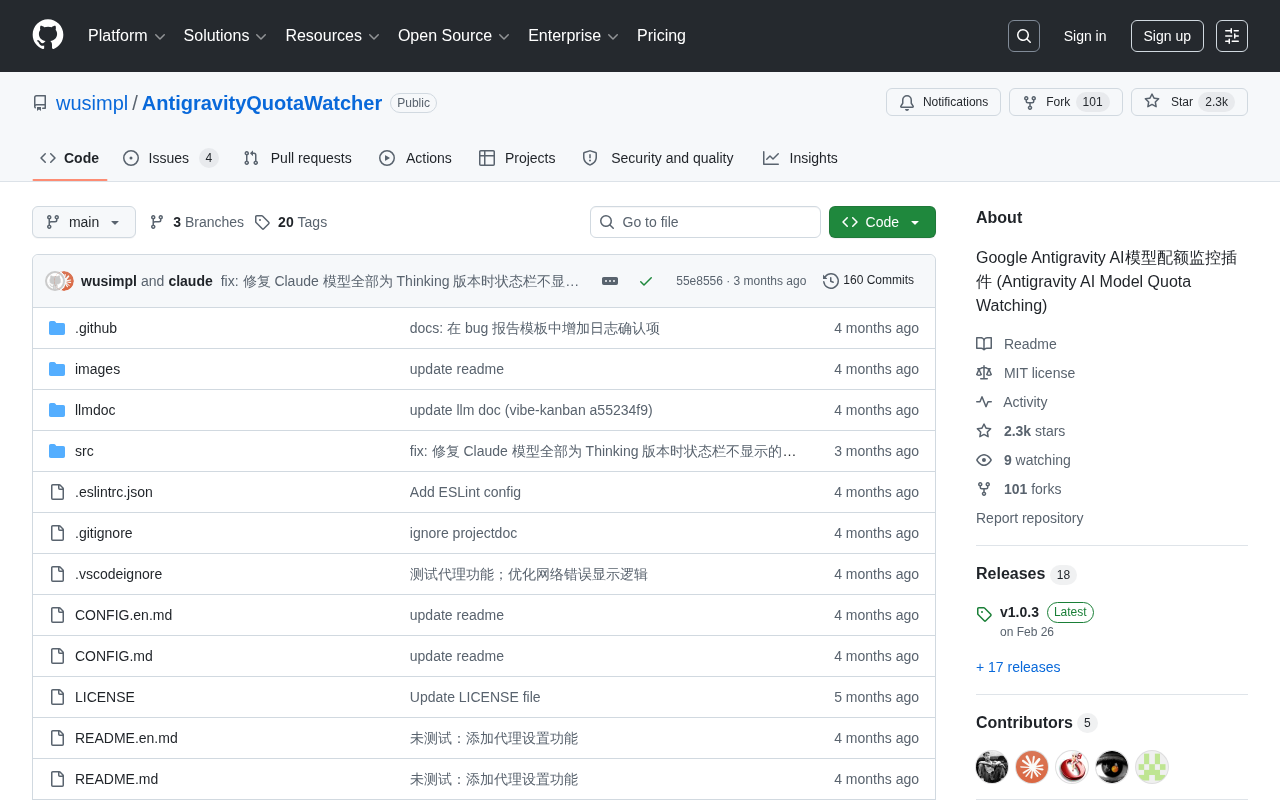
AntigravityQuotaWatcher is a quota monitoring plugin designed specifically for Google Antigravity AI models, helping developers track and manage AI model API call quotas in real time. The project has earned over 2,200 Stars on GitHub and is developed in TypeScript, demonstrating the community's strong demand for AI quota management tools.
As Google AI models (such as the Gemini series) gain widespread adoption, developers frequently encounter quota limitations when using free or paid APIs. Google AI API's quota system is a multi-dimensional rate limiting mechanism that typically includes three core dimensions: RPM (Requests Per Minute), TPM (Tokens Per Minute), and RPD (Requests Per Day). Taking Gemini 1.5 Flash's free tier as an example, the limits are approximately 15 requests per minute and 1,500 requests per day. Once exceeded, the API returns a 429 Too Many Requests error code, causing calls to fail immediately. While paid versions offer higher quotas through Google Cloud's Vertex AI or AI Studio, costs are calculated based on token consumption, and a lack of effective monitoring can easily lead to unexpected bills. Quota exhaustion means service disruption, and without effective monitoring tools, developers are often caught off guard. AntigravityQuotaWatcher was created to solve exactly this pain point.
Core Features and Capabilities
Real-Time Quota Monitoring and Visualization
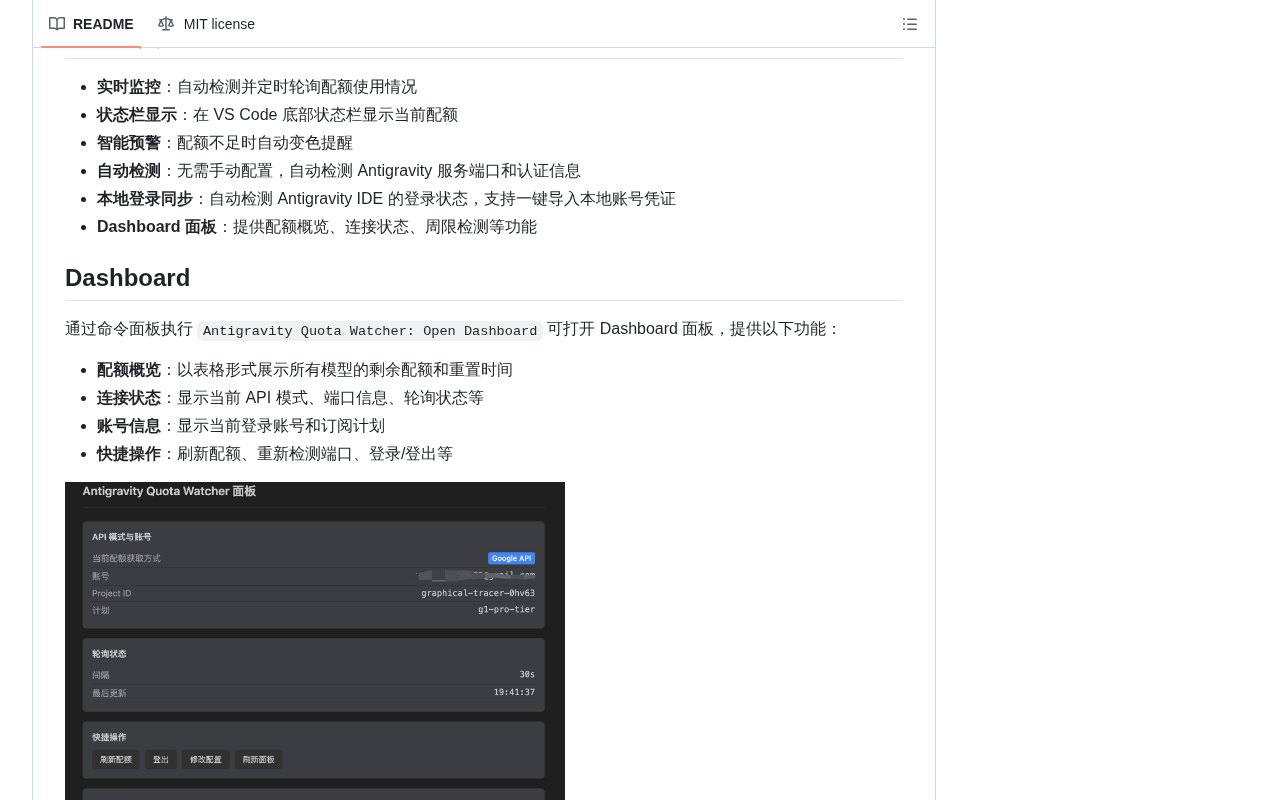
The plugin's core value lies in providing real-time visual monitoring of Google AI model quotas. Developers can check their current quota usage at any time, including:
- Consumed call volume: Clearly displays the number of API requests in the current cycle
- Remaining available quota: Intuitively shows how many more calls can be made
- Quota reset countdown: Clearly indicates when the next quota refresh will occur
This transparency enables developers to better plan their API call strategies and avoid service interruptions caused by quota exhaustion.
Advantages of the TypeScript Tech Stack
The project is developed in TypeScript, offering excellent type safety and code maintainability. TypeScript is a superset of JavaScript developed by Microsoft. Since its release in 2012, it has become a mainstream language in the modern frontend and Node.js ecosystem. Its core value lies in static type checking—developers can define types for variables, function parameters, and return values during coding, and the compiler catches type mismatches and other errors at build time rather than runtime. For quota monitoring tools that need to handle complex API response structures, TypeScript's Interfaces and Generics can precisely describe the data structures returned by Google APIs, significantly reducing the risk of monitoring data distortion caused by field parsing errors. For teams that need secondary development or customization, a TypeScript codebase is also easier to understand and extend.
Plugin-Based Architecture Design
As a plugin-form tool, AntigravityQuotaWatcher can be conveniently integrated into existing development workflows. Plugin Architecture is a software design pattern that decouples core functionality from extensions. Its central idea is to define stable Extension Points and Plugin Interfaces, allowing third-party modules to inject new functionality without modifying core code—a pattern widely adopted by mainstream tools like VS Code, Webpack, and Babel. For AntigravityQuotaWatcher, the plugin-based approach means it can serve as a browser extension embedded in AI Studio pages, as Node.js middleware intercepting API requests, or integrated into CI/CD pipelines as a pre-check step, greatly expanding the tool's applicable boundaries.
Typical Use Cases
Free Quota Management for Individual Developers
This tool is particularly useful for individual developers using Google AI's free quotas. Free tier quotas typically have strict per-minute/daily request limits (for example, the Gemini API free tier allows 15 requests per minute). The monitoring tool helps developers allocate call frequency wisely and maximize the utilization of limited free quotas.
Quota Coordination in Team Collaboration
In team environments where multiple people share the same API Key, quota monitoring becomes even more critical. AntigravityQuotaWatcher helps teams understand overall consumption trends, detect abnormal usage patterns in time, and prevent one member's excessive calls from affecting the entire team's normal workflow.
Early Warning Mechanisms in Production Environments
For enterprises integrating Google AI models into production services, quota monitoring is a vital component of operational assurance. By setting threshold alerts, operations teams can receive notifications before quotas are about to be exhausted, enabling them to take countermeasures such as scaling up or rate limiting to ensure business continuity.
Community Popularity and Future Prospects
The project has gained 2,282 Stars and 101 Forks in a short period, reflecting the developer community's urgent need for AI quota management tools. As AI API usage becomes increasingly widespread, similar quota management and cost control tools will become an indispensable part of the developer toolchain.
From a broader perspective, AntigravityQuotaWatcher represents an emerging tool category—AI infrastructure management tools. This space has already attracted capital attention from products like LangSmith, Helicone, and OpenMeter. The core driving force is that LLM API call costs are highly opaque, with token-based pricing models making per-request costs difficult to predict. Multi-model, multi-provider hybrid usage scenarios have also created demand for unified monitoring dashboards. AntigravityQuotaWatcher's vertical focus on the Google AI ecosystem is a concrete practice within this larger trend. As enterprises continue to increase their AI investments, the demand for fine-grained API call management, cost optimization, and resource planning will only intensify.
Summary
AntigravityQuotaWatcher fills a tool gap in the Google AI model quota monitoring space. Its TypeScript tech stack and plugin-based design provide excellent extensibility. Whether you're an individual developer worried about exceeding free quotas or an enterprise team needing fine-grained API cost management, this is an open-source project worth following and trying. If you're using Google Gemini or other AI APIs, consider adding it to your development toolkit.
Related articles
 Product Reviews
The Programmer's Desk Setup Guide: Building a Workspace That Feels Like Home
Discover how programmers build productive, comfortable workspaces. From multi-monitor setups to ergonomic design, explore the desk philosophy that drives focus and flow.
 Product Reviews
Qoder vs Cursor Real-World Comparison: Which $20/Month AI IDE Is Better?
Hands-on comparison of Qoder vs Cursor AI IDEs: Agent autonomy, human interaction count, and architecture decisions. Qoder needed only 2 interactions vs Cursor's 8.
 Product Reviews
Cursor Cloud Agent Demo: Eliminating Bottlenecks Across the Entire Software Development Lifecycle
Deep analysis of Cursor's Cloud Agent demo showing how cloud VMs, automated test artifacts, and a full-chain control plane systematically eliminate human bottlenecks across the software development lifecycle.