Antimatter: A Mattermost Fork Without the Commercial Restrictions

Antimatter is a Mattermost fork that strips out paywalls, nag screens, and telemetry for clean self-hosting.
Antimatter is an open-source Mattermost fork created by a frustrated long-time user tired of paywalls, feature restrictions, and sales nag screens. Built strictly on AGPL/Apache-licensed code, it removes all paid feature flags, nag screens, and telemetry, and reimplements enterprise features like LDAP, SAML, and OIDC from scratch. The roadmap ambitiously plans voice channels, disappearing messages, XMPP-style federation, and collaborative whiteboards inspired by Discord, Signal, and XMPP ecosystems. A working Docker image is already available for Mattermost users to migrate to, though the project remains in its early stages.
A developer who had been a long-time Mattermost user grew thoroughly disillusioned with the software's recent commercialization and decided to build a new fork based on its open-source code — Antimatter. The project's core mission is straightforward: restore a genuinely self-hosted, open-source chat application free from paywalls and pushy sales prompts.
Why Fork a Mature Project
The author openly admits he was a Mattermost advocate for years and considered it an excellent self-hosted chat solution. The turning point came from a series of business decisions he found unacceptable: previously free features being locked behind paywalls, artificial caps imposed on features that once had no limits, and recently added "nag screens" — persistent popups pushing users to purchase licenses, or even suggesting they simply leave the platform.
For someone who had recommended Mattermost to his company only to repeatedly hit walls during the licensing process, the author described the experience as a series of "backstabs." This shift from advocate to disillusionment is what gave birth to Antimatter.
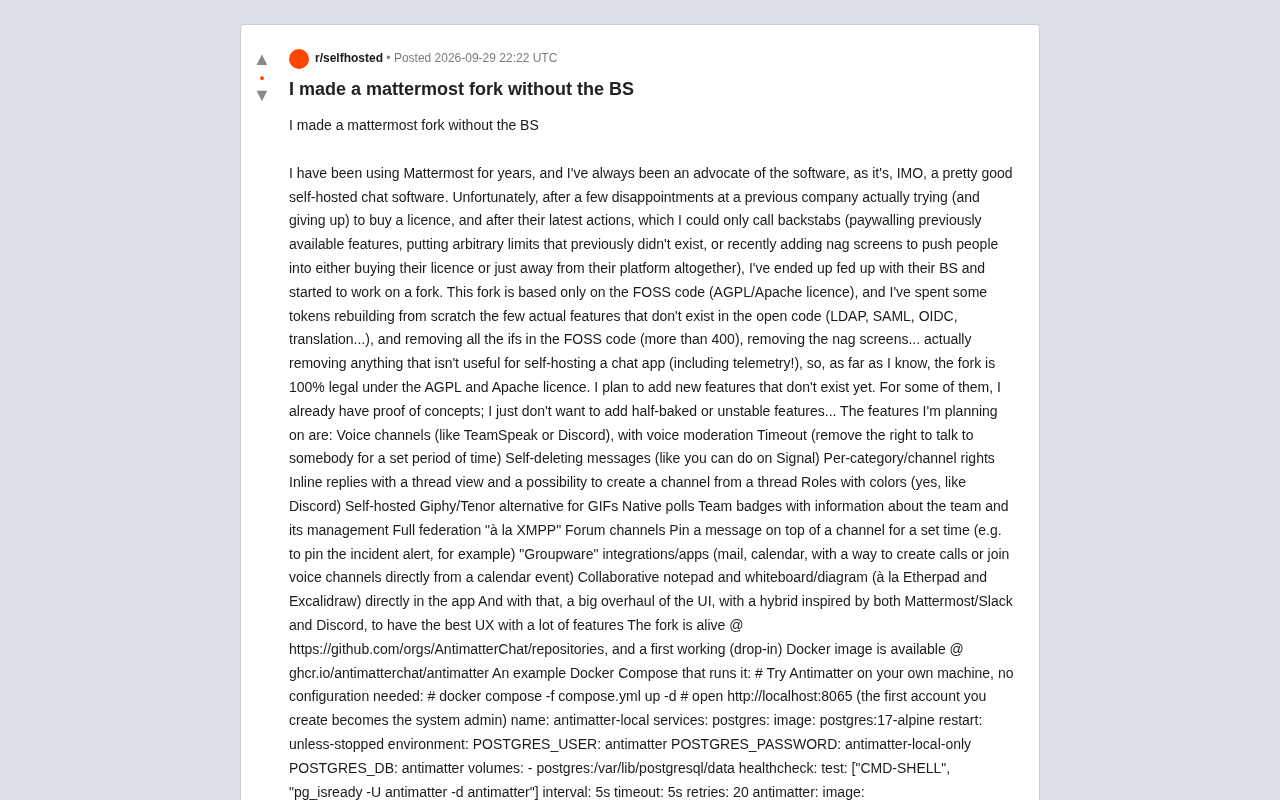
A Compliant Rebuild Strictly Based on FOSS Code
A key pillar of Antimatter is legal compliance. The author emphasizes that the fork is built entirely on Mattermost's free and open-source code (AGPL / Apache licensed) and does not touch any of the proprietary enterprise edition.
For features that existed only in the enterprise edition and were absent from the open-source codebase, the author chose to rebuild them from scratch — including LDAP, SAML, and OIDC authentication, as well as multi-language translation support. At the same time, he conducted a large-scale "cleanup" of the FOSS code: removing over 400 feature flag checks (the if branches that distinguish free from paid tiers), stripping out all sales nag screens, and eliminating telemetry.
In the author's own words, anything that serves no practical purpose for "self-hosting a chat application" has been stripped away. He believes this fork is 100% legally compliant under the terms of the AGPL and Apache licenses.
A note on licenses: AGPL (GNU Affero General Public License) and Apache License 2.0 are two common but fundamentally different open-source licenses. AGPL is a strengthened version of the GPL — its core requirement is that anyone providing a network service based on AGPL code must also release their modified source code under AGPL, making it a powerful tool against cloud providers free-riding on open-source projects. Apache 2.0 is more permissive, allowing use in commercial projects without mandatory open-sourcing, though it requires retaining the original copyright notice. Mattermost uses a dual-licensing model: the server core uses AGPL, some client code uses Apache 2.0, and enterprise features are released separately as closed-source. Antimatter only uses code under the first two licenses, deliberately sidestepping the closed-source enterprise components — this is the legal foundation behind the author's "100% legal" claim. Features like LDAP, SAML, and OIDC authentication are paid enterprise-only features in Mattermost; Antimatter's decision to reimplement them from scratch rather than reuse closed-source code is the key move that avoids copyright issues.
An Ambitious Feature Roadmap
Antimatter isn't content with being just a "clean version of Mattermost." The author has planned a range of new features that Mattermost doesn't yet offer, some of which already have proof-of-concept implementations. He has also made clear he won't rush half-baked or unstable features just to hit a deadline.
The planned feature list is extensive and draws obvious inspiration from mature products like Discord, Signal, and XMPP:
Communication & Social Features
- Voice channels: Similar to TeamSpeak or Discord, with voice moderation
- Timeouts: Temporarily revoke a user's ability to speak for a set duration
- Disappearing messages: Self-destructing messages similar to Signal
- Colored role system: A Roles mechanism similar to Discord
- Team badges: Displaying team info and administrative details
Organization & Collaboration Features
- Per-category/channel permission controls
- Inline replies and thread views, with the ability to create a channel directly from a thread
- Forum-style channels
- Message pinning with configurable duration (e.g., pinning an incident alert)
- Native polling functionality
Ecosystem & Integration Features
- Full XMPP-style federation
- Self-hosted Giphy/Tenor alternative for GIF search
- Groupware integration: email, calendar, with the ability to start or join voice calls directly from calendar events
- Collaborative notepads and whiteboards/diagramming tools, comparable to Etherpad and Excalidraw, built natively into the application
Beyond features, the author also plans a significant UI overhaul blending the Mattermost/Slack and Discord design philosophies, aiming for a good user experience despite the breadth of functionality.
A note on XMPP federation: XMPP (Extensible Messaging and Presence Protocol) is an open instant messaging protocol based on XML. Its defining characteristic is native support for "federation" — similar to how email works, users on different servers can communicate across server boundaries without relying on a single centralized platform. This stands in stark contrast to closed systems like Slack or Discord, where users can only interact within the same "workspace." Federation means that one company's Antimatter instance could, in theory, communicate directly with another company's separate instance, with each retaining data sovereignty. Matrix (the protocol behind Element) is currently the most active modern federated chat protocol; XMPP is older with a broader but more fragmented ecosystem. If Antimatter's planned "full XMPP-style federation" actually ships, it would give the platform cross-instance communication capabilities that Mattermost currently lacks.
A Docker Deployment You Can Try Today
The project isn't just on paper. Antimatter's code is hosted on GitHub (under the AntimatterChat organization) and already provides a working Docker image at ghcr.io/antimatterchat/antimatter. The author describes it as a "drop-in" replacement, meaning existing Mattermost users should theoretically be able to migrate with relative smoothness.
The author also provides a ready-to-use docker compose configuration paired with a PostgreSQL 17 database, which can be started locally with zero additional setup: run docker compose up -d and visit http://localhost:8065 — the first account created will automatically become the system administrator. For security, the example binds the port to localhost only (127.0.0.1) and uses a throwaway database password with plain HTTP, intended for local testing only.
An Open-Source Signal Worth Watching
Antimatter is still in its early stages. Many of the highlights on its feature roadmap have yet to land, and its long-term maintainability and community activity remain to be proven. But the project itself reflects a tension that plays out repeatedly in the open-source world: when a software product that started as open-source gradually tightens its free tier and doubles down on monetization, the community often responds by forking and reclaiming control.
For self-hosters who value data sovereignty and are tired of paywalls and telemetry, Antimatter offers at least one new option built on legitimate open-source code. Whether it can deliver on that ambitious roadmap is the most compelling question to watch going forward.
Related articles

Workbuddy for Absolute Beginners: How a Desktop AI Agent Fits Into Real Workflows
A beginner's guide to the Workbuddy desktop AI agent: installation, claiming credits, file management, and building automated workflows—compared with CodeX for fit and cost, helping professionals shift from AI question-askers to AI managers.

OpenAI's New Agent Stack: Computer Use, Decisions API, and Ultra-Fast Workflows
OpenAI Dev Day unveiled a new agent stack: Computer Use outperforms humans, Decisions API delivers ultra-low-latency classification via Luna, Agents API opens the same Computer Use capabilities, and GPT-6.1 Sol costs only one-seventh of Astra. Core updates, benchmark data, and developer insights.

Liang Wenfeng Open-Sources DeepInfo Inference Framework, Takes On U.S. Ban
DeepSeek open-sources its DeepInfo inference framework after its models, featuring GPU/CPU cross-pipelining, small-model prediction with large-model verification, and full Huawei Ascend and NVIDIA chip support—facing the U.S. federal ban head-on. This article analyzes its significance for AI deployment and open-source strategy.