Any Human Ever: A Philosophical Experiment Drawing One Life from 100 Billion People

A viral philosophical experiment that randomly presents one life from 100 billion humans who ever lived
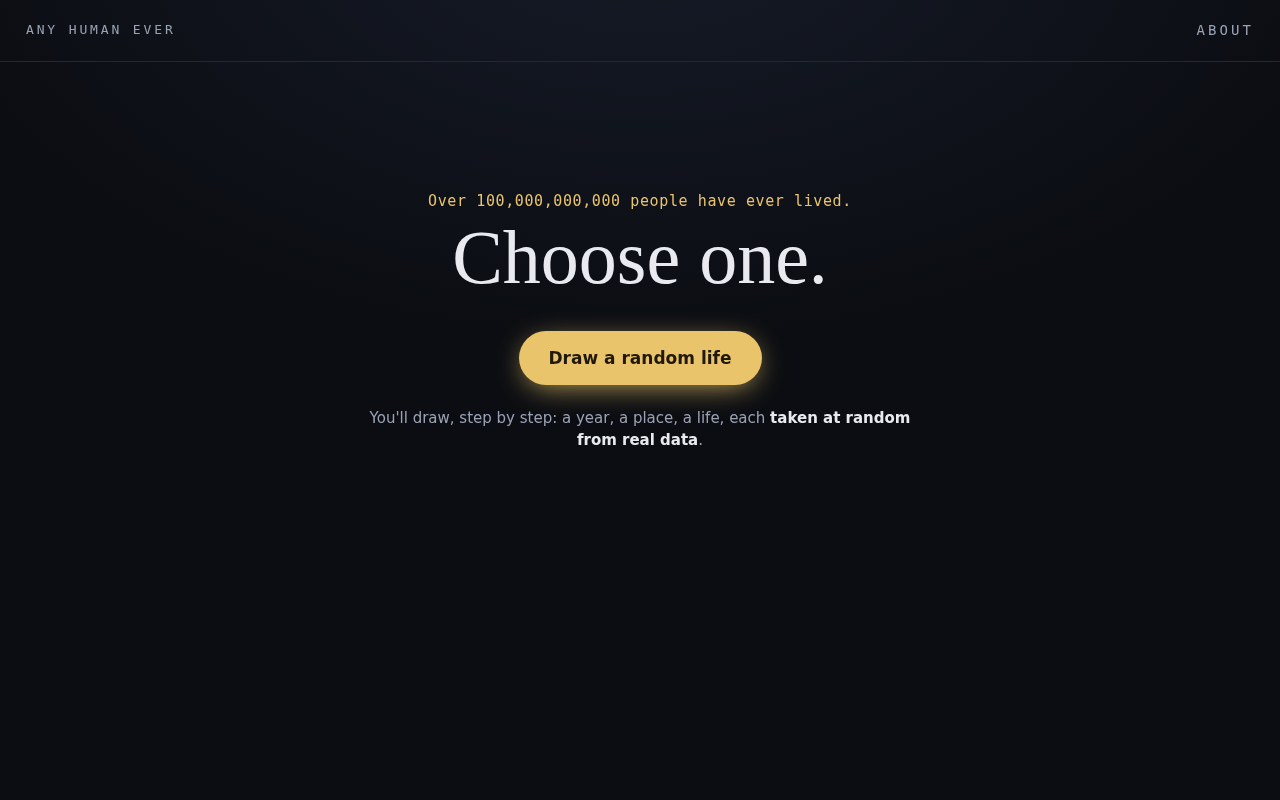
Any Human Ever is a minimalist web project that randomly selects one person from the estimated 100-117 billion humans who have ever lived. With just a single interaction, it creates profound existential reflection, reminding us that history is composed mostly of ordinary, unnamed individuals. The project exemplifies data humanism and minimalist design philosophy.
A Thought-Provoking Creative Project
Recently, a web project called "Any Human Ever" garnered 489 upvotes and over 247 comments on Hacker News, becoming a hot topic in the tech community. The core concept of this project is strikingly simple yet profoundly thought-provoking: randomly select one life from all humans who have ever lived, and present it to you.
The project website (anyhumanever.com) features a subtitle that reads: "One life, drawn at random from all who have ever lived." This statement carries strong philosophical weight—it attempts to make us realize that in the grand narrative of human history, each individual is both insignificant and unique.
The Grand Scale Behind the Numbers: How Many People Have Ever Lived?
A Sample Pool of 100 Billion
To understand the significance of Any Human Ever, we must first grasp the numerical scale behind it. According to demographic estimates, approximately 100 to 117 billion humans have lived on Earth since the emergence of Homo sapiens. This means when you randomly draw one "person" from this vast sample pool, you'll most likely encounter an obscure ordinary individual—a farmer, a craftsperson, a mother, a child.
The most frequently cited research on this figure comes from the Population Reference Bureau (PRB). PRB demographer Carl Haub first published this estimate in 2002 and has continuously updated it since. His model starts from 50,000 BCE when Homo sapiens began large-scale migration, combining birth rates, death rates, and population bases from different historical periods through segmented integration. Notably, early humans had extremely high birth rates (approximately 80 births per thousand people), but infant mortality was equally staggering, with pre-agricultural average life expectancy likely only 20-30 years. This means the vast majority of humans throughout history died in childhood, never having the opportunity to leave any trace.
This is precisely the project's most ingenious design element. History books typically record only emperors, generals, scientific giants, and artistic masters, but they represent an infinitesimal fraction of the total human population. When you sample randomly according to true population distribution, you feel more viscerally that the vast majority of history consists of countless ordinary people who left no names behind.
Temporal Distribution Imbalance
You may not have noticed that the temporal distribution of human history is also extremely uneven. Due to explosive modern population growth, any randomly drawn "person" has a fairly high probability of living in recent centuries, or even in the present day. This statistical skew itself is an intuitive representation of the accelerating development of human civilization.
The specific numbers of this nonlinear growth are even more striking: for most of human history, global population growth was extremely slow—around 300 million in year 1 CE, reaching only about 1 billion by 1800. But in just over 200 years since, it has exploded to 8 billion. This explosion stems from the combined effects of agricultural technology advances, the Industrial Revolution, public health improvements, and modern medicine. Specifically, the 8 billion people alive today represent approximately 6.5%-7% of total human history. In other words, if you randomly draw from 100 billion people, there's about a 7% probability of drawing someone currently breathing on Earth—and if you expand the range to those born in the last 500 years, this probability rises even more dramatically. This distribution itself is a silent lesson about the acceleration of human civilization.
The Power of Minimalist Interaction Design
From a product design perspective, Any Human Ever embodies the expressive power of minimalist interaction design. The entire project has no complex features, no flashy interface—just one core action: presenting a random life. This "less is more" design philosophy allows users to focus entirely on the concept itself, undistracted by superfluous elements.
Minimalist Interaction Design philosophy can be traced back to the Bauhaus movement and Dieter Rams' "Ten Principles of Good Design," with the most core principle being "Good design is as little design as possible." In the digital product realm, this philosophy has been widely practiced by companies like Apple and Google, but it manifests most extremely in concept websites.
These concept websites have become increasingly popular in the tech community. They often don't pursue commercial monetization but instead trigger users' emotional resonance or philosophical reflection through an ingenious idea. Similar viral projects include Neal Agarwal's "The Size of Space" (cosmic scale scrolling interaction), "Worldometer" (world real-time statistics counter), and various data narrative projects by The Pudding team. Their common characteristics: singular interaction paradigm, extremely low cognitive load, and conveying a profound insight through one core mechanism—using the simplest technical means to deliver the deepest concepts.
Why Does Any Human Ever Resonate So Widely?
Existentialist Inquiry
This project sparked heated discussion in a community like Hacker News, known for its technical rationality, precisely because it touches on existentialist propositions that transcend technology itself. When you realize you're just one random sample among over 100 billion people, a feeling that's both humbling and liberating arises spontaneously.
In the comments section, many users shared their reflections: some marveled at the preciousness of ordinary lives, while others associated it with the classic philosophical thought experiment "Veil of Ignorance"—if you didn't know which person in history you would become, what kind of world would you want?
The "Veil of Ignorance" is a core concept proposed by American political philosopher John Rawls in his 1971 work "A Theory of Justice." Rawls envisioned an "original position" where people must choose principles of justice for society without knowing what position they'll occupy—not knowing their gender, race, intelligence, wealth, or social class. Rawls argued that under these conditions, rational people would choose an institutional arrangement that maximally protects the interests of the most vulnerable groups (the "difference principle"). Any Human Ever's random selection mechanism is essentially a digitized "Veil of Ignorance"—it forces you to acknowledge that if you were a random person in human history, you'd most likely be poor, undocumented, short-lived, and ordinary. This cognitive impact is precisely the project's deepest philosophical power.
Humanistic Care in Data Visualization
From a more macro perspective, Any Human Ever represents a trend toward "data with warmth." In an era dominated by big data and AI, we're accustomed to reducing humans to statistics and user profiles. This project does the opposite—it uses data to remind us that behind every number is a real, unique life.
This philosophy in academia and design is called "Data Humanism," formally proposed by information designer Giorgia Lupi in 2017. She advocates that data visualization shouldn't only pursue efficiency and precision but should also convey the human stories, uncertainty, and emotional dimensions behind the data. This forms an interesting contrast with traditional data-driven thinking: in business and technology, data is typically used to optimize, predict, and classify, while data humanism emphasizes that each "point" of data represents a living person. Any Human Ever is the ultimate embodiment of this philosophy—it doesn't use charts or dashboards to display population data but instead restores the astronomical figure of 100 billion to individual life narratives, giving cold statistics warmth once again.
Insights for Technical Creators and Independent Developers
For developers and product creators, Any Human Ever provides an extremely valuable case study: excellent products don't necessarily require complex tech stacks or massive feature lists. A sufficiently profound core idea, paired with appropriately minimal execution, can equally move hearts and spark viral sharing.
In today's world where AI tools are increasingly ubiquitous and development barriers continuously lower, what's truly scarce is often not technical capability but ideas that touch hearts. This project's success reaffirms a truth: technology is a means; ideas are the soul.
Conclusion
Any Human Ever uses an extremely simple interaction to complete a profound thought experiment about human existence. It allows us to step outside our personal perspective and re-examine the concept of "life" from the vantage point of all human history. In the fast-paced, highly utilitarian tech world, such a "useless yet beautiful" project appears particularly precious.
It reminds us: while chasing efficiency and growth, don't forget to pause and contemplate truly important questions—who am I, where do I come from, and what does each individual truly mean in the long river of human civilization.
Related articles

Workbuddy for Absolute Beginners: How a Desktop AI Agent Fits Into Real Workflows
A beginner's guide to the Workbuddy desktop AI agent: installation, claiming credits, file management, and building automated workflows—compared with CodeX for fit and cost, helping professionals shift from AI question-askers to AI managers.

OpenAI's New Agent Stack: Computer Use, Decisions API, and Ultra-Fast Workflows
OpenAI Dev Day unveiled a new agent stack: Computer Use outperforms humans, Decisions API delivers ultra-low-latency classification via Luna, Agents API opens the same Computer Use capabilities, and GPT-6.1 Sol costs only one-seventh of Astra. Core updates, benchmark data, and developer insights.

Liang Wenfeng Open-Sources DeepInfo Inference Framework, Takes On U.S. Ban
DeepSeek open-sources its DeepInfo inference framework after its models, featuring GPU/CPU cross-pipelining, small-model prediction with large-model verification, and full Huawei Ascend and NVIDIA chip support—facing the U.S. federal ban head-on. This article analyzes its significance for AI deployment and open-source strategy.