AOSP Source Code Released Too Late, Developers Forced to Reverse Engineer and Disassemble to Report Bugs

AOSP source code releases lag severely, forcing developers to disassemble binaries, damaging ecosystem innovation and community trust.
AOSP source code releases lag severely behind binary version rollouts, leaving developers unable to obtain complete source code for corresponding versions in a timely manner. They can only disassemble system libraries to diagnose issues and submit bug reports. This approach is inefficient, limited in accuracy, and prevents proper patch submissions, fundamentally weakening the community's ability to participate in fixes. Behind the delays is a complex tug-of-war involving compliance reviews, export controls, and partners' commercial interests, but what the community is dissatisfied with is the lack of a transparent timeline and communication mechanism. Security researchers and third-party ROM communities are the most deeply affected groups, with vulnerability discovery and adaptation pace slowed down. Developers' demands focus on a clear release SLA, transparent delay explanations, and intermediate documentation solutions. If the problem continues to worsen, AOSP's "open source" label will become increasingly undeserved.
AOSP Source Code Delays: A Hidden Wound in the Android Development Ecosystem
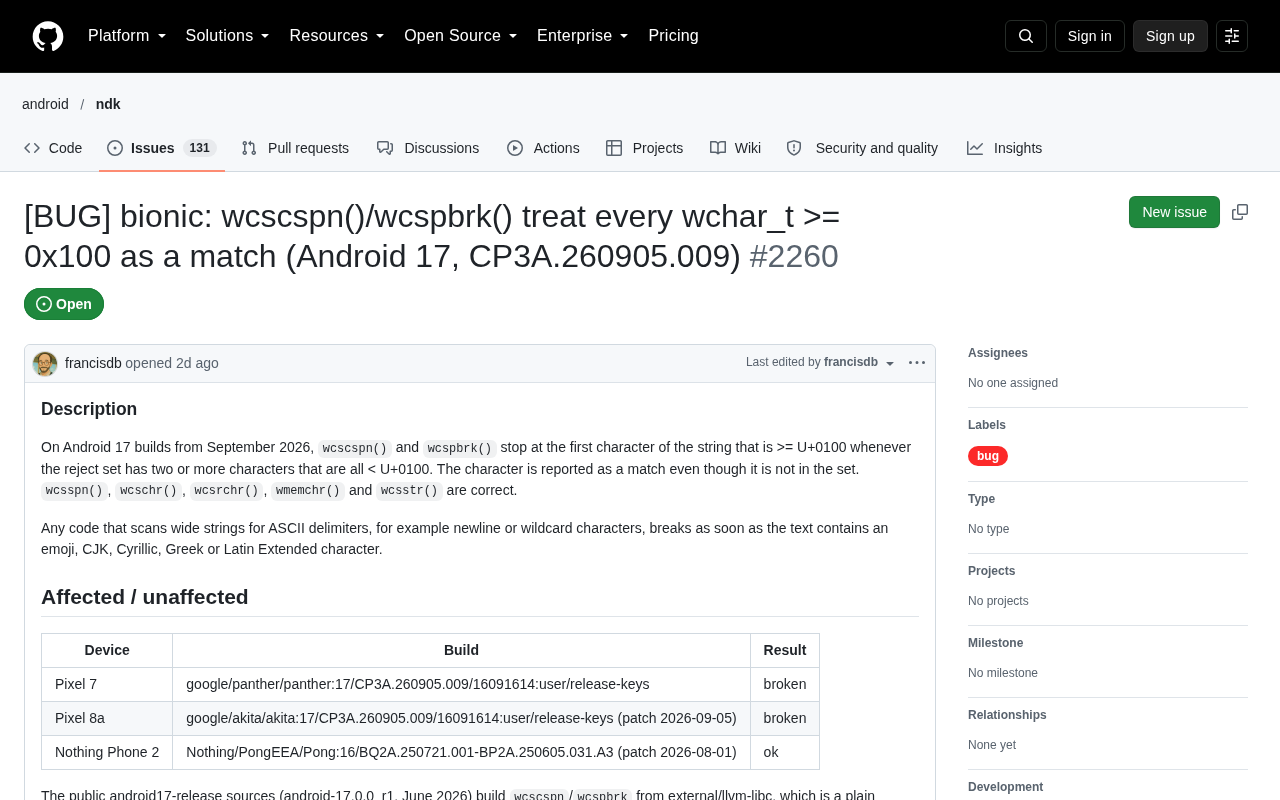
The Android Open Source Project (AOSP) has always flown the banner of "openness," but a long-standing complaint among developers is now intensifying: source code releases are severely delayed. According to discussions in the Hacker News community, AOSP source code is being released at a pace far behind that of binary version rollouts, leaving developers unable to obtain the complete source code for corresponding versions in a timely manner. As a result, they must resort to disassembling binary libraries to pinpoint issues and submit bug reports.
This is not a tech-purist complaint — it is a structural problem that directly impacts the efficiency of innovation in the Android ecosystem. When an open-source project requires reverse engineering to "complete" its openness, the value of the label "open source" deserves reexamination.
Reverse Engineering and Disassembly as a "Necessary Evil"
Why Developers Turn to Disassembly
Ideally, after each official Android release, AOSP should publish the corresponding complete source tree in sync or near-sync. In reality, however, source code releases often lag by months or even longer. During this "gap period," developers face an awkward situation: devices are already running the new version, but when they want to understand a change in system behavior or trace the root cause of a bug, the source code is nowhere to be found.
Discussions on Hacker News point out that some developers choose to directly disassemble Android system libraries (such as core .so files in the framework layer) and infer implementation logic through static analysis. This approach allows them to submit meaningful bug reports even when source code is unavailable, rather than merely describing "surface symptoms."
The relationship between AOSP and binary versions deserves further explanation. When Google develops Android internally, it uses a complete source tree, which after compilation produces binary images that devices can run (such as system.img, vendor.img, etc.). These images are pushed to device manufacturers and users via OTA or factory images. AOSP is the open-source version of this source tree after stripping out Google's proprietary components (GMS, Play Services, etc.). Ideally, binary rollouts and AOSP source releases should be synchronized, but in practice they are managed by different teams and different processes — the former focused on device availability, the latter requiring legal and partner review — creating a time gap. This gap was typically only a few weeks in early Android versions, but has shown a lengthening trend in recent years, with key module source code for some versions lagging by more than half a year.
The Cost of Disassembling to Report Bugs
While disassembly can address an urgent need, the cost is extremely high.
- Low efficiency: Reading assembly code is far more difficult than reading Java/Kotlin/C++ source code; locating a single logic branch can take several times longer
- Limited accuracy: Compiler optimizations eliminate or rearrange code structures, causing disassembly results to deviate from the original logic and leading to misjudgments
- Cannot submit patches: Even if a problem is found, without source code, a proper patch cannot be submitted — developers are stuck at the bug report stage
This means the source code delay is not just a matter of "seeing the code a few days late" — it fundamentally weakens the community's ability to participate in fixes.
Disassembly and static analysis are core techniques in reverse engineering. Disassembly converts compiled machine code back into assembly instructions, and developers then infer the original logic through control flow analysis, string references, system call tracing, and other methods. In the Android context, a large amount of core logic in the framework layer resides in native libraries such as libandroid_runtime.so and libart.so. After compiler optimizations (such as inlining, loop unrolling, and dead code elimination), the disassembly results differ significantly from the original C++ source code. Additionally, some Android versions strip symbols from key .so files, further increasing analysis difficulty. Therefore, disassembly can only serve as a stopgap when source code is unavailable — it cannot replace source-level reading and debugging.
Structural Contradictions Behind the Delays
The Tension Between Compliance Pressure and Open-Source Commitments
The reasons for AOSP source code release delays are not singular. A widely held view is that Google needs to coordinate multi-party compliance reviews, export control assessments, and partners' commercial interests — processes that naturally slow down source code release. But the problem is that there is tension between this "compliance-first" arrangement and AOSP's commitment as an open-source project.
When binaries come first and source code follows, AOSP looks more like a "delayed open-source" project than a truly real-time collaborative development platform.
Export controls and open-source compliance are key background for understanding the delays. Android source code contains a large number of sensitive technology components such as encryption algorithms and communication protocol stacks, which are subject to regulations including the U.S. Export Administration Regulations (EAR) and the International Traffic in Arms Regulations (ITAR). Before releasing AOSP source code, Google must assess whether each module involves controlled technology and, if necessary, apply for licenses or make technical adjustments. Meanwhile, chip manufacturers (such as Qualcomm and MediaTek) and device manufacturers (such as Samsung and Xiaomi) in the Android ecosystem contribute code to AOSP, and republishing this code requires contributor consent — a lengthy coordination cycle. The stacking of multiple compliance reviews makes the source code release process far more complex than binary rollouts, which is one of the structural roots of the delays.
The Erosion of Community Trust
The emotional tone of the Hacker News discussions is worth noting: developers do not fail to understand the complexity of compliance. What they are dissatisfied with is the lack of a transparent timeline and communication mechanism. When there is no clear explanation of when source code will be released or why it is delayed, the community can only fill the information vacuum with speculation and reverse engineering.
In the long run, this will erode developers' trust in the AOSP ecosystem. Some developers may turn to other, more transparent open-source mobile platforms, or simply reduce their contributions to AOSP.
Chain Effects Across the Entire Android Ecosystem
A Passive Situation for Security Research
Security researchers are among the most deeply affected groups. Timely access to source code is critical for vulnerability discovery and patch verification. When source code lags, security teams must rely on binary analysis to evaluate patch effectiveness, increasing the possibility of missed risks.
The Plight of Third-Party ROMs and Custom Development
For third-party ROM communities like LineageOS, as well as the many manufacturers and developers who build customizations based on AOSP, source code delays directly slow down their adaptation pace. They cannot begin porting work as soon as a new version is rolled out, and improvements to user experience are consequently delayed.
The workflow of third-party ROM communities is highly dependent on the timeliness of AOSP source code. Take LineageOS as an example: after a new Android version is released, its maintainers need to integrate AOSP source code with device-specific hardware abstraction layers (HAL), kernel drivers, and vendor blobs to build a usable ROM. Source code delays mean they cannot start adaptation work in advance and can only wait. More seriously, some device manufacturers stop updating the HAL for older devices after rolling out a new version. Third-party ROM developers must reverse engineer or rewrite these components themselves, and the absence of AOSP source code makes this process even more difficult. Such delays not only affect user experience but also weaken Android's appeal as an open platform.
Is There a Solution?
From community discussions, the demands developers have raised are actually not radical:
- A clear source code release SLA: At least provide a predictable time window, rather than indefinite waiting
- More transparent explanations for delays: Explain the reasons for delays so the community understands whether they are compliance, technical, or commercial factors
- Intermediate solutions: Before the complete source code is released, provide interface documentation or partial source code for key modules
AOSP's openness is one of its core competitive advantages. If source code release delays continue to worsen and force developers to use disassembly as a routine means of participating in ecosystem building, then the project's "open source" label will become increasingly undeserved. For Google, how to find a better balance between compliance rigidity and open-source commitments is an unavoidable challenge.
This article is based on analysis of discussions in the Hacker News community, reflecting developers' widespread concerns about the pace of AOSP source code releases.
Related articles

Chain of Thought Isn't Just for AI: How Humans Can Use CoT to Improve Thinking Quality
Chain of Thought isn't just a prompt trick for large models. Starting from a Hacker News discussion, this article analyzes why CoT works for human thinking too, breaks down actionable ways to transfer it, and highlights the key differences between human CoT and machine CoT.
Cloudflare Teams Up with OpenAI: Closi…
Cloudflare Teams Up with OpenAI: Closing the Loop from Vulnerability Discovery to Defense with AI
Cloudflare uses OpenAI Daybreak to investigate security vulnerabilities and generate reviewable remediation plans, while developers use Codex to boost coding efficiency and quality.

Orca Multi-Agent Orchestration in Practice: A Guide to Parallel Collaboration with Claude and Codex
Orca is Stable AI's free open-source agent workbench supporting 34 agents like Claude Code and Codex in parallel. Learn its Git worktree isolation, multi-model orchestration, and mobile management.