APDMem: Enabling AI Assistants to Achieve Precise Long-Term Memory Retrieval with Just 8% of Data

APDMem achieves high-quality long-term memory retrieval by reading just 8% of conversations via a four-layer progressive architecture.
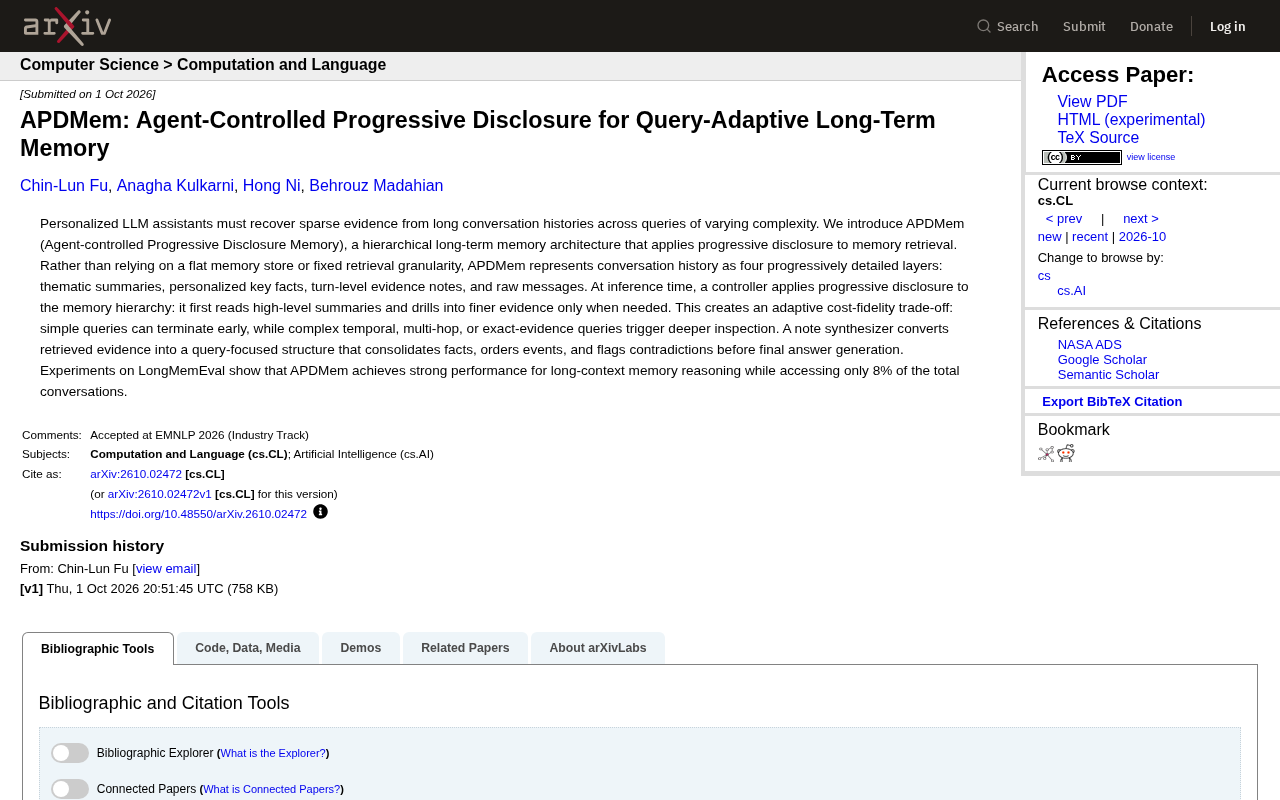
APDMem is a long-term memory architecture for personalized LLM assistants that organizes conversation history into four layers — thematic summaries, key facts, turn-level evidence, and raw messages — with a controller that dynamically decides how deep to drill during inference. Simple queries terminate early at shallow levels, while complex multi-hop or temporal queries trigger finer-grained retrieval. A note synthesizer then consolidates scattered evidence into a query-centric structured representation, flagging contradictions and ordering events. On the LongMemEval benchmark, APDMem achieved strong performance while accessing only 8% of the full conversation history, offering a new approach to efficient long-term memory system design.
Personalized LLM assistants face a persistent challenge: as conversation histories grow longer, how do you accurately retrieve those sparse, scattered key pieces of information from a massive archive? A new study published on arXiv proposes an architecture called APDMem (Agent-controlled Progressive Disclosure Memory), which attempts to address this pain point through a smarter hierarchical retrieval mechanism.
The Core Tension in Long Conversation Memory
As LLM assistants take on more personalized tasks, they need to remember things users have said in the past — preferences, events, and details mentioned across sessions. But this evidence is often sparsely scattered throughout a long conversation history, and user query complexity varies widely. Some queries are simple questions; others require temporal reasoning or multi-hop associations spanning multiple conversation turns.
Traditional approaches typically rely on flat memory storage or fixed retrieval granularity. This creates two problems: too coarse, and complex queries can't surface enough detail; too fine-grained, and simple queries waste enormous computational resources retrieving irrelevant content. APDMem is designed precisely to address this tension between cost and fidelity.
Multi-hop reasoning refers to queries whose answers require connecting multiple pieces of scattered information. For example, when a user asks "Is the restaurant I mentioned last time a good place to take my mom?" the system needs to simultaneously locate both "the restaurant name" and "mom's dietary preferences" — two pieces of information potentially separated by hundreds of conversation turns — and then make a combined judgment. This type of query is notoriously difficult for flat retrieval systems, where traditional vector similarity search tends to surface only the fragments most literally similar to the query, rather than the multiple logically related pieces. Temporal reasoning adds another layer, requiring the system to understand the chronological order of events — for instance, "Did I mention any moving plans after I changed jobs?" — which demands that temporal information be preserved during retrieval, not just semantic matching.
A Four-Layer Progressive Memory Structure
APDMem's core innovation lies in organizing conversation history into four progressively refined levels, rather than a single memory pool:
Drilling Down from Summary to Source
- Thematic summaries: High-level, overview information at the top layer
- Personalized key facts: Distilled user-relevant takeaways
- Turn-level evidence notes: Evidence from specific conversation turns
- Raw messages: Complete original text at the lowest layer
This design draws on the "progressive disclosure" principle from interaction design — show users an overview first, then expand into details when needed. In a memory retrieval context, this means the system doesn't need to load all information at once; instead, it drills deeper on demand.
Progressive Disclosure is a classic principle in user interface design, popularized by interaction designers like Jakob Nielsen: interfaces default to showing only the most essential information, hiding complex details behind user-triggered actions to reduce cognitive load. APDMem transplants this idea into the memory retrieval domain, essentially transforming "how much does the user need to see" into a dynamic decision about "how much does the system need to read." This parallels index layering in database systems — first querying a sparse index to narrow the range, then reading specific data blocks as needed — but APDMem's controller must use a language model's reasoning capabilities to determine when to "drill down," rather than relying on fixed numerical thresholds.
How the Controller Enables Adaptive Retrieval
During inference, a controller is responsible for executing progressive disclosure across the memory hierarchy: it first reads high-level summaries and only drills down to finer-grained evidence when genuinely necessary.
This creates an adaptive cost-fidelity tradeoff. Simple queries can terminate early at shallow levels, avoiding unnecessary retrieval overhead; complex temporal reasoning, multi-hop queries, or queries requiring precise evidence trigger deeper inspection. In other words, the system's computational investment dynamically matches the actual difficulty of the query, rather than treating all questions the same.
The Note Synthesizer: The Final Step Before Answer Generation
After evidence is retrieved, APDMem introduces a note synthesizer. It converts the scattered retrieval results into a query-centric structured representation, accomplishing three things:
- Integrating relevant facts
- Ordering events chronologically (especially important for temporal reasoning queries)
- Flagging contradictions between pieces of evidence
This step is completed before final answer generation — essentially providing the model with a curated, denoised, logically organized "working memo" that improves the accuracy and consistency of the final answer.
Experimental Results: Strong Performance at 8% Access
The research team conducted evaluations on the LongMemEval benchmark. Results show that APDMem achieves strong performance on long-context memory reasoning tasks — with the key highlight being that it accessed only 8% of the total conversation history.
This figure is compelling. It means APDMem dramatically reduces retrieval overhead without sacrificing reasoning quality. For personalized assistants that need to serve users over the long term and accumulate massive conversation histories, this kind of efficiency improvement directly impacts deployment costs and response latency.
LongMemEval is a benchmark dataset specifically designed to evaluate LLMs' long-term memory capabilities. Its core design involves constructing test scenarios spanning hundreds or even thousands of conversation turns, requiring models to answer questions that depend on early conversation content. The benchmark covers multiple task types including single-hop fact retrieval, multi-hop reasoning, temporal ordering, and contradiction detection — comprehensively stress-testing memory systems under sparse evidence conditions. "Accessing only 8%" means APDMem's controller found sufficient evidence at shallow levels in the vast majority of cases, and this ratio also indicates the system did not fall into a conservative "scan everything to be safe" strategy — making it economically viable for real-world deployment.
Implications for AI Memory System Design
APDMem represents a noteworthy direction in long-term memory architecture: letting the agent actively control the depth of information disclosure, rather than passively accepting a fixed retrieval strategy. This "drill deeper on demand" approach both mirrors how humans recall information (first remembering the gist, then working to recall specific details) and provides an adjustable cost-effectiveness curve from an engineering perspective.
That said, as a newly published preprint, APDMem's generalization capability still needs to be validated across more benchmarks and real-world scenarios. The controller's decision-making strategy, the granularity choices in layer delineation, and the note synthesizer's robustness when faced with large-scale conflicting evidence are all directions worth exploring in follow-up research. Regardless, APDMem offers a structurally clear and conceptually coherent answer to the question of "how to give AI assistants long-term memory that is both efficient and precise."
Related articles

Workbuddy for Absolute Beginners: How a Desktop AI Agent Fits Into Real Workflows
A beginner's guide to the Workbuddy desktop AI agent: installation, claiming credits, file management, and building automated workflows—compared with CodeX for fit and cost, helping professionals shift from AI question-askers to AI managers.

OpenAI's New Agent Stack: Computer Use, Decisions API, and Ultra-Fast Workflows
OpenAI Dev Day unveiled a new agent stack: Computer Use outperforms humans, Decisions API delivers ultra-low-latency classification via Luna, Agents API opens the same Computer Use capabilities, and GPT-6.1 Sol costs only one-seventh of Astra. Core updates, benchmark data, and developer insights.

Liang Wenfeng Open-Sources DeepInfo Inference Framework, Takes On U.S. Ban
DeepSeek open-sources its DeepInfo inference framework after its models, featuring GPU/CPU cross-pipelining, small-model prediction with large-model verification, and full Huawei Ascend and NVIDIA chip support—facing the U.S. federal ban head-on. This article analyzes its significance for AI deployment and open-source strategy.