API Aggregation Proxy Platforms: Call All Major AI Models Through a Single Interface

API aggregation platforms unify access to all major AI models through a single interface at lower cost.
API aggregation proxy platforms act as a unified gateway to call models from OpenAI, Anthropic, Google, and others through a single API key. This article explores how they work, demonstrates GPT-Image-2 image generation at just $0.006 per call, and weighs the trade-offs between cost savings, convenience, and concerns around data security, latency, and compliance.
AI models are multiplying fast—GPT, Claude, Gemini… Developers and creators constantly face a very practical headache: to use models from different providers, you need separate accounts, multiple API keys to manage, and different integration docs to read. Is there an easier way? API aggregation proxy platforms exist to solve exactly this problem—one interface to access virtually all mainstream models.
This article shares a hands-on experience with one such platform, exploring whether these services are actually useful and worth adopting.
What Is an API Aggregation Proxy Platform
Put simply, an API aggregation proxy platform is a "middle layer." It consolidates model APIs from OpenAI, Anthropic, Google, and other major providers into a unified service. You only need to integrate with this one platform to call the vast majority of mainstream models on the market.
From a technical architecture perspective, the core principle behind these platforms resembles the API Gateway pattern commonly seen in internet infrastructure. In microservices architecture, an API gateway serves as the unified entry point for all client requests, handling request routing, protocol translation, load balancing, and more. Aggregation proxy platforms apply this pattern to AI model invocation: they expose a unified RESTful API interface on the frontend while maintaining connection pools and authentication systems with various model providers on the backend. When a user sends a request, the platform routes it to the corresponding upstream provider based on the specified model name, while handling format adaptation, authentication proxying, and billing.
These platforms typically cover the following major model categories:
- Language Models: GPT series, Claude Sonnet 4, Claude Opus 4, and other large language models
- Image Generation Models: GPT-Image-2 (GPT-1M2), DALL·E, etc.
- Video Generation Models: Covering today's popular AI video generation tools
- Audio Models: Speech synthesis, speech recognition, etc.
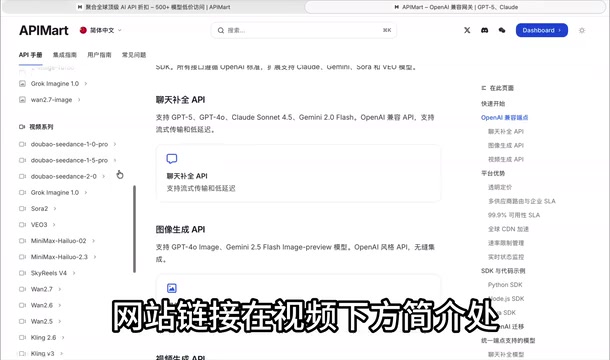
For developers, the most immediate benefit is eliminating the need to maintain a pile of API keys and integration docs—technical integration complexity drops dramatically. In practice, managing multiple API keys is far more than just "remembering a few extra passwords." Each AI provider has its own authentication mechanism—OpenAI uses Bearer Tokens, Google Cloud requires OAuth 2.0 service accounts, and Anthropic has its own API Key format. Developers also need to handle key rotation, permission tiers, usage quota monitoring, billing reconciliation, and other operational tasks. For small teams, even secure key storage alone is a challenge: you need environment variables or key management services (like AWS Secrets Manager or HashiCorp Vault) to prevent key leaks. Aggregation platforms encapsulate all this complexity on the backend—users only need to maintain a single API Key.
Model Coverage and Documentation Support
From hands-on experience, the platform's model coverage is quite comprehensive. Across video, image, language, and audio categories, it essentially covers "every notable name on the market." The documentation system is also well-organized, with left-side navigation categorized by text, image, video, and audio, each model accompanied by detailed invocation instructions and parameter descriptions.

If the documentation still doesn't get you there, there's a customer service entry point in the upper right corner of the platform where you can get human assistance directly. For newcomers without much API integration experience, this is genuinely useful.
Hands-On Demo: GPT-Image-2 Image Generation
Invocation Process
Let's demonstrate with the currently popular GPT-Image-2 (GPT-1M2) image generation model. The entire process is straightforward:
- Select GPT-Image-2 from the model list
- Enter a prompt
- Configure relevant parameters as needed
- Click generate and wait for the output

The technical background of GPT-Image-2 deserves some additional context: it's a native image generation model released by OpenAI in 2025, fundamentally different from the earlier DALL·E series. DALL·E uses a Diffusion Model architecture, generating images from random noise through progressive denoising; GPT-Image-2, on the other hand, is directly integrated into GPT-4o's multimodal framework, generating image tokens in an Autoregressive manner. This means it can better understand complex text instructions, with significantly improved performance in text rendering, spatial relationship understanding, and style consistency.
How Cheap Is It Really
The most impressive aspect of this platform is the pricing. Taking GPT-Image-2 as an example, a single invocation costs only $0.006, roughly 4 Chinese cents (fen). Compared to going directly through OpenAI's official API, the cost advantage is very clear—especially for users who need batch image generation, the savings add up considerably.

From actual testing, even with relatively simple prompts, the generated images show good detail and overall quality. If you have higher requirements, you can invest time in optimizing prompts and parameters. Prompt quality directly determines AI image generation results, which involves the emerging technical field of Prompt Engineering. For image generation models, effective prompts typically include several key dimensions: Subject description, Style specification, Composition requirements, Lighting atmosphere, and technical parameters (such as resolution and aspect ratio). For example, "a cat" versus "an orange shorthair cat sitting on a sun-dappled windowsill, soft side lighting, 35mm film photography style, shallow depth of field" will produce dramatically different results.
Clear Consumption Records
The platform console provides a task log feature where you can clearly check how much each invocation cost and what results were generated, making cost management and result tracking convenient.
Pros and Cons of Aggregation Proxy Platforms
Advantages
- One-stop access: No need to register separately on multiple AI platforms, low barrier to entry
- Lower costs: Aggregated scheduling often secures better pricing than official rates
- Flexible model switching: Freely switch between different models based on specific task requirements
- Unified management: Consumption records and invocation logs centralized in one dashboard for easy monitoring
Risks to Be Aware Of
- Data security: Requests pass through a third party, requiring careful evaluation when sensitive data is involved
- Service stability: Platform stability depends on its own operational capabilities and upstream API availability
- Response latency: The additional relay layer may introduce extra network latency
- Compliance: Need to verify whether the platform's model invocation methods comply with each provider's terms of service
Regarding data security risks, further elaboration is warranted. The security risks of data passing through a third-party relay involve multiple layers. First is transmission security: request data can potentially be intercepted at each hop in the user→proxy platform→upstream API chain. Even with TLS encryption, the proxy platform itself can still see plaintext data. Second is data retention: whether the proxy platform caches or logs user request content and generated results directly relates to GDPR (EU General Data Protection Regulation) and China's Personal Information Protection Law compliance requirements. Additionally, model providers' Terms of Service (ToS) typically have explicit restrictions on API key sharing and resale—some aggregation platforms' business models may operate in a gray area. Enterprise users should carefully review the platform's Data Processing Agreement (DPA) and security certifications when making their choice.
Regarding response latency, from a technical analysis perspective, the additional delay introduced by relaying consists mainly of three components: DNS resolution and TCP connection establishment (typically 10-50ms), the proxy platform's request processing and routing logic (5-20ms), and potential geographic detours. For streaming output scenarios, such as token-by-token generation from large language models, Time to First Token (TTFT) is more noticeably affected. However, for tasks like image and video generation that inherently require seconds to tens of seconds of processing time, an extra few dozen milliseconds of latency is virtually negligible.
Who Should Use Aggregation Proxy Platforms
These platforms are well-suited for the following types of users:
- Individual developers and small teams: Want to try multiple models without integrating with each provider's API separately
- Content creators: Need low-cost batch generation of images, copy, and other materials
- AI application prototype developers: Quickly validate different models' performance on specific tasks to find the best solution
However, if you're an enterprise user or your business involves sensitive data, it's recommended to integrate directly with official APIs. After all, official channels offer better guarantees in terms of data security and Service Level Agreements (SLA). SLA is a core commercial commitment in cloud services, typically measured by "nines" of availability—99.9% means at most approximately 8.76 hours of downtime per year, while 99.99% compresses that to about 52 minutes. Major AI providers like OpenAI and Google Cloud offer explicit SLA terms and failure compensation mechanisms, whereas most aggregation proxy platforms have not yet established equivalent service guarantee systems.
Overall, API aggregation proxy platforms provide a hassle-free, cost-effective path for everyday AI model usage, with clear advantages in cost control and model selection flexibility. However, there are trade-offs in data security and service stability—it's best to decide based on your actual needs.
Related articles
Building an AI Sci-Fi Short with LTX + MiniMax H3: Restrained Cinematography in ComfyUI
Sci-fi short REMAINDER uses LTX, MiniMax H3, and ComfyUI with restrained cinematography and flat aesthetics to solve visual consistency in AI filmmaking.
LangChain Deep Agents vs. MDA: Clearing Up the Confusion for Developers
What's the difference between LangChain's Deep Agents and MDA (Managed Deep Agents)? We break down create_deep_agent vs. define_deep_agent and help developers choose.

Why Is AI Agent Development So Fragmented? The Real Causes and How to Work Around Them
Why does AI Agent development feel so fragmented? Logic scattered across prompts, configs, and frameworks makes portability nearly impossible. Here's why — and how to cope.