App Store 2026: AI, Pricing, and the 'Abandoned App' Dilemma

The App Store ecosystem shifts to stock maintenance: AI apps, subscription pricing, and zombie apps reshape competition.
Based on Hacker News discussion, the article examines App Store annual data across three dimensions: the AI app boom, pricing strategy shifts, and abandoned apps. AI lowers development barriers but shortens differentiation windows, pushing competition toward use-case embedding and retention. Subscription fatigue drives pricing divergence, reviving one-time purchases and hybrid models. Zombie apps accumulate hidden trust costs and store noise. Together they show competition has shifted from acquiring new users to maintaining app activity and trustworthiness, with long-term maintenance itself becoming a differentiator.
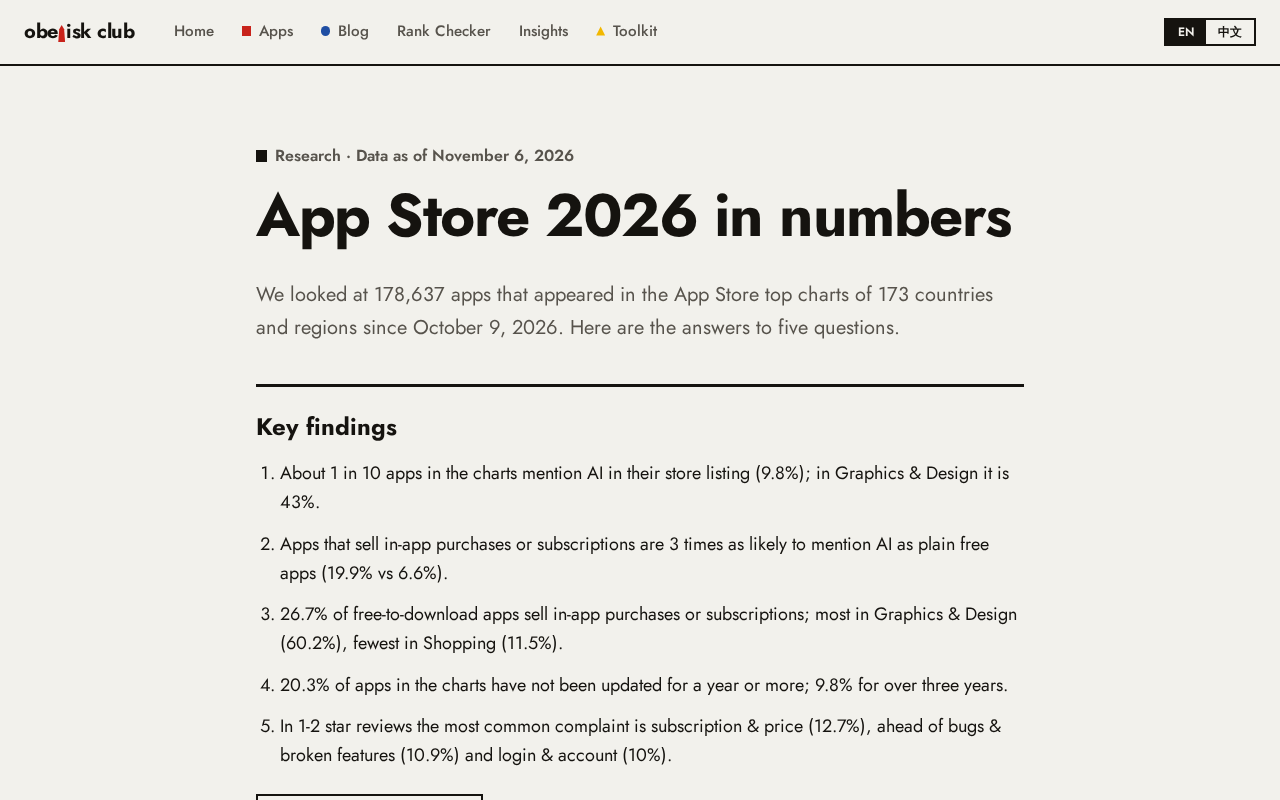
The App Store's annual data is shifting from a "growth story" into a more complicated health report. A recent article, "App Store 2026 in numbers: AI, pricing, abandoned apps," which sparked discussion on Hacker News, focuses on three intertwined threads: the explosion of AI apps, ongoing adjustments to pricing strategies, and the "silent inventory" formed by large numbers of apps abandoned by their developers. Together, these three paint a picture of an ecosystem that no longer relies purely on new growth—the main battleground of competition is shifting from "capturing users" to "keeping apps active and trustworthy."
AI Apps: From Quantity Expansion to Quality Screening
AI has been the most visible source of growth on the App Store in recent times. Generative models have lowered the barrier to app development and made "AI features" almost a default selling point for newly listed apps. But the original article's discussion points to a more sobering fact: the absolute number of AI apps is expanding, yet the proportion that can actually retain users is not growing in tandem.
This is not hard to understand. When model capabilities are universally accessed via APIs, the window for functional differentiation is extremely short—a hit feature is often copied en masse within weeks. As a result, competition among AI apps in the store quickly slides from "do you have AI" to "do you have a use case." Products that embed AI into specific workflows—rather than stopping at chat boxes and demo videos—are more likely to build up retention data. This trend, mentioned in the original article, is essentially a reminder to developers: AI is no longer a label advantage but a product baseline.
Generative models and API-ification: Generative models refer to machine learning models (such as large language models) capable of generating text, images, code, and other content based on input. "API-ification" means model capabilities are provided externally through standardized interfaces, so developers need not train models themselves and can simply integrate them by paying per call. This dramatically lowers the technical barrier and startup cost for AI apps, but it also means the moat at the feature level is very shallow—any capability that can be wrapped in an API may be replicated by competitors within weeks. Therefore, competition among AI products in the app store will ultimately come down to use-case understanding, workflow integration, and data accumulation.
Pricing Strategy: Subscription Fatigue and Price Tiering
Pricing is another keyword repeatedly mentioned in the original article. Subscriptions have long been the mainstream monetization method on the App Store, but as more and more apps flock to subscriptions simultaneously, users' willingness to pay is diluted, and "subscription fatigue" has gone from an individual feeling to an observable market resistance.
A recurring discussion in the original article is price tiering: on one side, raising subscription prices to cover higher development and inference costs (especially the ongoing compute expenses brought by AI features); on the other, users' resistance to "yet another monthly subscription." As a result, some developers are turning to lighter models—one-time purchases, pay-per-use, or hybrid pricing with feature tiers. This divergence shows that there is no longer a one-size-fits-all optimal solution for App Store pricing; it depends on how deeply an app is embedded in users' daily lives.
Subscription Fatigue: Refers to the psychological resistance and decision fatigue users experience when facing an increasing number of recurring paid subscriptions. When a single device carries multiple subscriptions—video, music, tools, AI assistants, and more—users begin to actively cut non-essential items and become sensitive to "yet another monthly charge." For developers, this means lower subscription conversion rates, higher churn, and reduced efficiency in funnels that rely solely on "free trial to subscription." Subscription fatigue is also a direct driver of the resurgence of price tiering and hybrid pricing models.
Abandoned Apps: Hidden Costs and a Trust Deficit
"Abandoned apps" is the part of the original title most easily overlooked, yet it may have the most lasting impact. Large numbers of apps stop being maintained after one or several updates, remaining downloadable in the store but no longer receiving security fixes, system compatibility updates, or feature updates. For users, this is a layer of hidden trust erosion; for the ecosystem, it is accumulating noise in search results and recommendation slots.
The original article's treatment of this phenomenon is not mere moral criticism but ties it to business reality: the long-term cost of maintaining an app is often higher than the one-time development investment. As customer acquisition costs rise and subscription conversion comes under pressure, some developers choose to direct resources toward new projects rather than maintaining old ones. This behavior pattern of "heavy on new releases, light on maintenance" is the structural reason behind the proliferation of zombie apps.
For platforms, this is a problem that needs governance; for developers, it is a reverse opportunity—in a store flooded with half-finished products, sustained maintenance itself constitutes differentiation.
Abandoned / Zombie Apps: Refers to apps that remain downloadable in the app store but have stopped being maintained. They typically no longer receive security patches, system version compatibility updates, or feature updates, yet still occupy search results and recommendation slots. Their hidden costs include: users encountering crashes or compatibility issues after download, potential security vulnerabilities left unfixed, and dilution of the store's overall content quality. For platforms, identifying and governing such apps requires sustained investment; for developers, persisting in maintenance within categories flooded with zombie apps can instead build a trust advantage.
Three Judgments Worth Remembering
Looking at AI, pricing, and abandoned apps together yields several conclusions that go beyond the data. First, the democratization of development brought by AI is shifting the focus of competition toward operations and maintenance rather than feature firsts. Second, subscriptions are no longer the default answer; pricing needs to be tied to an app's actual usage frequency and irreplaceability. Third, trust in the app store is becoming a scarce asset, and the value of long-term maintenance will be repriced.
It should be noted that the discussion volume for this post on Hacker News is very limited, and the original article is more of an observation checklist from a data perspective than a complete industry report. Among the above judgments, the parts about AI app retention and subscription fatigue align with recent industry discussion trends, but specific quantitative conclusions should still be based on the original data.
One-line Summary
The App Store ecosystem is shifting toward stock maintenance: AI apps, subscription pricing, and zombie apps are together reshaping the logic of competition.
Paragraph Summary
Based on Hacker News discussion, the article examines the App Store's annual data from three dimensions: the explosion of AI apps, pricing strategy adjustments, and abandoned apps. AI has lowered the development barrier, but the window for feature differentiation is extremely short, and competition is shifting from "do you have AI" to use-case embedding and retention. Subscription fatigue is driving pricing divergence, with one-time purchases and hybrid pricing regaining ground. Large numbers of unmaintained zombie apps are accumulating into hidden trust costs and store noise. Together, these three show that the focus of ecosystem competition has shifted from capturing new users to keeping apps active and trustworthy, with long-term maintenance itself becoming a differentiating advantage.
Related articles

AI Coding Enters the Team Collaboration Era: Interpreting Three Major Moves from Meta, GitHub, and Mistral
Meta acquires Conductor, GitHub Copilot Fusion becomes available, Mistral opens Large 4 weights—three moves show AI coding shifting from code generation to organizing development workflows. This article explains task orchestration, model collaboration, and cost control for developers.

Building a RAG Assistant with Dify: A Practical Guide to Knowledge Bases, Workflows, and Agent Nodes
How should knowledge bases, workflows, and Agent nodes connect in a Dify RAG assistant? We break down the division of labor and wiring logic for a shippable app.
 Tech Frontiers
The AI Industry Doesn't Lack Marketing—It Lacks Good Products
AI faces market selloffs and public skepticism—is marketing really the problem? This analysis of market signals and product experience argues the core困境 is incomplete products and a gap between promises and experience; the only way to change perceptions is to ship better products.