Apple Announces October Event: OLED MacBook Pro Leads, iPad Mini Joins the Stage
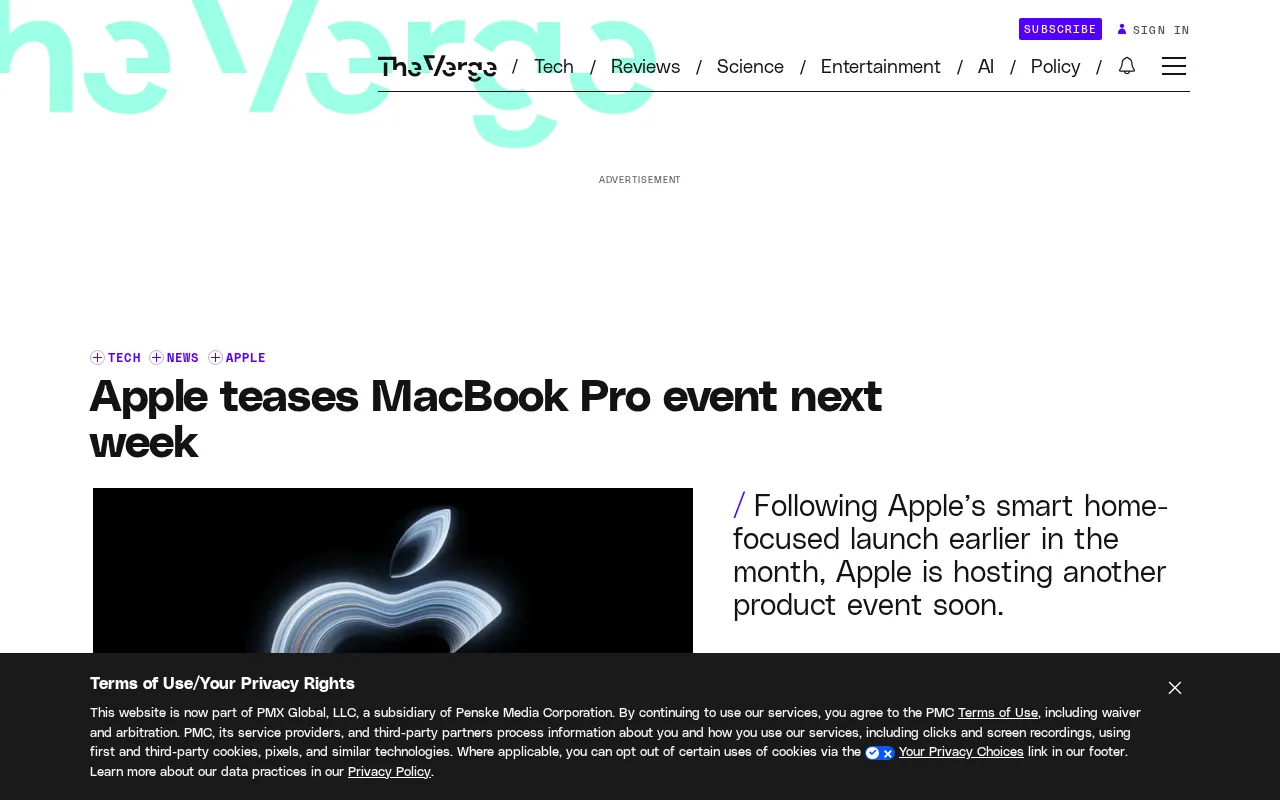
Apple's October 28 LA event centers on an OLED MacBook Pro, with iPad Mini updated alongside.
Apple has confirmed a second product event this month, on October 28 at 1 PM ET in Los Angeles. Bloomberg reports the centerpiece is a new MacBook Pro with an OLED screen for the first time—a key step from Mini-LED to OLED. A spec-upgraded iPad Mini also appears, closer to a routine refresh than a redesign. The LA venue and the rare two-events-in-one-month pace reflect Apple's push to accelerate hardware updates and drive upgrades. The OLED MacBook Pro also aligns Apple with the Windows camp on high-end notebook displays.
Apple sent invitations to media this week, confirming a second product event this month on the 28th at 1 PM ET in Los Angeles. According to Bloomberg, the headline products are a brand-new MacBook Pro and a refreshed iPad Mini. It's Apple's second launch event this month—a cadence rarely seen in recent years.
Event Time and Location Confirmed
The invitation says the event is set for October 28 at 1 PM ET in Los Angeles. This is Apple's second product launch this month, signaling that the company is accelerating its hardware refresh cycle.
Bloomberg reports that Apple will unveil new Mac models and a refreshed iPad Mini at the event. Judging from the invitation's wording and media reports, the MacBook Pro is the star of the show.
Los Angeles as the venue is noteworthy. Apple typically holds events at its Cupertino headquarters or theaters in San Jose. Choosing LA this time may hint at something special about the format or content of the event.
OLED Display: The Biggest Draw of the MacBook Pro
According to Bloomberg, the "major announcement" for the new MacBook Pro is the introduction of an OLED display. If true, this will be the first time the MacBook Pro line adopts an OLED panel, marking a significant leap forward in Apple's notebook display technology.
Compared with the current Mini-LED backlighting solution, OLED technology has inherent advantages in contrast ratio, response time, and power consumption control. For professional users, the true blacks and wider color gamut delivered by OLED mean a more precise color workflow. However, the long-term burn-in risk and lifespan performance of OLED in notebooks remain topics the industry continues to watch.
Apple has accumulated years of OLED tuning experience on iPhone and Apple Watch. Migrating this technology to larger notebook screens poses engineering challenges mainly in yield rates and cost control for large-size panels.
The Technical Divide Between Mini-LED and OLED
To understand the significance of this upgrade, it helps to first clarify the differences between the two panel technologies. Mini-LED is essentially still LCD—it divides the traditional LED backlight into hundreds or thousands of independently controlled dimming zones, using local dimming to boost contrast. But blooming is hard to eliminate entirely; there's still faint light bleed around dark areas. OLED, by contrast, has each pixel emit its own light—when a pixel is off, it's truly black, so contrast is theoretically infinite, and response time is far faster than LCD. The trade-off is that uneven degradation of organic light-emitting materials can cause burn-in, and evaporation yield rates for large panels are low while costs are high. Apple adopted Mini-LED on the 12.9-inch iPad Pro and MacBook Pro precisely because of its high peak brightness and stable lifespan; switching to OLED means re-engineering the trade-off between brightness and longevity.
Routine Update for iPad Mini
Also sharing the stage with the MacBook Pro is a refreshed iPad Mini. Bloomberg describes it as a "refreshed" version, suggesting it's closer to a spec bump than a design overhaul.
The iPad Mini line has always had an irregular update cycle, and it's been a while since the last refresh. For loyal users of small-size tablets, any update is worth paying attention to—especially improvements in processor performance and connectivity.
You may not have noticed, but Apple holding two events in the same month usually means there are clear positioning distinctions between product lines, or that some products need a separate launch window to get enough media attention.
The iPad Mini's Place in the Lineup
The iPad Mini is the smallest and most irregularly updated line in Apple's tablet matrix. It has long served two groups: mobile productivity and reading users who need one-handed grip and portability, and industry customers who use it in commercial scenarios such as ordering, logistics, and healthcare. Because its screen size sits between a phone and a regular tablet, the iPad Mini's positioning has always been somewhat awkward, and Apple's investment in it has been relatively limited—often getting a substantive upgrade only every other generation. This also explains why Bloomberg used "refreshed" to describe this update—a new processor and improved connectivity are standard fare, while the external design typically carries over for multiple generations.
Market Interpretation and Expectations
From a competitive standpoint, the launch of an OLED MacBook Pro will further widen the display technology gap between Apple's high-end notebooks and the Windows camp. Several Windows manufacturers have already adopted OLED panels in premium thin-and-light laptops, and Apple's move will make OLED a standard option for high-end notebooks.
Specific product details still await official unveiling. Bloomberg's report sets the tone for this event: the MacBook Pro's screen upgrade is the main course, and the iPad Mini is the side dish. For professional users holding off on a purchase, the October 28 event will provide a clear reason to upgrade.
The pace of two Apple events this month also reflects the company's aggressive stance on hardware updates. Against the backdrop of slowing overall PC market growth, stimulating upgrade demand through differentiated selling points like display technology is a reasonable strategy for Apple to maintain its high-end market share.
One-line Summary
Apple's October 28 Los Angeles event headlines an OLED MacBook Pro, with iPad Mini updated alongside.
Paragraph Summary
Apple has confirmed a second product event this month, set for October 28 at 1 PM ET in Los Angeles. According to Bloomberg, the centerpiece is a new MacBook Pro featuring an OLED screen for the first time—a key step in the line's transition from Mini-LED to OLED. Also appearing is a spec-upgraded iPad Mini, closer to a routine refresh than a design overhaul. The LA venue and the rare pace of two events in one month reflect Apple's acceleration of hardware updates to stimulate upgrade demand. The OLED MacBook Pro will also bring Apple in line with the Windows camp, which has already adopted OLED in high-end notebooks.
Related articles

How Did Da Vinci Prove the Sun Is Hot? A Neglected Chapter in Science History
How did da Vinci use a concave mirror experiment to overturn Aristotle's cold sun theory? This article traces this neglected chapter in science history, revealing the embryo of scientific thinking in the 15th century and da Vinci's cold observations on solar heat and the nature of life.

SharpLogic: Formalizing Bug Detection for LangGraph Routing Graphs with k-CNF
SharpLogic, an open-source project, maps LangGraph-style multi-agent routing and retry graphs to k-CNF, using a Rust kernel to count deadlocks and failing paths (#F counting), offering a Python AgentGuard hook and CLI for pre-release formal gate checks. This article analyzes its principles, its complementary relationship with evals, and the community's concern about modeling costs.

PPO Training of a Franka Robotic Arm for Pick-and-Place: A Reinforcement Learning Starter Project
A reinforcement learning project using PPO to train a Franka Panda robotic arm for pick-and-place in PyBullet, covering tech stack choices, task design challenges, and future text/voice command interaction plans—a good reference for beginners.