Apple Caps Engineers at $200 Daily AI Budget

Apple's $200 daily AI budget cap for engineers reflects the challenge of enterprise AI cost control.
Starting from a Hacker News discussion about Apple setting a $200 daily AI budget cap for engineers, the article analyzes the cost anxiety behind this management decision. A daily rather than monthly cap embeds cost awareness into daily work but sacrifices individual usage differences. Enterprise AI adoption faces unpredictable token consumption, large departmental differences, and difficult cost attribution; a uniform allowance is crude but easy to implement. The article distinguishes commercial API costs from in-house model compute, notes that public information is limited, and argues that AI coding tools are shifting from free perks to budgeted resources, spurring demand for cost observability tools.
A Budget Cap That Exposes Big Tech's AI Cost Anxiety
A Hacker News thread titled "Apple capped engineers at a $200 daily AI budget" has drawn 64 comments. The information itself is brief: Apple has set a daily budget cap of $200 for engineers' use of AI tools.
The number itself isn't small—annualized across workdays, it could reach several thousand dollars a month. But the fact that it's explicitly framed as a "cap" suggests that within Apple, AI inference costs have grown high enough to warrant financial discipline. For a company known for its margin management, this isn't a technical decision—it's a management decision.
Reactions in the discussion thread cluster around two directions: whether this allowance is sufficient for heavy users, and why the world's most valuable tech company would need to cap engineers' AI spending at all. Both questions point to the same backdrop—AI coding tool bills are shifting from "experimental spending" to "recurring costs."
Why "Daily" Rather Than "Monthly"
Setting the limit per day rather than per month is a notable detail. Monthly budgets are easily distorted by a "heavy use early in the month, belt-tightening at the end" pattern, whereas a daily cap embeds cost control into the daily work rhythm.
For engineers, this means having to prioritize their AI usage: which tasks are worth delegating to a model, and which are faster to write yourself. This kind of judgment is itself becoming a new engineering competency. One commenter in the discussion noted that the real question isn't the size of the allowance but what happens after it runs out—do you switch back to manual coding, or apply for an exception? That answer determines whether the budget cap is a "cost guardrail" or "process friction."
"Token consumption" is a key concept for understanding AI cost fluctuations. Large language models are billed by token, the basic unit of text processed by the model, roughly equivalent to a word or part of a word (in English, about 4 characters per token; in Chinese, typically 1–2 tokens per character). Billing for a single conversation includes input tokens (prompts, attached context, code files) and output tokens (model-generated content), with output typically priced higher than input. The peculiarity of coding assistant scenarios is extremely long context: to help the model understand an entire codebase, tools often need to repeatedly feed in large amounts of file content, so a single call can consume tens of thousands of tokens. This is precisely why AI coding costs are hard to predict and tend to accumulate rapidly under heavy use—and why enterprises need daily caps rather than simple monthly estimates.
The Real Friction Points of Enterprise AI Adoption
From an industry perspective, Apple's approach isn't isolated. Once enterprise AI deployment reaches a certain scale, nearly everyone encounters the same set of problems: unpredictable token consumption, enormous usage differences across departments, and difficulty allocating costs. Setting a uniform daily cap is the crudest but also the easiest to implement.
Its cost is sacrificing individual differences. An engineer doing large-scale code migration and an engineer who occasionally uses AI to autocomplete a function are placed under the same allowance. Some Hacker News commenters questioned whether this "one-size-fits-all" approach is reasonable, while others argued that this is exactly the purpose of a budget system—forcing teams to allocate resources themselves rather than having a centralized department guess.
It's worth distinguishing that such budget caps typically target calls to commercial APIs or third-party AI services, not internal compute for in-house models. This suggests that even for a company like Apple, capable of building its own infrastructure, a substantial portion of the AI toolchain engineers use daily still depends on external services.
The cost-structure difference between "in-house models" and "commercial APIs" is an important premise for understanding the boundaries of this news. Calling third-party commercial APIs (such as OpenAI, Anthropic, or cloud providers' model services) is billed transparently per token, and bills can be attributed directly to users or teams, making them naturally suited to monetary caps. Internal compute for in-house models, by contrast, is capital expenditure and fixed cost: GPU cluster procurement and depreciation are predetermined, the marginal cost of internal calls is close to zero, and usage is typically managed through quotas, queue priorities, or rate limits rather than dollar pricing. Apple has both paths, so the $200 cap most likely constrains only the external API channel—the one with a "visible bill"—and doesn't cover internal model compute. This also explains why, even with self-built infrastructure, reliance on external services still creates an expenditure surface subject to financial control.
Implications for Developers
The direct value of this news for ordinary developers is limited—most people don't have a $200 daily allowance. But the signal it sends is worth noting: the cost of AI coding tools is now being formally "seen" by corporate finance systems and brought under control.
What may follow is a wave of demand for tools around cost observability: who used how much, on what tasks, and how is output measured. As AI shifts from a "free perk" to a "budgeted resource," the engineering management practices around it will mature accordingly. For individual engineers, learning to make cost-effective usage decisions within a limited allowance will have more long-term value than simply chasing "more AI use."
It should be noted that currently public information includes only the fact of the budget cap and community discussion; Apple has not officially disclosed the basis for the allowance, its scope of application, or exception mechanisms. The above analysis is inferred from common industry practices, and specific implementation details should be confirmed against official information.
"Cost observability" borrows from cloud computing observability practices and refers to the ability to measure, attribute, and track resource consumption. In AI scenarios, it includes at least three levels: the usage level (who called which model when, and how many tokens were consumed), the task level (which specific work those consumptions correspond to, such as code completion, unit test generation, or large-scale refactoring), and the output level (whether consumption translated into measurable efficiency or quality gains). Traditional APM and FinOps tools excel at tracking infrastructure costs but struggle to associate a single model call with a specific developer task, leaving room for a new generation of AI gateways, usage dashboards, and billing middleware that allocates costs by team. As budget caps become the norm, such tools will shift from "nice to have" to a must-have for enterprise procurement.
One-line Summary
Apple set a $200 daily AI budget cap for engineers, reflecting the challenge of enterprise AI cost control.
Paragraph Summary
Starting from a Hacker News discussion that "Apple set a $200 daily AI budget cap for engineers," the article analyzes the cost anxiety behind this management decision. The author notes that capping per day rather than per month embeds cost awareness into the daily work rhythm but sacrifices individual usage differences, resulting in a one-size-fits-all approach. Enterprise AI adoption generally faces unpredictable token consumption, large departmental usage differences, and difficulty allocating costs; a uniform allowance is crude but easiest to implement. The article also distinguishes the different cost attributes of commercial APIs versus in-house model compute, and notes that public information is limited and the analysis is largely inferred from industry norms. It concludes that AI coding tools are shifting from free perks to budgeted resources, and demand for cost observability tools may grow.
Related articles
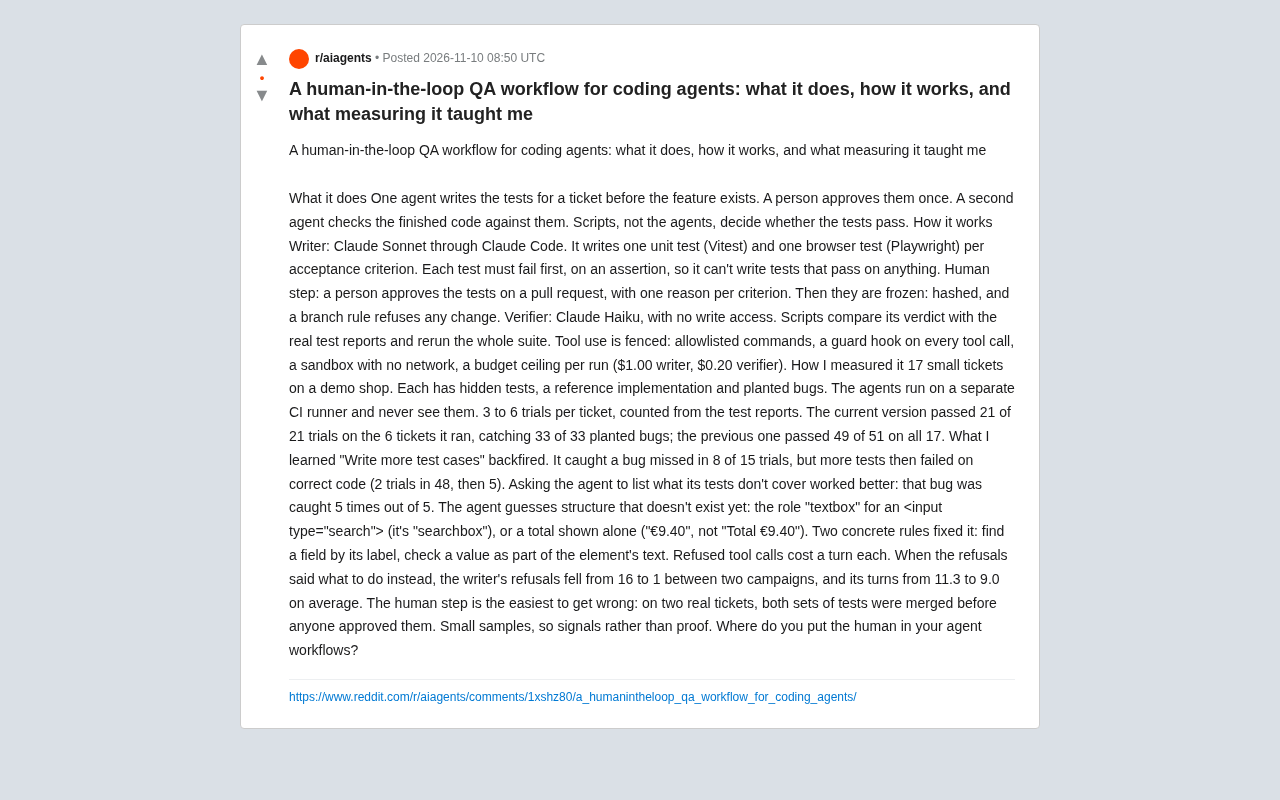
Human-in-the-Loop QA Workflow: Adding Test Gates to Coding Agents
A Reddit developer shares a human-in-the-loop QA workflow for coding agents: agents write tests first, humans freeze them, scripts adjudicate. Across 17 tickets, more tests increased false positives—listing uncovered scope proved more effective.
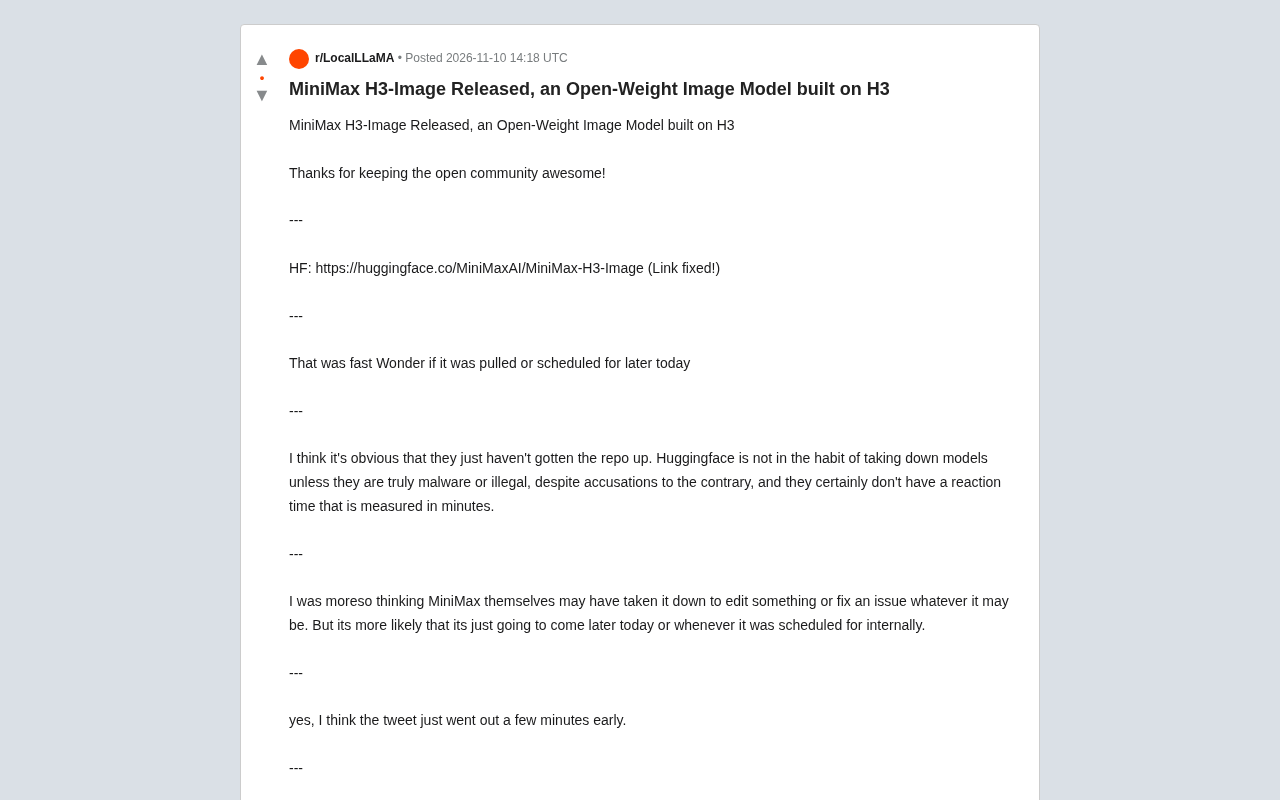
MiniMax Open-Sources H3-Image: An Open-Weights Image Model Built on H3
MiniMax releases H3-Image, an open-weights image model built on the H3 video model. The community is watching its image editing, text-to-image quality, and the deployment burden of its 32B text encoder, with potential competition against Qwen Image 2.1.

Reddit Turns User Discussions into AI Product Reviews
Reddit launches AI product reviews that aggregate community discussions into pros and cons summaries for 10,000 products, helping consumers research before holiday shopping. This analysis examines data value, accuracy concerns, and commercialization boundaries.