MiniMax Open-Sources H3-Image: An Open-Weights Image Model Built on H3
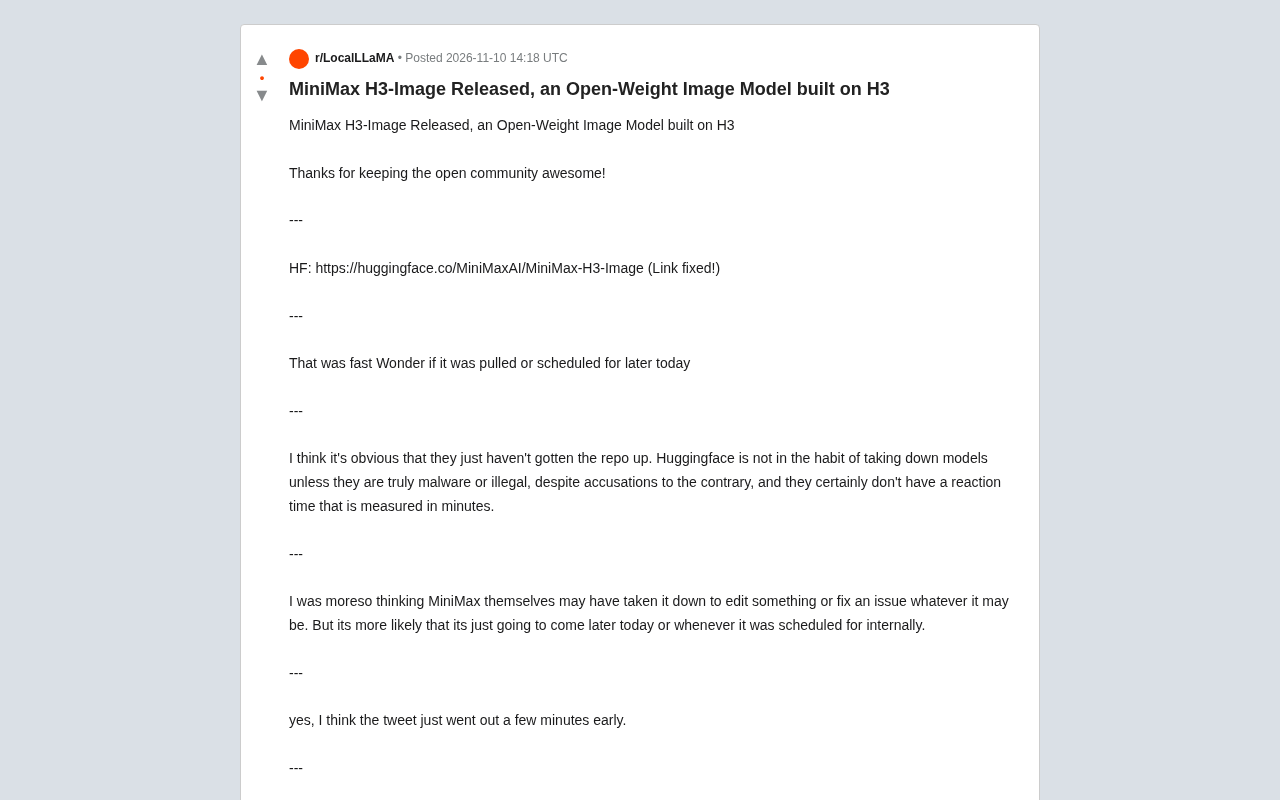
MiniMax releases H3-Image, an open-weights image generation model built on the H3 video model, on Hugging Face.
MiniMax released H3-Image, an open-weights image model built on its H3 video model, on Hugging Face; the news surfaced via Reddit and sparked discussion. The repository link was briefly inaccessible at launch, which the community judged to be an early tweet rather than a takedown. Based on users' prior experience generating single images with the H3 video model, it is smarter than other local image models but lacks fine detail and carries the heavy load of a 32B text encoder, so the community hopes H3-Image addresses both. Developers are focused on comparisons with Qwen Image 2.1 for image editing and with Moss Image and Krie 2 for text-to-image quality. Open weights aid research and customization, but the 32B text encoder may raise the barrier to consumer-grade hardware deployment.
MiniMax recently released H3-Image on Hugging Face, an open-weights image generation model built on top of the H3 video model. The news was first surfaced by the Reddit community and subsequently sparked heated discussion in the open-source AI community.
A Bumpy Release
According to the Reddit discussion, the Hugging Face repository link for H3-Image was initially inaccessible when it first appeared, with some users speculating that the model had been taken down or that the release had been delayed. The community quickly clarified, however: it was more likely that the tweet went out early while the repository had not yet officially gone live.
"Huggingface doesn't just take models down unless it's malware or illegal content, and their reaction time is definitely not measured in minutes."
Several users believed this was simply a timing gap—the tweet was posted a few minutes early, and the repository went live later per an internal schedule. This kind of "announce first" release cadence is not uncommon in the open-source community, but it also shows that MiniMax placed considerable importance on building hype for this launch.
Technical Foundation: Standing on H3's Shoulders
The core idea behind H3-Image is to reuse the capabilities of the H3 video model. According to community users, generating single-frame images with the H3 video model combined with the fizgig node had already produced results that were "smarter than all other available local image models," but with two clear shortcomings: a lack of fine detail and the heavy load imposed by the 32B text encoder.
"I've had good results using H3 video with the fizgig node for single images. It's much smarter than other local image models, but it lacks detail and is very heavy due to the 32B text encoder. I'm highly anticipating this release to solve both of these problems."
This first-hand experience reveals key information: H3-Image was not trained from scratch, but is rather an image-oriented extension of H3's video generation capabilities. If MiniMax can preserve the "smartness" while filling in the details and optimizing the inference burden, this model could occupy a unique position in the open-source image generation space.
Open Weights means that after a model's training is complete, its weight parameters can be publicly downloaded for anyone to use and fine-tune, though training data or complete training code is not necessarily included. Compared with fully open-source models (which come with data and training scripts), open weights emphasize "usability" rather than "reproducibility." In the image generation space, the Stable Diffusion series is a typical example of open weights, having spawned a large number of community fine-tuned models and toolchains. For researchers, open weights mean they can reproduce inference results locally and perform targeted fine-tuning; for businesses, attention must be paid to license restrictions on commercial use, redistribution, and naming of derivative models. By releasing H3-Image as open weights, MiniMax is essentially trading a controlled intellectual property boundary for community ecosystem and feedback speed.
Text Encoder is the component in text-to-image/video models that converts prompts into semantic vectors, and its size directly affects VRAM usage and inference latency. Common open-source solutions mostly use CLIP (about 120 million to 350 million parameters) or T5-XXL (about 4.7 billion parameters). The 32B text encoder mentioned here is an extra-large specification; loading just this encoder alone could require tens of GB of VRAM (depending on precision), far exceeding the capacity of most consumer-grade GPUs (8–24 GB). This is also the community's main concern about H3-Image's deployment barrier: even if the diffusion backbone itself is not large, the text encoder could become the bottleneck. Quantization, CPU offloading, or swapping in a lightweight encoder are common mitigation approaches, but often at the cost of semantic understanding.
Two Things the Community Cares About Most
Based on the discussion, developers' expectations for H3-Image are concentrated in two directions.
First, image editing capability. Some users directly compared it with Qwen Image 2.1, wanting to know whether H3-Image can match it on editing tasks. The Qwen series has built a solid reputation in image editing, and H3-Image as a newcomer needs to prove itself.
Second, text-to-image quality. Horizontal comparisons with models such as Moss Image and Krie 2 were also mentioned. Previous H3 video workflows performed poorly on text-to-image, and users are curious whether H3-Image can "nail it"—that is, truly raise text-to-image quality to a high level.
Neither question has a definitive answer yet, but they reflect that competition in the open-source image model space has already become granular, extending to specific dimensions such as editing, text-to-image, and detail restoration.
Image Editing and text-to-image are two different tasks: the latter generates images from noise, while the former modifies local content given an original image and an instruction (such as "change the sky to dusk"), requiring the model to simultaneously understand visual structure and textual intent while maintaining consistency in unedited regions. Evaluation commonly uses benchmarks such as InstructPix2Pix and MagicBrush, focusing on instruction adherence, background fidelity, and the naturalness of edited regions. The Qwen-Image-Edit series has earned a good reputation partly thanks to its underlying multimodal large model's strong understanding of Chinese and English instructions and text rendering. For H3-Image to match it on editing tasks, it needs not only generation quality but also image-conditioned input and region-awareness capabilities, which are not entirely the same as the architectural requirements of pure text-to-image.
What Open Weights Mean
MiniMax chose to release H3-Image as open weights, and a line in the Reddit post—"thanks for keeping the open-source community exciting"—captures the community's sentiment. In the image generation field, the reproducibility and customizability of open-weights models are especially important to researchers and independent developers.
However, open weights also bring practical challenges: the sheer size of the 32B text encoder means the local deployment barrier will not be low. Whether H3-Image can run at usable speeds on consumer-grade hardware will directly affect its real-world adoption rate.
Consumer-grade hardware deployment typically refers to running a model on a single consumer-grade GPU with 8–24 GB of VRAM (such as an RTX 3060/4070/4090). The VRAM usage of image diffusion models mainly comes from three parts: the text encoder, the UNet/DiT backbone, and the VAE decoder. Taking SDXL as an example, its text encoders total about 800 million parameters, occupying about 1.6 GB in FP16, and the entire model can run on 8 GB of VRAM with optimizations. If the text encoder reaches 32B parameters, even with 4-bit quantization it would require more than 16 GB, and adding the backbone and intermediate activations, the actual requirement would be even higher. Therefore, common community approaches include staged loading (encoding text first and then offloading), GGUF quantization, and replacing with a lightweight encoder, but these solutions all increase configuration complexity and may affect prompt adherence quality.
Signals Worth Watching
The release cadence and community reaction to H3-Image reveal a trend: the boundary between video models and image models is blurring. Leveraging video model capabilities to benefit image generation is a technical path worth watching. This time, MiniMax is porting H3's "smartness" to the image side, and if it can simultaneously solve the detail and efficiency problems, the open-source image model landscape may gain another strong competitor.
The model is now live on Hugging Face, and its actual performance awaits large-scale testing and verification by the community.
Related articles

LLM Interview Focus Shifts to Agents: Harness Engineering and Langfuse Tracing Become Must-Know Topics
2026 LLM application interviews now focus on AI agents: multi-agent systems, Harness engineering, Langfuse tracing/evaluation, and security mechanisms are must-know topics. This article covers interview trends and resume tips.

Claude Code Advanced Guide: 10 Tips to Stop Approving Manually
Based on The Benmore Brief's Claude Code tutorial, 10 practical tips: from Auto mode, effort levels, and side chats to phone remote control and scheduled tasks—stop approving every step.

Why Did ByteDance's Coze Suddenly Go Quiet? Outdated AI Workflows and Shifting Internal Priorities
ByteDance's Coze went from a must-learn AI tool to fading out. A Bilibili creator analyzes its outdated workflow model, failed coding pivot, and ByteDance's resource reshuffling among Doubao, Feishu, and Tree Work under Workbody pressure—with the Coze team possibly facing merger or dissolution.