Apple Developer Agreement Update: Live Assistance API, HomeView, and Other New Clauses Explained

Apple updates developer agreement with new API and entitlement clauses, tightening security and tax compliance requirements.
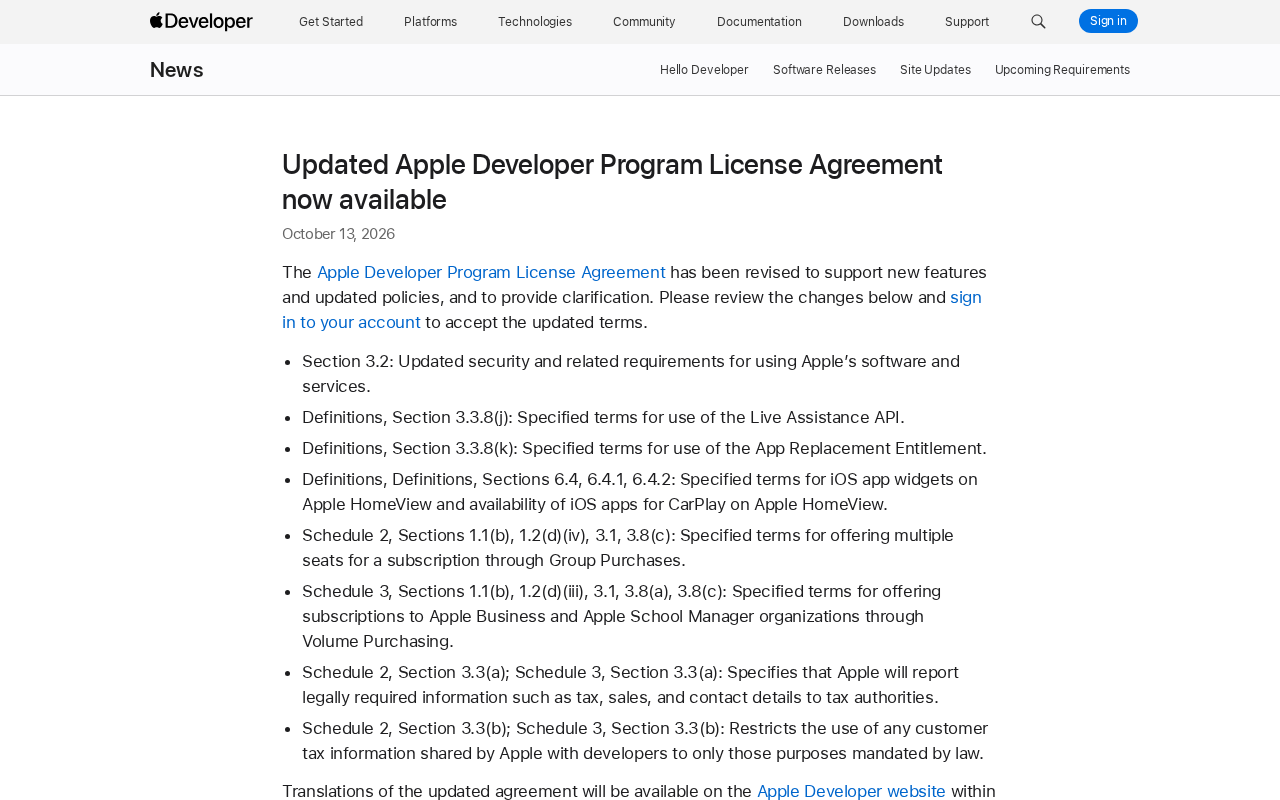
Apple has updated the Apple Developer Program License Agreement, adding several new clauses to support upcoming features. On security, Section 3.2 was revised to strengthen data protection and API usage standards. New API and entitlement clauses include terms for the Live Assistance API and App Replacement Entitlement. For ecosystem expansion, rules were clarified for iOS app widgets on HomeView and CarPlay scenarios. On monetization, subscription terms for group purchases and volume purchasing were updated to strengthen B2B distribution. For tax compliance, new clauses on tax information reporting and customer data usage restrictions were added. Developers must re-accept the agreement and assess whether their existing apps and future plans are compliant.
Apple recently updated the Apple Developer Program License Agreement, adding several new clauses to support upcoming features and clarifying existing policies. All developers must log in to their accounts and re-accept the updated terms.
Security Requirements Tightened Across the Board
In this update, Section 3.2 has been revised regarding security and related requirements for the use of Apple software and services. While official details have not been disclosed, given Apple's ongoing investment in security compliance across the developer ecosystem, this adjustment likely involves strengthened requirements for data protection, API usage standards, and third-party service integration. For developers who rely on Apple APIs to build their apps, it's time to re-evaluate whether their product's security strategy meets the new requirements.
New API and Entitlement Clauses Take Effect
The agreement adds two key clauses in the Definitions section and Section 3.3.8:
- Section 3.3.8(j): Clarifies the terms for using the Live Assistance API. This API allows developers to integrate real-time assistance features into their apps, and Apple has now defined specific usage boundaries and compliance requirements for it.
- Section 3.3.8(k): Sets forth the conditions for using the App Replacement Entitlement. This entitlement allows developers to replace already-installed apps under specific circumstances, potentially for enterprise distribution or testing scenarios.
The addition of these two clauses signals that Apple is offering developers more granular access to system capabilities while simultaneously tightening control over these capabilities through contractual terms.
Ecosystem Expansion: HomeView and CarPlay
The agreement, in the Definitions section and Sections 6.4, 6.4.1, and 6.4.2, specifically addresses the terms for using iOS app widgets on Apple HomeView, as well as the availability of iOS apps on Apple HomeView through CarPlay.
HomeView, a platform capability Apple has been actively promoting, now has a legal framework for app distribution and feature presentation through this clause update. Developers planning to extend their apps to in-car or smart home hub scenarios should pay close attention to how these clauses limit feature implementation.
HomeView is a unified interface framework Apple has introduced across iOS and CarPlay, designed to standardize app presentation in smart home hub and in-car scenarios. Previously, CarPlay primarily supported limited categories such as navigation, music, and communication, but the introduction of HomeView allows more types of iOS apps (such as smart home control, energy management, and vehicle status) to be displayed as widgets or cards. Sections 6.4, 6.4.1, and 6.4.2 of the agreement specifically regulate the functional scope, data access permissions, and user interface requirements for apps in these scenarios. Developers must ensure their app's behavior on HomeView complies with Apple's Human Interface Guidelines and privacy policies.
Group Purchases allow organizations or families to provide subscription seats for multiple members through a single purchase, similar to Apple's "Family Sharing" but extended to enterprise teams. Developers need to configure the corresponding subscription groups and seat management logic in App Store Connect. Volume Purchasing is a bulk purchasing program for organizations using Apple Business Manager and Apple School Manager, allowing educational institutions and enterprises to centrally purchase apps and subscriptions and distribute them to members. Both mechanisms require developers to enable the corresponding entitlements and comply with Apple's sales reporting and tax regulations.
New Rules for Subscriptions and Volume Purchasing
For monetization and the enterprise market, the agreement updates several clauses in Schedule 2 and Schedule 3:
- Group Purchases: Sections 1.1(b), 1.2(d)(iv), 3.1, and 3.8(c) of Schedule 2 set forth specific terms for providing multiple subscription seats through group purchases. This means developers can sell subscription services to teams or families more flexibly in the future.
- Volume Purchasing: Sections 1.1(b), 1.2(d)(iii), 3.1, 3.8(a), and 3.8(c) of Schedule 3 clarify the terms for providing subscriptions to Apple Business and Apple School Manager organizations through volume purchasing. Educational institutions and enterprise customers will be able to obtain app subscriptions in bulk more conveniently.
These two adjustments reflect Apple's efforts to strengthen its B2B distribution capabilities and open new channels for subscription-based revenue for developers.
Tax Information Reporting and Compliance
The agreement adds new tax compliance-related clauses:
- Section 3.3(a) of Schedules 2 and 3: Provides that Apple will report information required by law to tax authorities, including tax, sales, and contact details.
- Section 3.3(b) of Schedules 2 and 3: Limits the scope of developers' use of customer tax information shared by Apple, restricting it to purposes legally mandated.
This change aligns with the tightening regulatory landscape for digital services taxation across global markets. Developers handling customer tax data obtained through Apple must strictly adhere to usage restrictions to avoid compliance risks.
Recommendations for Developers
In light of this agreement update, developers should log in to their Apple Developer accounts as soon as possible to accept the new terms, and focus on evaluating the following:
- Whether existing apps involve use cases for the Live Assistance API or App Replacement Entitlement, ensuring compliance with the new rules;
- If there are HomeView or CarPlay-related development plans, adjust product design in accordance with the new clauses;
- Consider whether to leverage the new rules for Group Purchases and Volume Purchasing to expand into enterprise or education markets;
- Review internal tax data processing workflows to ensure compliance with usage restrictions.
Apple has stated that translated versions of the updated agreement will be available on the Apple Developer website within one month.
Apple Developer Program License Agreement is a legal contract between Apple and all registered developers, setting forth the rights and obligations of developers using Apple software, APIs, SDKs, and distribution channels. This agreement is typically revised alongside iOS, macOS, and other system version updates, and developers must re-agree to it in App Store Connect or their developer account portal before they can continue submitting apps or using related services. The agreement covers app review, privacy, security, payments, taxes, enterprise distribution, and more. This update is a routine annual revision, but due to the addition of multiple API and entitlement clauses, it has a significant impact on developers involved in real-time assistance, app replacement, in-car and home scenarios, and enterprise volume purchasing.
Live Assistance API is an interface Apple provides to support real-time assistance scenarios, allowing developers to integrate remote guidance, screen sharing, or live customer support features into their apps. Such APIs typically involve sensitive permissions, so Apple uses contractual clauses to clearly define usage boundaries, such as requiring developers to obtain explicit user consent, limit data usage, and prohibit unauthorized recording or storage of session content.
App Replacement Entitlement is a special entitlement that allows developers to replace already-installed apps on a device under specific conditions, commonly in enterprise internal distribution, testing, or MDM (Mobile Device Management) scenarios. This entitlement requires a separate application and can only be used for legitimate, compliant business purposes, such as updating enterprise-owned apps or unified deployment by educational institutions. It must not be used to bypass App Store review or force users to install apps.
Related articles

Chain of Thought Isn't Just for AI: How Humans Can Use CoT to Improve Thinking Quality
Chain of Thought isn't just a prompt trick for large models. Starting from a Hacker News discussion, this article analyzes why CoT works for human thinking too, breaks down actionable ways to transfer it, and highlights the key differences between human CoT and machine CoT.
Cloudflare Teams Up with OpenAI: Closi…
Cloudflare Teams Up with OpenAI: Closing the Loop from Vulnerability Discovery to Defense with AI
Cloudflare uses OpenAI Daybreak to investigate security vulnerabilities and generate reviewable remediation plans, while developers use Codex to boost coding efficiency and quality.

Orca Multi-Agent Orchestration in Practice: A Guide to Parallel Collaboration with Claude and Codex
Orca is Stable AI's free open-source agent workbench supporting 34 agents like Claude Code and Codex in parallel. Learn its Git worktree isolation, multi-model orchestration, and mobile management.