Apple Home Gets AI Camera Features with iOS 27: Up to $60/Month
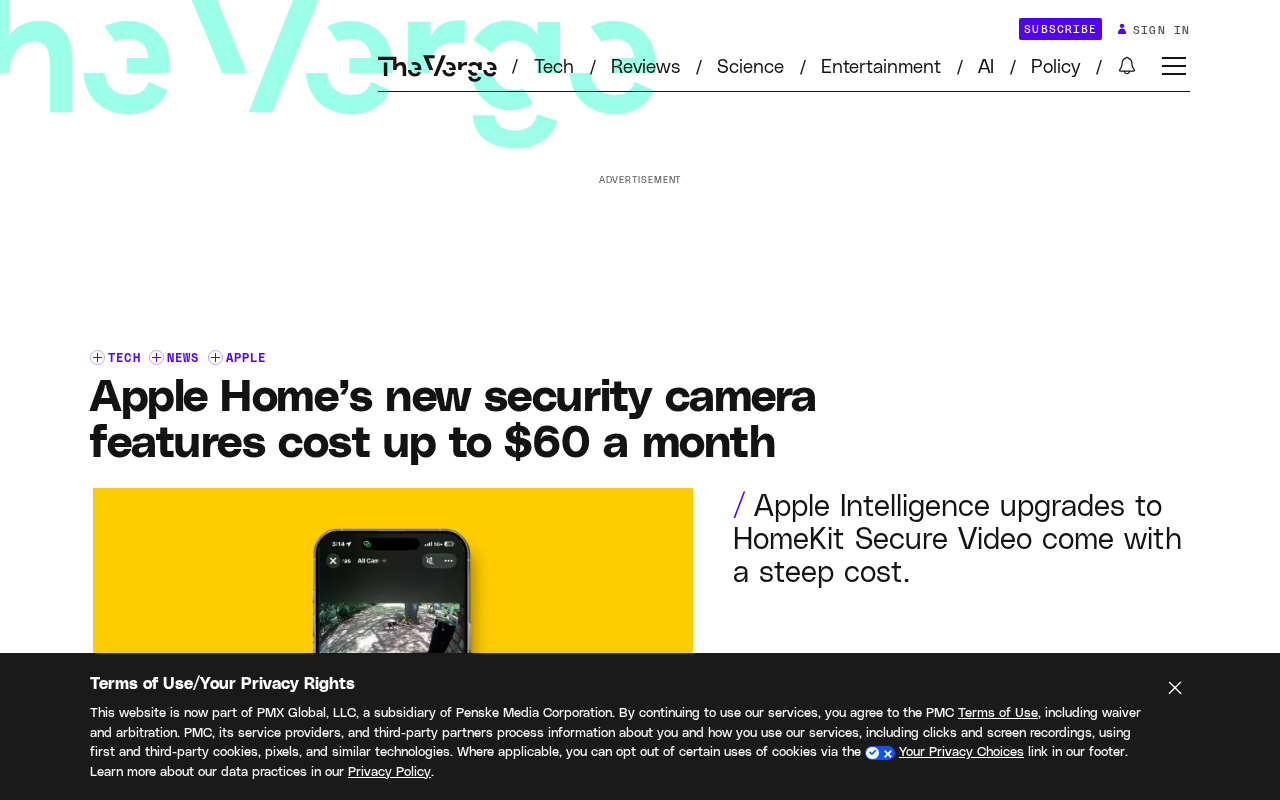
iOS 27 brings AI security camera summaries to Apple Home, but it'll cost up to $60/month.
iOS 27 and tvOS 27 expand Apple Intelligence into the smart home, with AI-powered video summaries for HomeKit Secure Video as the headline feature — automatically converting camera footage into natural language descriptions so users never have to scrub through recordings. This mirrors AI event description features from Ring and Google Nest, signaling Apple's push to catch up in smart home AI. However, the features aren't free: they require iCloud+ and HomeKit Secure Video subscription tiers, and heavy users with multiple cameras could pay up to $60/month. The move continues Apple's strategy of positioning generative AI as a paid value-add, adding yet another cost consideration for users already subscribed to multiple Apple services.
With the official release of iOS 27 and tvOS 27, Apple Home gains Apple Intelligence capabilities — but unlocking these AI features comes at a price. Apple is bringing generative AI to the smart home, centered around AI-powered video summaries for HomeKit Secure Video. For longtime users of Apple's smart home ecosystem, this represents both an experience upgrade and a new subscription bill.
What Apple Intelligence for Home Actually Brings
The headline feature of this update is AI video summaries. When a compatible security camera captures footage, the system no longer just delivers a video clip — it generates a brief text description telling you who and what the camera saw.
This kind of capability is genuinely useful in security contexts. Traditional HomeKit Secure Video relied on users manually scrubbing through recordings, or on basic detection labels like people, packages, and vehicles. AI summaries translate visual content into natural language, letting users quickly understand what happened at their front door without ever opening a video. This aligns with the direction Ring, Google Nest, and other competitors have been pushing with AI event descriptions — it's an industry-wide trend in smart security.
HomeKit Secure Video (HKSV) is Apple's end-to-end encrypted security video solution, launched in 2019. Unlike traditional camera manufacturers' cloud storage, HKSV footage is encrypted locally on a HomeHub (Apple TV or HomePod) before being uploaded to iCloud — meaning even Apple itself cannot access the video content. Basic detection capabilities include people, animals, vehicles, and package recognition, with notification triggers. The AI video summaries introduced here build on this architecture, meaning the generative AI inference layer must also respect Apple's privacy-first design principles — a key distinction from the cloud-based AI processing approaches used by Ring and Google Nest.
Where the $60/Month Figure Comes From
The "up to $60/month" figure refers to the subscription tiers that underpin these new features. Apple Intelligence for Home's advanced capabilities aren't freely available — they're tied to iCloud+ and HomeKit Secure Video storage plans.
The more cameras you have and the more video storage and AI processing you need, the higher the subscription tier required. For heavy users with multiple security cameras deployed throughout their home, the cumulative monthly costs can climb significantly. This reflects Apple's broader monetization approach for AI: positioning generative AI as a value-added service rather than a free default.
iCloud+ is Apple's 2021 rebranding of its iCloud storage subscription, adding privacy features like Private Relay and Hide My Email on top of storage. HomeKit Secure Video recording is deeply tied to iCloud+ tiers: the 50GB plan supports one camera, the 200GB plan supports up to five, and the 2TB plan supports unlimited cameras. In the US, the 2TB tier costs $9.99/month — but households simultaneously subscribed to Apple One family plans, higher-tier enterprise storage, and the upcoming Home AI add-on could see combined costs approaching or exceeding $60/month. That figure represents the upper bound of a multi-subscription scenario, not the price of any single plan.
The Industry Logic Behind Subscription-Based AI
Folding AI capabilities into paid subscriptions is standard practice among major tech companies. The inference costs for generative AI and cloud video processing are substantial, and vendors prefer subscriptions to recoup costs and generate recurring revenue.
For users, the calculus comes down to convenience vs. cost: AI video summaries can genuinely save time and improve security response, but spending tens of dollars per month is no small commitment for an average household. Apple ecosystem users in particular often already pay for iCloud+, Apple Music, Apple TV+, and other services — adding a Home AI subscription only pushes the total cost of ecosystem participation higher.
What This Means for Apple's Smart Home Ecosystem
For years, Apple's smart home ambitions have been relatively cautious. HomeKit has been widely criticized for lagging behind Amazon and Google in device compatibility and feature velocity. By using Apple Intelligence to enter the AI security space, Apple is signaling its intent to close that gap and deepen ecosystem lock-in.
Combining AI capabilities with privacy protection and local processing — hallmarks of the Apple brand — theoretically creates a differentiated advantage. But whether users will actually pay for it ultimately depends on the accuracy and speed of AI summaries, and whether the pricing feels reasonable. If the experience is genuinely polished, the subscription may well be worth it. If not, the high monthly barrier could push many users to stick with basic features.
Apple's smart home ecosystem has gone through several strategic pivots. The HomeKit framework, launched in 2014, gained traction slowly due to high certification requirements and limited compatible devices. The Matter protocol, co-developed with Amazon and Google and officially launched in 2022, enabled cross-platform device connectivity and partially addressed HomeKit's compatibility gaps. Even so, Apple still trails Amazon's Echo/Ring and Google's Nest ecosystems in smart speaker market share and camera ecosystem breadth. Embedding Apple Intelligence into Home scenarios is Apple's continued effort — following Matter's establishment of a connected foundation — to rebuild a competitive advantage through software intelligence.
Summary
iOS 27 and tvOS 27 bring Apple Intelligence to the smart home, with AI-powered security video summaries as the flagship new feature — but access requires a subscription, with costs reaching up to $60/month at the highest tier. This reflects both Apple's determination to catch up with smart home competitors and its ongoing strategy of monetizing AI through subscriptions. For users, the decision to pay for AI-powered security ultimately comes down to a practical question: is the convenience worth the cost?
Related articles
Claude Code v2.1.271 Update Deep Dive: Fast Mode, Sandbox Security, and Enterprise Improvements
Claude Code v2.1.271 adds fast mode for remote sessions, per-command sandbox network controls, enterprise policy fixes, MCP protocol improvements, and terminal/IDE enhancements.

AI Giants Collectively Hit the Brakes: Safety Protocol or Industry Cartel?
OpenAI, Anthropic, Google DeepMind, and SpaceX leaders agree to slow AI development. Is this a responsible safety pact — or an oligopolistic cartel in disguise?

AI Race Becomes a Matter of National Security: How the US and China Are Framing Tech Competition as an Existential Struggle
US Treasury Secretary frames losing the AI race to China as existential. China calls it a pretext for tech hegemony. Analysis of how AI competition became a survival narrative.