Apple HomeView Smart Display Now Available for Pre-Order: A $299 Bet on the Smart Home Hub

Apple launches the $299 smart display HomeView, entering the smart home hub market with a squircle design.
Apple has officially opened pre-orders for its first smart display, HomeView, priced at $299. The device features a seven-inch squircle screen with a speaker base, resembling an enlarged Apple Watch, and is positioned as the core control hub of Apple's smart home strategy. The $299 price point targets the mid-to-high-end, higher than entry-level smart displays but lower than the iPad's starting price. The product will deeply integrate with the HomeKit ecosystem and may become a management entry point for Matter protocol devices. Facing competition from Amazon Echo Show and Google Nest Hub, HomeView's success depends on HomeKit device coverage, Siri's usability in home scenarios, and whether Apple can offer a use case that makes people feel they must buy it.
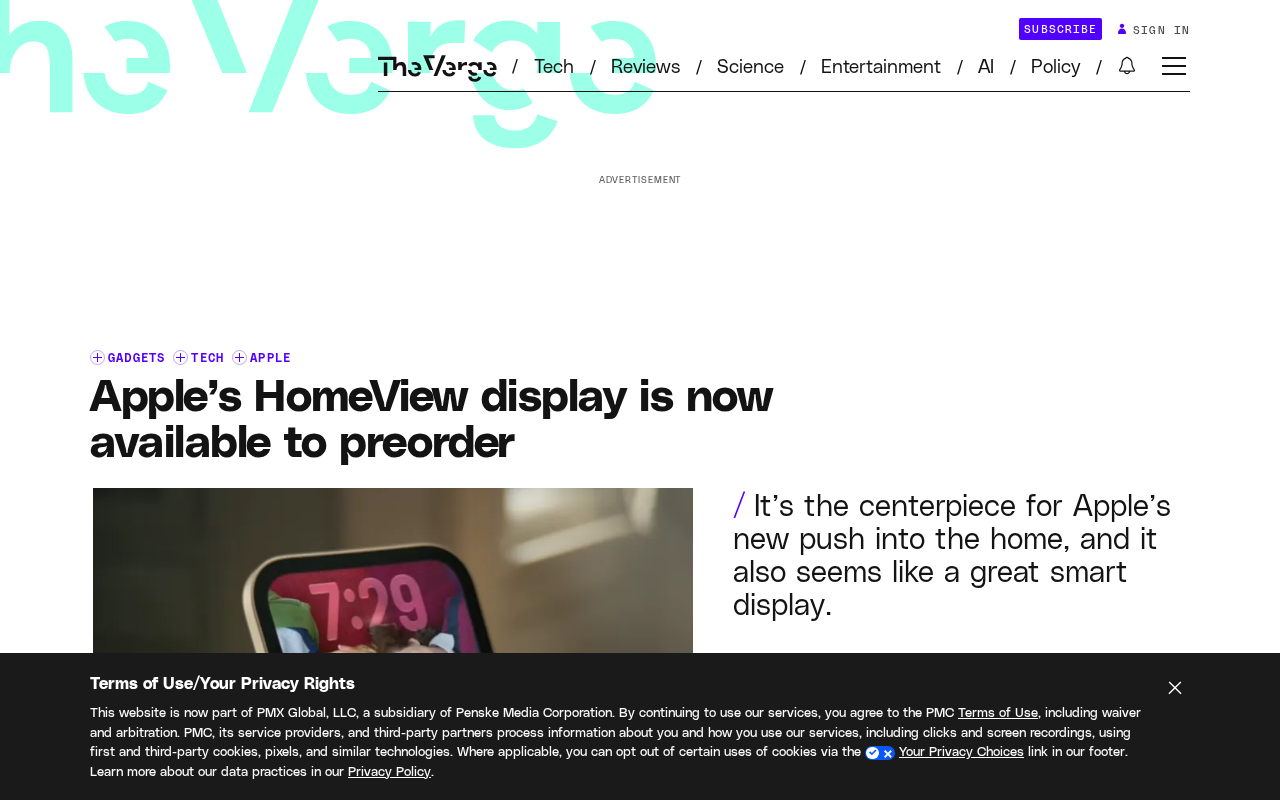
Apple is officially entering the smart display market. Its first smart display product, HomeView, is now available for pre-order at $299. The device features a seven-inch "squircle" design that looks like a giant Apple Watch mounted on a speaker base. In terms of positioning, Apple has high hopes for HomeView, aiming to make it the core control hub of its smart home strategy.
A Design Philosophy of an "Enlarged Apple Watch"
HomeView's industrial design continues Apple's consistent product form language from recent years. The seven-inch squircle screen creates an obvious visual echo with the Apple Watch's rounded rectangular display, while the speaker base evokes the product lineage of the HomePod line.
This design choice is no accident. Squircle is a shape language Apple has used extensively across watchOS and iOS, and users already have strong brand recognition of it. By scaling this element up to the smart display category, Apple is essentially migrating its existing design assets into a new product category to lower the cognitive barrier for users. The addition of a speaker base suggests that this product won't compromise on audio capability—which is crucial for a device meant to sit on a kitchen counter or nightstand.
Squircle is not simply a rounded rectangle, but a mathematically continuous curvature shape between a square and a circle. It was first introduced into industrial design by Nokia on the N9 phone in 2011, and was later systematically applied by Apple to iOS icons and Apple Watch faces. Compared to the traditional "straight edges + fixed-radius corners," a squircle's curvature is gradual, with no abrupt transition points from edge to corner, making it visually softer and more "organic." Apple even provides a dedicated continuousCorners property in its developer documentation, allowing developers to precisely reproduce this curve.
For hardware form factors, adopting a squircle means that both screen cutting and casing molds require customized processing, costing more than standard rounded rectangles. Apple's willingness to bear this cost for HomeView is essentially using the shape language it has accumulated over years on screens as a kind of "visual trademark"—when users see this shape, they subconsciously associate it with Apple's ecosystem experience.
Matter protocol is a unified smart home standard jointly promoted by Apple, Google, Amazon, and other tech giants in 2022, aiming to solve the pain point of devices from different brands being "siloed" and unable to interoperate. Previously, if a user wanted to control a non-HomeKit-certified light bulb with Siri, it was nearly impossible; but the Matter protocol, through a unified application-layer specification, allows compliant devices to be recognized and controlled across platforms. For HomeView, becoming a management entry point for Matter devices means it theoretically can connect not just to Apple-certified products, but to the entire Matter ecosystem—greatly expanding its pool of usable devices and lowering the barrier for third-party manufacturers who "only support Apple."
The $299 Price Point: Positioning in the Mid-to-High-End Smart Display Market
The $299 pricing strategy deserves a closer look. This price is higher than most entry-level smart displays on the market, but lower than the starting price of Apple's own iPad. Apple clearly doesn't intend to trade price for market share, but has instead chosen a mid-to-high-end position.
Behind this pricing logic is Apple's positioning of HomeView's role: it's not a "cheap speaker with a screen," but a smart home control hub. If this positioning holds, then $299 corresponds not just to hardware costs, but also to the collaborative value of smart home devices within Apple's ecosystem.
The Ambition of a Smart Home Control Hub
HomeView's most core functional selling point is controlling a large number of smart home devices. This means it will deeply integrate Apple's HomeKit ecosystem and will likely become a management entry point for Matter protocol devices.
The smart display category is not new—Amazon Echo Show and Google Nest Hub have been cultivating it for years. But Apple's approach is different—it emphasizes the concept of a "hub" rather than simply a voice assistant terminal. If HomeView can smoothly orchestrate lighting, temperature control, security, and other devices, and seamlessly link with iPhone and Apple Watch, then its value lies not in the screen itself, but in filling the gap of a "visual control center" in Apple's smart home puzzle.
The real challenge lies in the richness of the ecosystem. The value of a smart display depends heavily on the number and quality of connectable devices. Apple needs to persuade more third-party manufacturers to deeply integrate with HomeKit, otherwise HomeView could become just an expensive HomePod with a screen.
HomeKit is Apple's smart home framework launched in 2014, managing compatible devices through the unified "Home" app. Unlike Amazon Alexa and Google Assistant, HomeKit has prioritized privacy and security from the start: all automation logic executes locally by default, video surveillance data is end-to-end encrypted, and devices must pass Apple's MFi certification to be integrated. This strategy has earned a stronger security reputation, but has also led to slow growth in compatible devices and high integration costs for third-party manufacturers. If HomeView is to truly become a "hub," its success largely depends on whether Apple is willing to adjust HomeKit's openness and certification thresholds.
What It Means for Apple
HomeView is a flagship product of Apple's strategy to "make a major push into the home scenario." For a long time, Apple's smart home efforts have been considered behind Amazon and Google, and HomePod's market performance has also fallen short of expectations. HomeView's arrival signals that Apple is re-evaluating the strategic weight of the home scenario.
Whether this product succeeds depends on three variables: the device coverage of the HomeKit ecosystem, Siri's practical usability in home scenarios, and whether Apple can offer a use case that makes people feel they must buy it. Hardware design and brand premium alone are not enough to support the long-term growth of an entirely new product category.
One-line Summary
Apple launches the $299 smart display HomeView, entering the smart home hub market with a squircle design.
Paragraph Summary
Apple has officially opened pre-orders for its first smart display, HomeView, priced at $299. The device features a seven-inch squircle screen with a speaker base, resembling an enlarged Apple Watch, and is positioned as the core control hub of Apple's smart home strategy. The $299 price point targets the mid-to-high-end, higher than entry-level smart displays but lower than the iPad's starting price. The product will deeply integrate with the HomeKit ecosystem and may become a management entry point for Matter protocol devices. Facing competition from Amazon Echo Show and Google Nest Hub, HomeView's success depends on HomeKit device coverage, Siri's usability in home scenarios, and whether Apple can offer a use case that makes people feel they must buy it.
Related articles

@ai-sdk/vue 3.0.306 Patch Release Syncs with [email protected] Update
@ai-sdk/vue 3.0.306 released, synced with [email protected]. A routine patch release for the Vercel AI SDK ecosystem with no public API changes; the Vue adapter layer stays version-aligned with the core package.

Gemini 4 Argon API Launches: The Era of Million-Token Output Begins
Google launches Gemini 4 Argon with sparse MoE architecture, up to 1M output tokens, and a 68.90% Vals Index score, available across API, AI Studio, and the Gemini app.

DukaanAI: Turning Product Photos into Inventory Lists with Open-Source AI
DukaanAI is an AI inventory tool for small retailers that turns product photos into inventory entries using the open-source Gemma 3 model, with local inference, editable fields, and CSV export.