Apple HomeView Wall-Mounted Version: $299 for the Device, but the Mount Costs Extra

Apple's HomeView wall-mounted version costs $299, but the dedicated mount requires at least $59 more, making the actual starting price $358.
Apple launched the HomeView smart home display, with both the speaker base and wall-mounted versions priced at $299. However, the wall-mounted version requires an additional dedicated mount costing at least $59, bringing the actual wall-mount setup starting price to $358 — about 20% more than the speaker version. The article notes this is standard accessory economy practice, with Apple keeping the main device price low while boosting accessory margins. But the "Wall Mounted" name implies it's ready to mount out of the box, easily creating a consumer expectation gap. For deep users who genuinely need wall mounting, the extra cost matters little; but for ordinary consumers drawn in by the name, insufficient transparency could harm brand trust. The author suggests countertop users choose the speaker version, while wall-mount users should budget $358 or more.
Apple HomeView Wall-Mounted Version: $299 for the Device, but the Mount Costs Extra
Apple officially unveiled the HomeView smart home display today, with both models priced at $299. One comes with a speaker base, while the other is literally a "wall-mounted version." But if you want the latter, you'll actually spend at least $59 more — because the mount that actually secures the device to your wall isn't included.
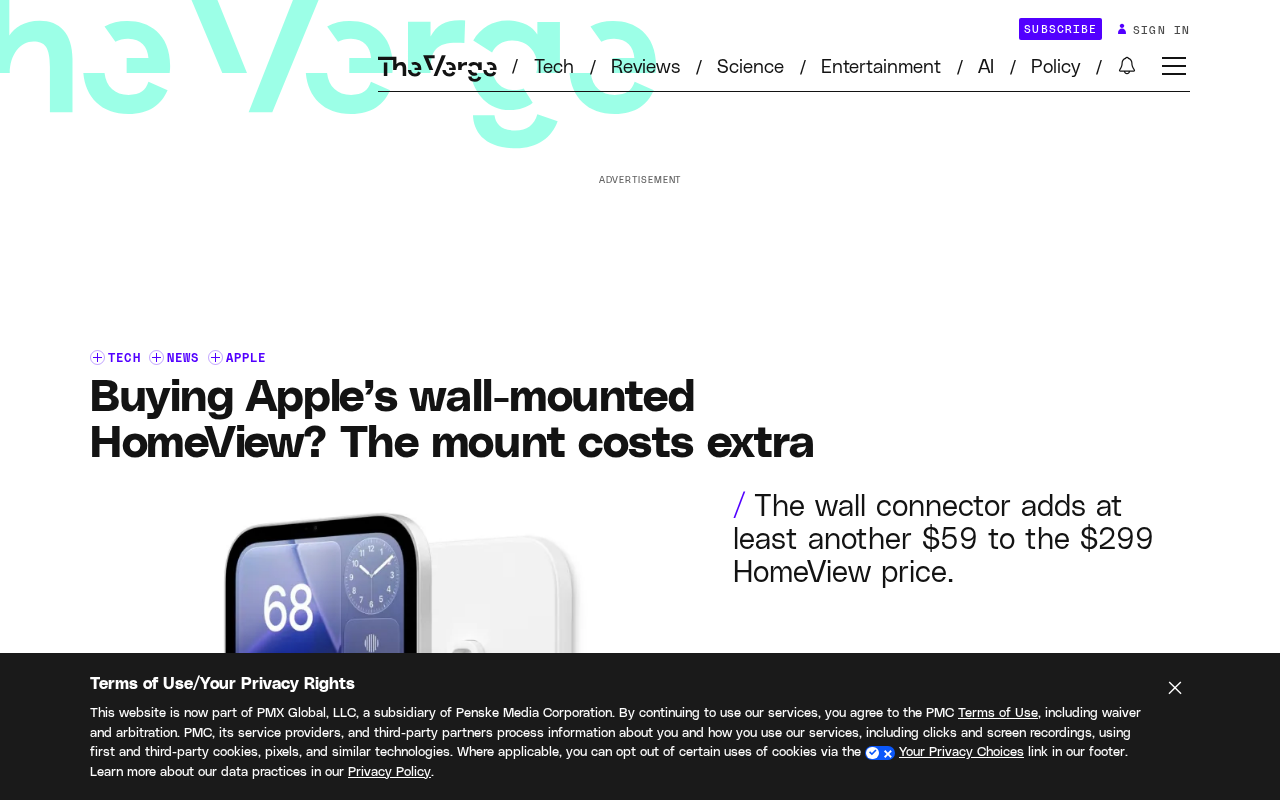
Two Models, One Price
HomeView's pricing strategy looks simple at first glance: no matter which form factor you choose, Apple charges $299. The version with the speaker base is suited for desktops or countertops, ready to use once plugged in. The wall-mounted version targets users who want to embed the screen into a wall, kitchen, or hallway.
The problem lies in the semantics of the word "wall-mounted." Apple named the $299 version "Wall Mounted," which easily leads people to assume it's ready to go up on the wall right out of the box. In reality, users still need to buy a dedicated mount to complete the installation, with a minimum additional cost of $59. This means the true starting price for a wall-mounted setup is $358 — a full 20% more than the speaker version.
This pricing approach isn't uncommon in the smart home industry. Many manufacturers sell installation accessories separately to keep the listed price low and boost accessory profit margins. But when the product name itself implies the installation method, consumer expectation management easily goes off the rails.
The Accessory Economy Strikes Again
Selling the mount separately is essentially standard practice in the accessory economy. Apple has always been aggressive on accessory pricing — from Magic Keyboards to various adapters, dedicated ecosystem accessories often command premium prices. The HomeView wall mount follows the same logic.
For Apple, this brings two direct benefits. First, the main device pricing can stay within the $299 psychological threshold, maintaining the impression of being "not expensive." Second, the mount, as a low-frequency but essential accessory, can contribute higher unit margins. For users who have already decided to mount the device on a wall, there's virtually no alternative — whether third-party mounts are compatible or might affect the warranty are risks that need weighing.
From the user's perspective, this extra expense may not be hard to bear, but the transparency of information is debatable. If Apple had more clearly noted on the launch event or product page that "wall mount sold separately," there would be far less controversy. The current phrasing feels more like burying key information in a secondary position.
Accessory economy (Razor-and-Blade Model) is a classic business pricing strategy: sell the main device (the razor handle) at near cost or even at a loss, and generate long-term profits by continuously selling high-margin disposable consumables or dedicated accessories (the blades). In consumer electronics, this model is widely applied — printer manufacturers make money on ink cartridges, game console makers profit from games and memberships, and Apple achieves similar logic through dedicated ecosystem accessories (Magic Keyboard, adapters, watch bands, etc.). The HomeView wall mount is a textbook example of this strategy: the main device pricing is pushed within the $299 psychological threshold, while the mount, as a low-frequency but essential accessory, serves to boost unit margins. There's nothing inherently right or wrong about this model — the key is whether manufacturers fully disclose the necessity of accessories before purchase. Otherwise, it's easy to slide from "smart pricing" into the controversy of "misleading consumers."
How Strong Is the Demand for Wall Mounting?
Where a smart display is placed determines its use case. On a kitchen countertop or bedside table, the speaker base version is clearly more convenient and doesn't require damaging walls. But the wall-mounted version has irreplaceable value: when cooking in the kitchen, a screen attached to the wall saves more space than sitting on the countertop, and the viewing angle is more natural; in a hallway or entryway, a wall-mounted unit can serve as a home information hub, displaying calendars, reminders, and smart home control panels.
The problem is that users willing to drill holes and run cables through walls are inherently a minority. These users are usually already prepared to pay installation costs, and a $59 mount may seem like just a small fraction of their overall budget. The ones truly caught off guard are consumers drawn in by the "Wall Mounted" name, assuming they could skip the extra steps.
In other words, the HomeView wall-mounted version's pricing structure filters users into two categories: one is the deep user who genuinely needs wall mounting and is price-insensitive; the other is the ordinary consumer who thought $299 would cover everything, only to discover hidden costs before checkout. The negative sentiment from the latter may offset the approachability Apple cultivated with the main device pricing.
Smart Display is a category of screen-equipped devices within the smart home ecosystem, typically integrating a voice assistant, touchscreen, speaker, and camera for information queries, video calls, smart home control, and more. Unlike tablets, it emphasizes "always-on" and "hands-free" interaction, so placement has a major impact on user experience. The three common form factors are: countertop versions with speaker bases, wall-mounted versions, and in-wall versions that can be embedded into walls. The core advantages of wall-mounted versions are saving countertop space, optimizing viewing angles, and serving as a fixed home information hub displaying calendars, reminders, and security feeds. But wall mounting also means drilling, running cables, and possibly wall modifications — installation barriers far higher than plug-and-play countertop versions, which is why its target users are relatively niche.
Is It Worth Buying?
If you just need a smart display on your countertop, the $299 speaker base version is the more straightforward choice, with no additional accessory expenses. If you clearly need wall mounting, your real budget should start at $358, plus installation tools and possible wall modification costs.
Apple's pricing strategy this time isn't necessarily wrong — selling accessories separately is a mature business practice. But placing the "mount sold separately" information more prominently in product naming and marketing pages would better maintain brand trust. For consumers, checking exactly what's included in the product list before ordering is always the most practical advice.
One-line Summary
Apple's HomeView wall-mounted version costs $299 for the device, but the dedicated mount requires at least $59 more, bringing the actual starting price to $358.
Paragraph Summary
Apple launched the HomeView smart home display, with both the speaker base and wall-mounted versions priced at $299, but the wall-mounted version requires an additional dedicated mount costing at least $59, bringing the actual wall-mount setup starting price to $358 — about 20% more than the speaker version. The article notes this is standard accessory economy practice, with Apple using it to keep the main device price low and boost accessory margins. But the "Wall Mounted" name implies it's ready to go up on the wall out of the box, easily creating a consumer expectation gap. For deep users who genuinely need wall mounting, the extra cost has limited impact; but for ordinary consumers drawn in by the name, insufficient information transparency could harm brand trust. The author suggests countertop users choose the speaker version directly, while wall-mount users should budget $358 or more.
Related articles

Felix Rieseberg Personal Homepage
Felix Rieseberg's personal homepage sparks attention on Hacker News. This article covers the Slack engineer's technical background, the rise and fall of nativefier, and the value of a developer homepage as a tech calling card.

@ai-sdk/vue 3.0.306 Patch Release Syncs with [email protected] Update
@ai-sdk/vue 3.0.306 released, synced with [email protected]. A routine patch release for the Vercel AI SDK ecosystem with no public API changes; the Vue adapter layer stays version-aligned with the core package.

Gemini 4 Argon API Launches: The Era of Million-Token Output Begins
Google launches Gemini 4 Argon with sparse MoE architecture, up to 1M output tokens, and a 68.90% Vals Index score, available across API, AI Studio, and the Gemini app.