Apple iMac Upgraded with M6 Chip: Performance Boost and $1,499 Starting Price

Apple quietly releases a new iMac with the M6 chip ahead of the Pro and Tell event, starting at $1,499.
Apple quietly listed a new iMac before its "Pro and Tell" event, featuring the same M6 custom chip as the Mac Mini, with the starting price maintained at $1,499. This update is a routine annual performance iteration with no changes to exterior or screen specs, mainly improving the all-in-one's computing and graphics performance headroom. Using the M6 in both the Mac Mini and iMac reflects Apple's unified chip supply strategy, helping reduce costs and making performance differences between product lines more transparent. The timing before a professional-grade event may be intended to分散 focus and free up exposure for products like the MacBook Pro. For consumers, the M6 iMac is the latest all-in-one option, but the exact performance gains still need to be confirmed by later reviews.
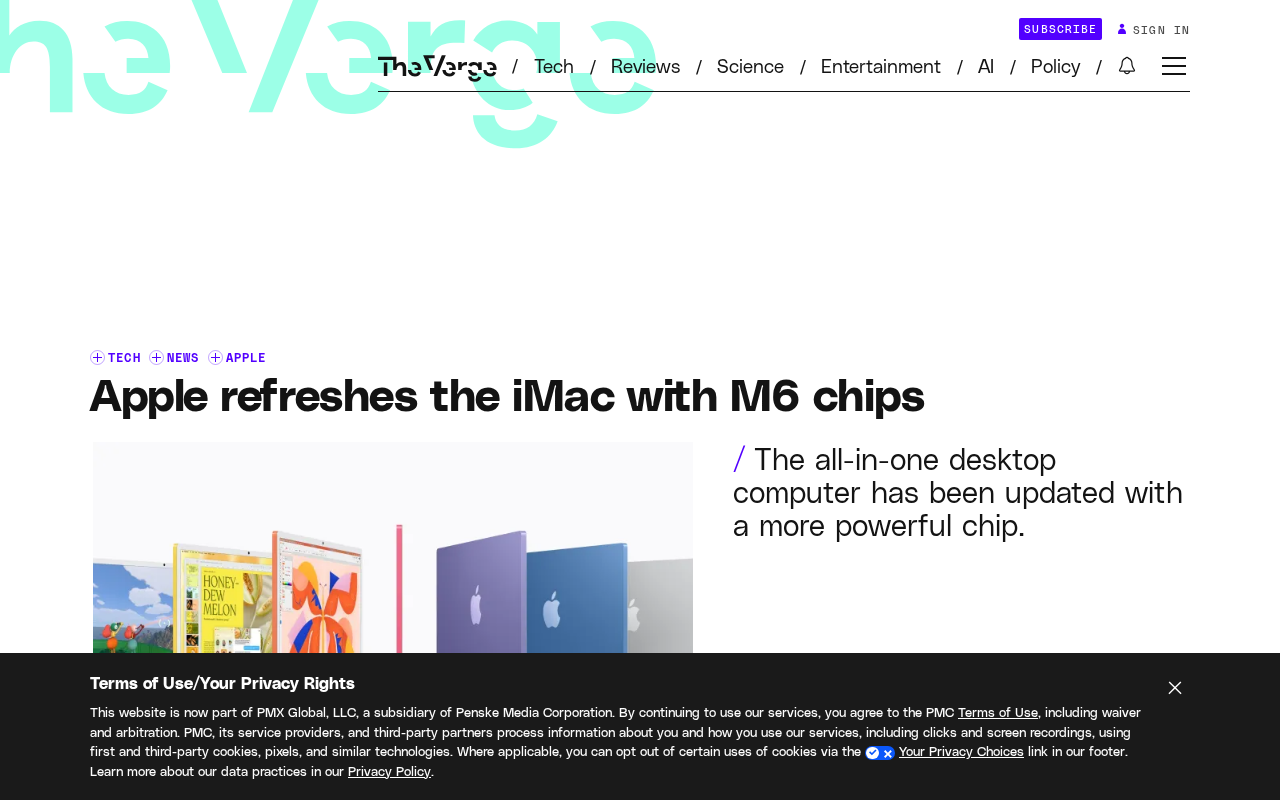
Apple has quietly updated its iMac lineup, equipping its all-in-one desktop with the M6 chip. According to RSS sources, the new iMac was released ahead of Apple's "Pro and Tell" event, featuring the same chipset as the Mac Mini and delivering a performance boost. The starting price is $1,499.
A Low-Key Chip Iteration
Apple didn't make a big splash with this iMac update, instead listing it directly before the "Pro and Tell" event. This approach is not uncommon in Apple's product line—when updates primarily involve internal chips rather than exterior design, Apple often releases them via press release. The M6 chip previously debuted on the Mac Mini, and now its arrival in the iMac means Apple's custom silicon coverage has expanded further.
From a product cadence perspective, the iMac's last major update was the transition to M-series chips, and this switch to M6 is a routine annual performance iteration. For users waiting for all-in-one performance improvements, this is a clear signal: the iMac product line is still being actively updated and hasn't been forgotten by Apple.
What the M6 Chip Brings
The M6 chip is the same as the one in the Mac Mini, which means the iMac will deliver computing performance close to that of the Mac Mini. Although the original source didn't disclose specific core counts, clock speeds, or benchmark data, it's reasonable to infer that the M6 offers improvements in power efficiency and graphics performance over its predecessor. For everyday office work, content creation, and light video editing, the iMac's performance headroom will be more ample.
Interestingly, Apple is using the M6 in both the Mac Mini and the iMac, reflecting a unified chip supply strategy. This helps reduce production costs and makes performance differences between product lines more transparent. When choosing, users can base their decision more purely on form factor and screen requirements rather than being troubled by chip generation gaps.
The M-series chips are custom ARM-architecture SoCs that Apple has been gradually using to replace Intel processors since 2020. They employ a Unified Memory Architecture that integrates the CPU, GPU, neural engine, and memory into a single package, reducing data transfer latency and improving power efficiency. The M6 is the sixth-generation product in this series, and following Apple's past iteration patterns, it typically features year-over-year optimizations in CPU/GPU core counts, process technology, and performance per watt. Because the M6 is the same as in the Mac Mini, the iMac benefits from sustained performance under desktop-class cooling conditions rather than the power-constrained version found in laptops—a point that is particularly critical for long rendering or compilation tasks.
Pricing and Market Positioning
The new iMac starts at $1,499, consistent with the current iMac's pricing range. This pricing strategy indicates that Apple intends to maintain the iMac's position in the premium all-in-one market while enhancing its competitiveness through the chip upgrade.
In the Windows all-in-one market, $1,499 falls in the mid-to-high-end price range. Apple's competitive advantages lie in the macOS ecosystem, color management, and integrated design. The addition of the M6 chip ensures the iMac doesn't fall behind competitors at the same price point in terms of performance. However, the original source didn't mention screen specifications, port changes, or accessory updates—these details may need to wait for subsequent reviews to confirm.
All-in-One refers to a desktop computer form factor that integrates the system unit, display, speakers, and camera into a single chassis. The iMac is the flagship product in this category, with main competitors including the Lenovo YOGA AIO, HP Envy AIO, and Microsoft Surface Studio. $1,499 roughly corresponds to the high-end consumer all-in-one price band in the U.S. market, but Apple's pricing typically doesn't directly benchmark against Windows competitors' hardware specifications—instead, it relies on the macOS ecosystem, Retina display color management, and software-hardware integration to justify the premium. Therefore, when evaluating the iMac's competitiveness, simply comparing CPU models or memory capacity can be misleading; the overall experience and ecosystem lock-in effects deserve more attention.
Timing Considerations for the Launch
Apple's choice to release the iMac before the "Pro and Tell" event may serve two purposes. First, to分散 the event's focus, allowing professional-grade products (such as the MacBook Pro or Mac Pro) to occupy more time during the event; second, to release entry-level product information in advance, avoiding competition with professional products for attention.
For consumers, the iMac update means clearer choices: if an all-in-one form factor is needed, the M6 iMac is the latest option available; if pursuing ultimate performance, they can look forward to the professional-grade chip products that may be announced at the "Pro and Tell" event.
"Pro and Tell" is Apple's naming convention for events aimed at professional users. These events typically focus on high-power, high-price professional-grade products such as the MacBook Pro, Mac Pro, and Mac Studio. Apple's customary strategy is to release products with different positioning in batches: professional-grade products are featured at events with keynote presentations to maximize exposure, while consumer products with routine spec upgrades are quietly listed via the official website's newsroom. This pacing arrangement avoids information overload at a single event and allows each product category to garner attention from its target audience—a product communication convention Apple has developed over the years.
Conclusion
Apple's switch to the M6 chip for the iMac is a pragmatic performance upgrade, with the $1,499 starting price maintaining the product's positioning. Although there's no information on exterior or screen innovations, the chip iteration is enough to keep the iMac attractive in the highly competitive all-in-one market. For macOS users, this is a routine update worth noting.
One-line Summary
Apple quietly releases a new iMac with the M6 chip ahead of the Pro and Tell event, starting at $1,499.
Paragraph Summary
Apple quietly listed a new iMac before its "Pro and Tell" event, featuring the same M6 custom chip as the Mac Mini, with the starting price maintained at $1,499. This update is a routine annual performance iteration, with no changes to exterior or screen specifications; its main significance lies in boosting the all-in-one's computing and graphics performance headroom. The analysis suggests that using the M6 in both the Mac Mini and iMac reflects Apple's unified chip supply strategy, helping reduce costs and making performance differences between product lines more transparent. The timing of the release before a professional-grade event may be intended to分散 focus and free up exposure for professional products like the MacBook Pro. For consumers, the M6 iMac is the latest all-in-one option available, but the exact magnitude of performance improvement still needs to be confirmed by subsequent reviews.
Related articles

How Did Da Vinci Prove the Sun Is Hot? A Neglected Chapter in Science History
How did da Vinci use a concave mirror experiment to overturn Aristotle's cold sun theory? This article traces this neglected chapter in science history, revealing the embryo of scientific thinking in the 15th century and da Vinci's cold observations on solar heat and the nature of life.

SharpLogic: Formalizing Bug Detection for LangGraph Routing Graphs with k-CNF
SharpLogic, an open-source project, maps LangGraph-style multi-agent routing and retry graphs to k-CNF, using a Rust kernel to count deadlocks and failing paths (#F counting), offering a Python AgentGuard hook and CLI for pre-release formal gate checks. This article analyzes its principles, its complementary relationship with evals, and the community's concern about modeling costs.

PPO Training of a Franka Robotic Arm for Pick-and-Place: A Reinforcement Learning Starter Project
A reinforcement learning project using PPO to train a Franka Panda robotic arm for pick-and-place in PyBullet, covering tech stack choices, task design challenges, and future text/voice command interaction plans—a good reference for beginners.