Apple Launches Touchscreen MacBook Pro, Starting at $2,899

Apple launches a touchscreen MacBook Pro starting at $2,899, bringing touch to the Mac lineup for the first time.
Apple has officially launched its new touchscreen MacBook Pro starting at $2,899, confirming earlier industry speculation that the Mac would adopt touchscreens. This release marks a substantive shift in Apple's long-held position that "the Mac doesn't need touch." Touch debuts on the high-end Pro series rather than as a standard feature across the lineup, continuing Apple's tiered product strategy and likely positioning touch as an efficiency tool for professional creative scenarios. The success of this product will depend on the depth of macOS touch adaptation and third-party professional applications' willingness to follow suit; if the software ecosystem cannot fully leverage touch input, the appeal of paying a premium for touch will be greatly diminished. Details such as screen specifications, touch technology type, and battery life impact have not yet been announced and await official documentation.
Apple has officially unveiled its new touchscreen MacBook Pro, with a starting price of $2,899. The news, sourced from an RSS feed, confirms earlier industry speculation: the Mac product line has finally embraced touchscreens.
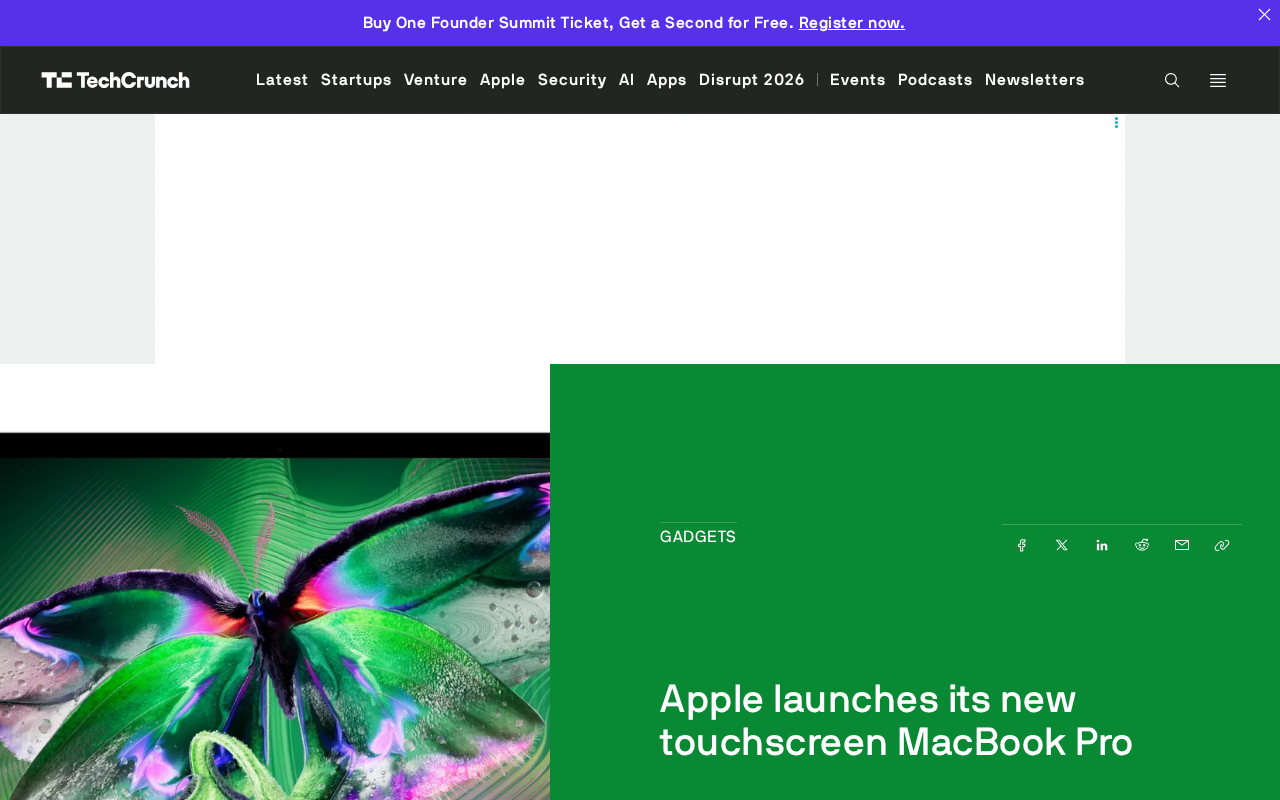
Touchscreen Mac Arrives: A Compromise or a New Starting Point for Apple
For a long time, Apple has taken a rather conservative stance on adding touchscreens to the Mac, with executives repeatedly stating publicly that touch is not the interaction direction for the Mac. The release of a touchscreen MacBook Pro marks a substantive shift in that position. From a product positioning standpoint, the $2,899 starting price continues the Pro series' premium pricing strategy, and touch functionality is likely to be framed as an efficiency tool for professional creative scenarios rather than a simple entertainment interaction.
For developers and creative professionals, a touchscreen combined with the macOS ecosystem could bring new workflows—for example, directly performing fine retouching, hand-drawing storyboards, or dragging timelines on the screen. However, whether macOS interface elements and interaction logic have been systematically adapted for touch remains unclear, as no further details are currently available.
macOS and iPadOS share the Darwin kernel and some frameworks at the底层 level, but their interaction models have long diverged: macOS is centered on pointers (mouse/trackpad), with interface sizing, click hit areas, and gesture systems all designed for indirect input; iPadOS, by contrast, natively targets direct manipulation with fingers and Apple Pencil. Apple has deliberately kept the two apart precisely to preserve the Mac's productivity positioning built on precise pointer operation, while letting the iPad handle touch and handwriting scenarios. To introduce touch on the Mac, the core issues that need to be addressed include: whether control hit areas are enlarged, how menus and right-click context are mapped, how cursor and finger operations can coexist without conflict, and whether support is reserved for Apple Pencil-style handwriting input. If these adaptations remain only at the system level without application-layer cooperation, touch could easily become a mere auxiliary input.
Pricing and Product Line Impact
The $2,899 starting price is higher than the typical price of the current entry-level MacBook Pro configuration. Whether this price difference corresponds to hardware upgrades beyond the touchscreen is not specified in the source material. What is certain is that Apple is launching touch as a Pro-tier feature rather than a standard across the entire lineup, consistent with its long-standing tiered product strategy.
For existing Mac users, whether it is worth paying a premium for touch depends on how quickly the actual software ecosystem follows suit. If mainstream professional applications cannot fully leverage touch input, the appeal of this feature will be greatly diminished.
2-in-1 devices typically refer to Windows machines that can switch between laptop and tablet forms via a flip hinge or detachable keyboard, with representative forms including Microsoft's Surface Pro series and various convertible thin-and-light laptops. These products rely on Windows' native support for touch and stylus, focusing on note-taking, drawing, and portable productivity. For years, the industry has repeatedly asked why Apple doesn't make similar products, and Apple's response has been to let the Mac and iPad each play their own role. The emergence of the touchscreen MacBook Pro means Apple is beginning to respond to this competition by "layering touch onto the traditional laptop form factor" rather than directly adopting a detachable 2-in-1 design—which also explains why touch first lands on the professional-oriented Pro series.
Market Reaction and Follow-up Observations
The release of the touchscreen MacBook Pro directly responds to years of competitive pressure from Windows 2-in-1 devices. Apple's choice to debut touch on the Pro series rather than the Air series indicates its desire to first validate demand among high-end professional users.
Points worth watching going forward include: the depth of macOS adaptation to touch operations, third-party applications' willingness to follow suit, and whether this feature will trickle down to lower-priced MacBook product lines. Currently, information on screen specifications, touch technology type, and battery life impact remains limited, and we await Apple's full technical documentation.
The mainstream technical approach to enabling touch on laptops is to overlay a touch-sensing layer (such as on-cell or in-cell structures) on an LCD or OLED panel, which increases panel thickness, cost, and power consumption, and may affect screen brightness and color accuracy. For the MacBook Pro, which sells itself on professional color work, maintaining P3 wide color gamut and high brightness specifications while adding a touch layer is an engineering challenge. In addition, touch sampling rate, palm-rejection algorithms (especially involving the palm rest area), and coordination with trackpad gestures will all affect the actual experience. These technical details are precisely the key basis for judging whether this product represents "feature stacking" or "interaction reconstruction."
One-line Summary
Apple launches a touchscreen MacBook Pro starting at $2,899, introducing touch to the Mac product line for the first time.
Paragraph Summary
Apple has officially launched its new touchscreen MacBook Pro starting at $2,899, confirming earlier industry speculation that the Mac would adopt touchscreens. This release marks a substantive shift in Apple's long-held position that "the Mac doesn't need touch." Touch debuts on the high-end Pro series rather than as a standard feature across the lineup, continuing Apple's tiered product strategy and likely positioning touch as an efficiency tool for professional creative scenarios. The article notes that the product's success will depend on the depth of macOS touch adaptation and third-party professional applications' willingness to follow suit; if the software ecosystem cannot fully leverage touch input, the appeal of paying a premium for touch will be greatly diminished. Details such as screen specifications, touch technology type, and battery life impact have not yet been announced and await official documentation.
Related articles

Fifty Years Studying Power: Robert Caro's Writing and Insights on Power
Robert Caro reflects on 50 years studying power: Lyndon Johnson's persuasion and leverage, Robert Moses's transformation from idealist to ruthless builder, the dilemmas of large-scale construction, and his methods of compressing themes and solitary focus in biography writing.

Can a $20,000 Robot Do Your Chores? The Test Results Are Surprising
A YouTube test video shows how a $20,000 robot responds to commands like washing dishes, turning off lights, taking out trash, and feeding the dog. This article analyzes its real capability boundaries, the state of voice interaction technology, and how far household robots are from mainstream adoption.
The Complete Guide to Running AI Models Locally: Inference Engines and Tool Stack Explained
A systematic breakdown of the complete local LLM tool stack: from PyTorch and GGML compute libraries to llama.cpp, vLLM, SGLang inference engines and Ollama, LM Studio wrapper layers, with benchmark data on performance differences and selection logic.