Apple Loses Haptic Patent Case: Jury Awards $5.7 Billion in Damages

A San Diego jury ruled Apple infringed Taction's haptic patents, awarding over $5.7 billion in damages.
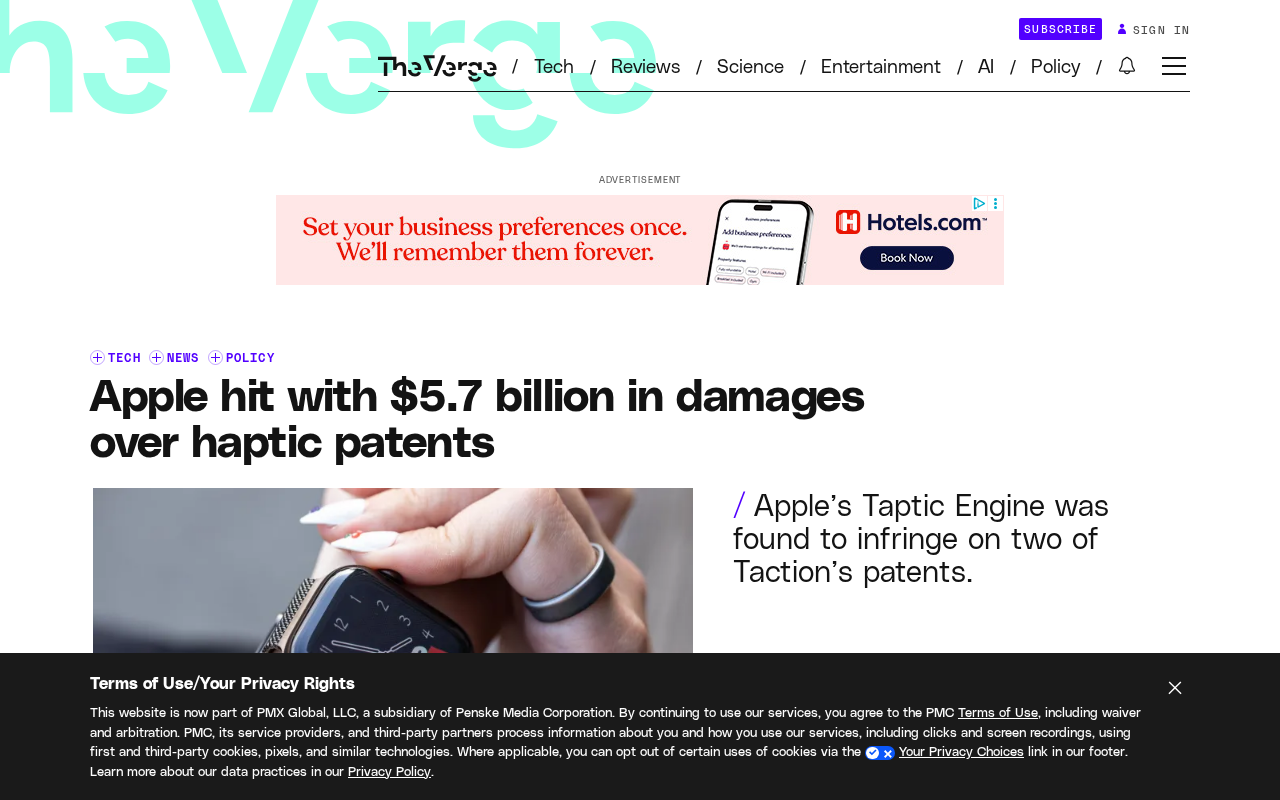
Haptic technology company Taction has won a landmark patent case against Apple: a San Diego federal jury found Apple infringed two U.S. patents (Nos. 10,659,885 and 10,820,117) covering vibration-based tactile transducer technology and awarded over $5.7 billion in damages. Haptic feedback is a core differentiator in Apple products, from the iPhone's Taptic Engine to Apple Watch vibration alerts. With the technology potentially embedded in hundreds of millions of devices, the damages base was dramatically amplified. However, large jury awards rarely mark the end of patent litigation, and Apple is widely expected to appeal.
A Multi-Year Patent Battle Comes to a Close
Haptic technology firm Taction sued Apple years ago, alleging infringement of two patents related to vibrotactile technology. Now, a federal jury in San Diego has ruled in Taction's favor, ordering Apple to pay more than $5.7 billion in damages. The figure ranks among the highest ever awarded in a patent infringement case, drawing widespread attention across the industry.
According to CNBC, the lawsuit centers on two U.S. patents — U.S. Patent Nos. 10,659,885 and 10,820,117 — both covering vibration-based tactile transducer technology that enables users to feel physical feedback when interacting with a device.
Why Haptic Technology Is Under the Spotlight
Haptic feedback has become a critical component of the modern smart device experience. From the Taptic Engine in the iPhone to the vibration alerts on Apple Watch, Apple has long positioned haptics as a key differentiator in its user experience. The subtle vibrations users feel when pressing the screen, receiving notifications, or interacting with virtual buttons all rely on precision tactile transducers and actuation technology.
The two patents Taction asserts focus on the implementation of vibration-based tactile transducers — technology capable of delivering physical feedback to users in a more precise, lifelike way. When foundational technologies of this kind become entangled in patent disputes, the potential damages scale dramatically because of the sheer volume of mass-market consumer electronics involved.
Apple's Taptic Engine is a proprietary Linear Resonant Actuator (LRA) that debuted in the Apple Watch in 2015, later appeared in the iPhone 6s with 3D Touch, and has since replaced traditional Eccentric Rotating Mass (ERM) motors across Apple's lineup. An LRA drives a mass back and forth at a specific frequency via an electromagnetic coil, responding far faster than an ERM and enabling fine-grained tactile sensations — simulating button clicks, page turns, dial rotations, and more. This pursuit of haptic precision is precisely what makes underlying actuation patents so commercially valuable: once a core implementation method is patent-protected and proven to be widely deployed in mass-produced devices, damages calculations scale linearly with unit shipments.
What a $5.7 Billion Award Actually Means
The more-than-$5.7-billion verdict reflects the jury's assessment of the scope of infringement and its commercial impact. Given that the haptic technology in question may be embedded in hundreds of millions of Apple devices, the damages base was substantially amplified. If the award ultimately stands, it would represent one of the most significant financial and legal burdens Apple has ever faced.
That said, a jury verdict is rarely the end of the road in cases like this. Awards of this magnitude almost always invite appellate proceedings, and Apple will very likely challenge the ruling — seeking either to overturn the verdict or to dramatically reduce the damages figure. The final outcome of patent litigation typically only becomes clear after a prolonged judicial back-and-forth.
In U.S. patent infringement cases, damages generally fall into two categories: reasonable royalty and lost profits. Juries typically apply the so-called "hypothetical negotiation" framework — estimating the royalty rate that the patent holder and the defendant would have agreed upon in a licensing negotiation before infringement occurred, then multiplying that rate by the number of infringing units sold. Apple ships more than 200 million iPhones per year, so even a per-device royalty estimate of just a few dollars, multiplied across hundreds of millions of units, can rapidly push total damages into the billions. On top of that, courts may award up to three times the jury-determined amount in cases where willful infringement is found — a mechanism that further elevates the likelihood of blockbuster verdicts.
What This Means for the Tech Industry
This case is yet another reminder of the enormous commercial value embedded in foundational hardware technology patents. For a company like Apple — which integrates a dense array of innovative features into a single device — patent risk in underlying technologies such as haptics, displays, and sensors is a permanent reality. The practice of smaller technology firms seeking returns through patent licensing or litigation has become a familiar feature of the competitive tech landscape.
For those following the consumer electronics space, this case is worth watching closely. It isn't just about a massive damages award — it could also influence how Apple designs and implements haptic feedback in its future products.
Related articles

Felix Rieseberg Personal Homepage
Felix Rieseberg's personal homepage sparks attention on Hacker News. This article covers the Slack engineer's technical background, the rise and fall of nativefier, and the value of a developer homepage as a tech calling card.

@ai-sdk/vue 3.0.306 Patch Release Syncs with [email protected] Update
@ai-sdk/vue 3.0.306 released, synced with [email protected]. A routine patch release for the Vercel AI SDK ecosystem with no public API changes; the Vue adapter layer stays version-aligned with the core package.

Gemini 4 Argon API Launches: The Era of Million-Token Output Begins
Google launches Gemini 4 Argon with sparse MoE architecture, up to 1M output tokens, and a 68.90% Vals Index score, available across API, AI Studio, and the Gemini app.