Apple MacBook Pro Upgraded with M6 Chip: Entry-Level Performance Evolves Again
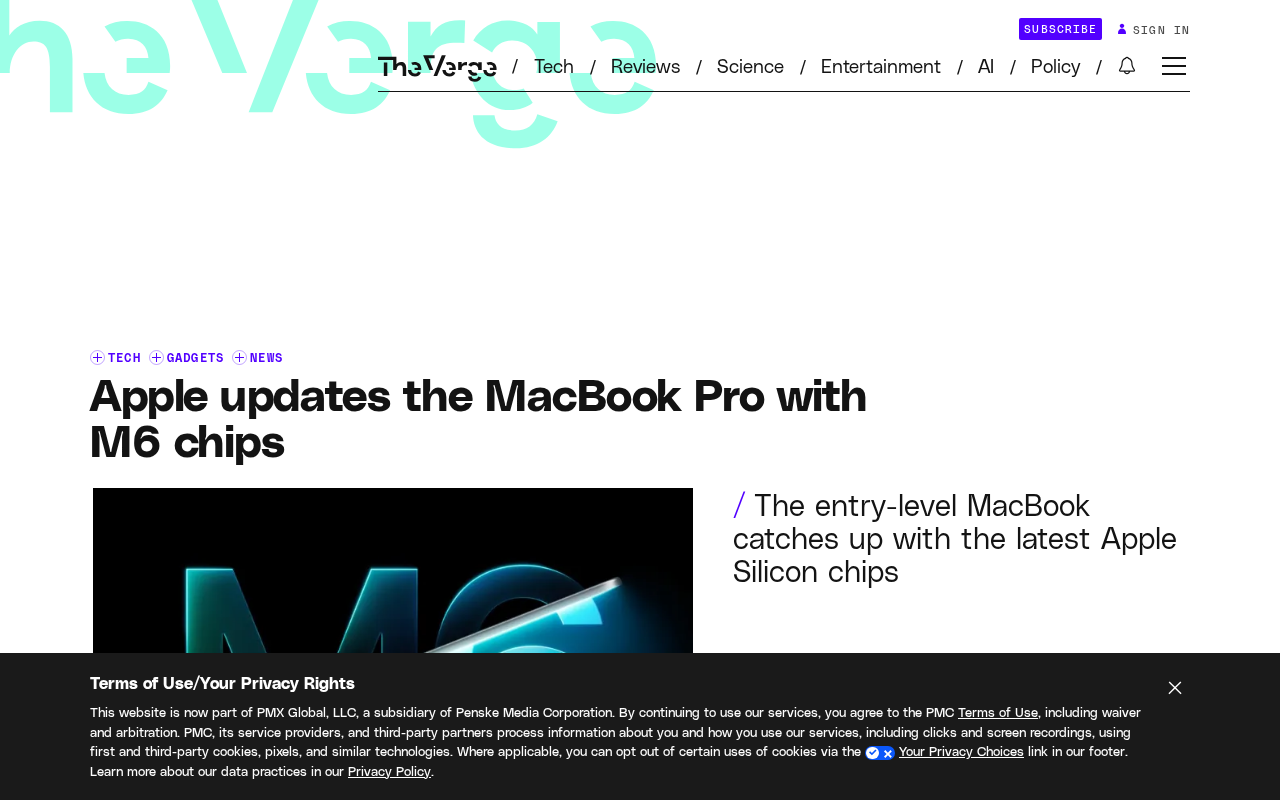
Apple's entry-level MacBook Pro gets a routine M6 chip upgrade, keeping pace with chip iterations while design stays unchanged.
Apple has given its entry-level MacBook Pro a routine update with the M6 chip, first released last August with the Mac Mini—just one year after the M5 version. The upgrade leaves the design unchanged, offering a "more for the same price" spec refresh. The M6 brings the laptop in sync with desktop products in core computing power, with performance ample for everyday tasks, content consumption, and light creative work. The entry-level MacBook Pro retains Pro-level ports and cooling but uses a standard M chip, targeting budget-conscious users who want a Pro experience. It's a good upgrade time for M1 or earlier users; M5 users have limited incentive. Apple hasn't announced pricing or availability, but pricing is expected to remain stable.
Apple has just given its entry-level MacBook Pro a routine update, equipping it with the M6 chip that was released last August alongside the new Mac Mini. This marks the second time in a year that Apple has refreshed the entry-level MacBook Pro with a "more for the same price" approach, following last year's M5 upgrade. Although the external design and display remain unchanged, the addition of the M6 chip brings this product in line with Apple's own chip iteration cadence in terms of performance.
The Origins of the M6 Chip
The M6 chip is not making its debut here—it first appeared in the Mac Mini product line updated last August. By bringing it down to the entry-level MacBook Pro, Apple ensures that this laptop maintains parity with desktop products in terms of core computing power.
Apple has not yet released specific performance comparison data for the M5-to-M6 upgrade, but based on Apple's historical chip iteration patterns, the M6 will deliver typical improvements in CPU and GPU performance and power efficiency. For everyday office work, content consumption, and light creative tasks, the performance reserves of this entry-level MacBook Pro are already more than sufficient.
Apple's M-series chips use a Unified Memory Architecture, integrating the CPU, GPU, neural engine, and other components onto a single SoC that shares the same high-bandwidth memory pool. This design eliminates the data copy overhead between CPU and GPU found in traditional PCs, significantly improving power efficiency and graphics processing efficiency. The standard M6 in the entry-level MacBook Pro—though not a Pro or Max variant—benefits equally from this architecture, with memory bandwidth and core counts sufficient for most everyday tasks. Understanding the Unified Memory Architecture helps grasp the internal logic of Apple's chip iterations: each generation of M chip upgrades not only in clock speed and core count but also in memory bandwidth, efficiency core scheduling, and coordinated optimization of dedicated accelerators (such as the media engine).
Product Positioning and Market Strategy
The entry-level MacBook Pro has always been a unique presence in Apple's laptop lineup. It retains Pro-level ports and thermal design but uses the standard M-series chip of the same generation as the MacBook Air, rather than Pro or Max versions. This positioning makes it the top choice for users on a budget who still need a Pro-level experience.
This update comes just one year after the previous M5 version, marking a clear acceleration in Apple's refresh cadence. Behind this is the steady progress of Apple's custom silicon roadmap—the expansion of the M6 chip from the Mac Mini to the MacBook Pro indicates that production capacity and yield rates have reached the requirements for large-scale distribution.
Notably, the update method for this entry-level MacBook Pro is very "Apple-like": no keynote, no teasers, just a direct spec update on the official website. This low-key approach also aligns with the product line's positioning as a "routine iteration."
Apple's custom silicon roadmap follows a "one update per year" cadence, but there is a time lag in how chips are deployed across different product lines. Typically, new M-series chips debut first in volume products like the MacBook Air or Mac Mini, then gradually expand to the MacBook Pro and iPad Pro. This strategy ensures stable capacity ramp-up and extends the chip's lifecycle. The entry-level MacBook Pro uses standard M chips rather than Pro/Max versions to create performance differentiation from high-end MacBook Pros while maintaining the appeal of Pro-level chassis and ports. The rapid transition from M5 to M6 reflects Apple's full confidence in supply chain yield rates and capacity, and also means that the development cycle of standard M chips is now highly coupled with the product release cadence.
Should Users Upgrade?
For users still on M1 or earlier models, the M6 entry-level MacBook Pro offers a generational performance leap and is a suitable time to upgrade. For M5 users, the actual experience difference from this update may be limited unless you have an extreme pursuit of chip performance.
Apple has not yet announced the specific price or release date for the M6 version, but as usual, the pricing strategy for the entry-level MacBook Pro is expected to remain stable. For users who need a reliable Mac laptop with a full set of ports, this product remains a solid choice.
Summary
Apple's M6 chip update to the entry-level MacBook Pro is a typical "spec upgrade" operation. It brings no surprises in appearance or features but ensures the product does not fall behind Apple's own chip cadence in terms of performance. Against the backdrop of Apple's custom silicon rolling out across the board, this annual update rhythm also reflects Apple's consistent requirements for the performance baseline of the Mac product line. For consumers, the addition of the M6 chip further solidifies the value proposition of the entry-level MacBook Pro.
Related articles

How Did Da Vinci Prove the Sun Is Hot? A Neglected Chapter in Science History
How did da Vinci use a concave mirror experiment to overturn Aristotle's cold sun theory? This article traces this neglected chapter in science history, revealing the embryo of scientific thinking in the 15th century and da Vinci's cold observations on solar heat and the nature of life.

SharpLogic: Formalizing Bug Detection for LangGraph Routing Graphs with k-CNF
SharpLogic, an open-source project, maps LangGraph-style multi-agent routing and retry graphs to k-CNF, using a Rust kernel to count deadlocks and failing paths (#F counting), offering a Python AgentGuard hook and CLI for pre-release formal gate checks. This article analyzes its principles, its complementary relationship with evals, and the community's concern about modeling costs.

PPO Training of a Franka Robotic Arm for Pick-and-Place: A Reinforcement Learning Starter Project
A reinforcement learning project using PPO to train a Franka Panda robotic arm for pick-and-place in PyBullet, covering tech stack choices, task design challenges, and future text/voice command interaction plans—a good reference for beginners.