Apple May Launch a Screen-Free Fitness Tracker to Rival Whoop and Challenge Wearable Norms

Apple is reportedly developing a Whoop-like screen-free fitness tracker, though it remains in early development.
Bloomberg reports Apple is developing a screen-free fitness tracker featuring a thin fabric wristband with a built-in sensor module, closely resembling the form factor of professional fitness wearable brand Whoop. If launched, the device would be differentiated from the Apple Watch by focusing exclusively on continuous health data collection, with longer battery life and lighter all-day wear. Still in early development and unlikely to launch soon, the move reflects a broader industry shift from all-in-one wearables toward specialized health devices — and would pose direct competitive pressure on players like Whoop and Oura.
According to Bloomberg, Apple is developing a new screen-free fitness tracking device with a form factor strikingly similar to that of popular fitness wearable brand Whoop. If true, this signals that Apple may be exploring an entirely new health monitoring product line beyond the Apple Watch.
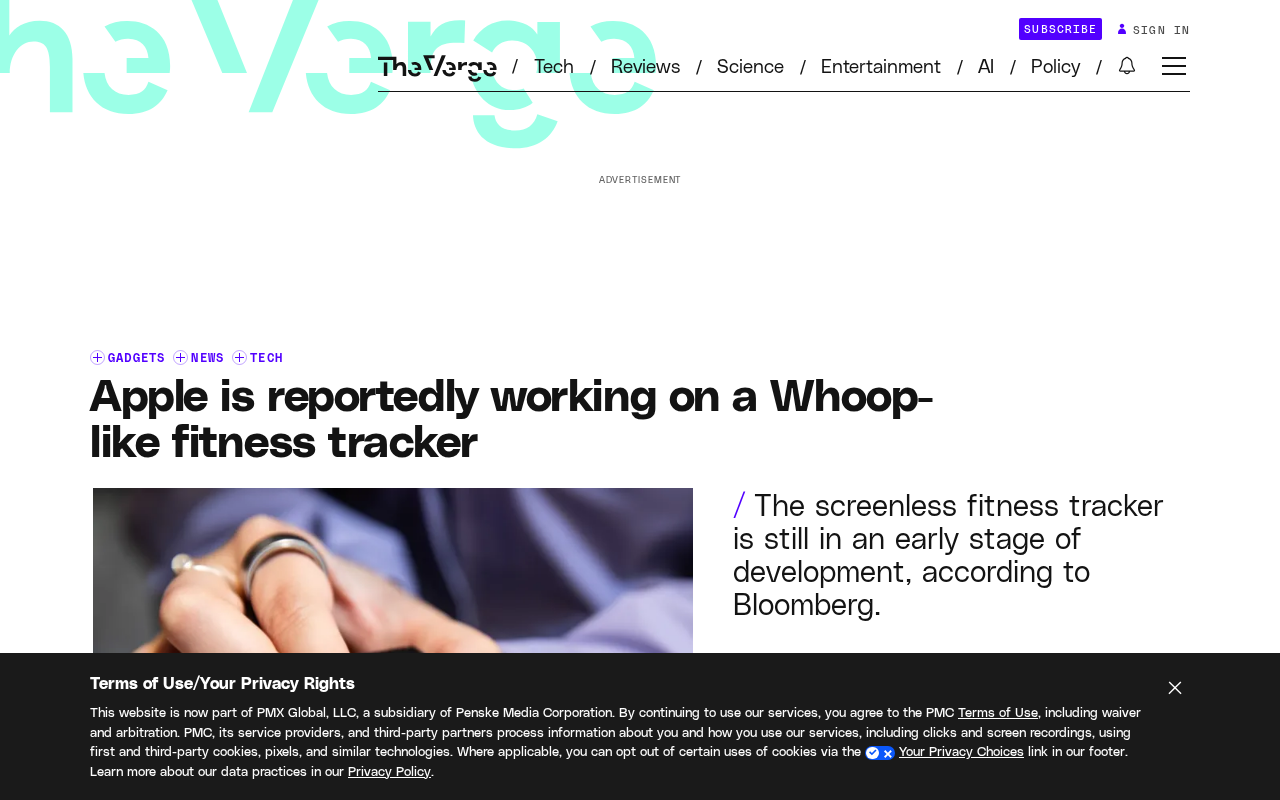
Screen-Free Design: A Different Vision for Wearables
According to the report, the device prototype features "a thin fabric wristband paired with a computational module housing built-in sensors." This design stands in sharp contrast to mainstream smartwatches — with no display, there's no burden of frequent charging or constant interaction.
This is precisely the philosophy that earned Whoop its loyal following among fitness and athletic communities. It doesn't show the time or push notifications; instead, it focuses on continuously capturing physiological data such as heart rate, sleep, recovery, and strain, presenting in-depth analysis through a companion app. The core value of these products lies in their "invisible presence": wearers barely notice the device, yet gain round-the-clock insight into their physical state.
For Apple to enter this form factor is essentially an acknowledgment that a single "smartwatch" cannot meet every user's health monitoring needs. For those who find the Apple Watch overly complex, or who don't want to be distracted by a screen, a device dedicated purely to data collection may be far more appealing.
Whoop operates on a subscription-based business model, where users pay monthly or annually to access data analytics, while the hardware itself is provided free or at low cost. This model differs sharply from Apple's traditional hardware premium strategy, and it reflects an emerging business paradigm in health wearables: "hardware as the gateway, data as the service." The Oura Ring — a smart ring focused on sleep tracking — employs a similar strategy, further validating this trend. Should Apple enter the screen-free tracker space, how it prices the device and whether it bundles the service with Apple One or a Health+ style subscription will be critical variables in determining market acceptance.
Differentiated Positioning Against the Apple Watch
It's worth considering why Apple would explore a screen-free category when it already has the well-established Apple Watch product line.
At its core, the Apple Watch is a miniaturized, multi-function device akin to a smartphone on your wrist — health monitoring is just one of many features. A screen-free tracker, by contrast, could lead with a single-point value proposition: "dedicated health focus." The two target distinctly different users: the former serves a broad market seeking comprehensive functionality, while the latter targets the more vertical segments of sports, fitness, and health quantification enthusiasts.
From a product logic standpoint, a screen-free design also enables longer battery life, lighter weight, and a more comfortable all-day wearing experience — precisely the qualities that keep users loyal to dedicated devices like Whoop. Apple possesses mature sensor technology and a robust health data ecosystem (HealthKit). If those capabilities are channeled into a lightweight hardware form, the competitive potential is considerable.
HealthKit is Apple's health data aggregation platform, launched with iOS 8 in 2014, which allows third-party apps to store fitness, sleep, heart rate, blood glucose, and other data in a unified repository and share it with user authorization. After a decade of development, HealthKit has become the data hub of Apple's health ecosystem, connecting Apple Watch, blood pressure monitors, glucose meters, and other external hardware. If a new screen-free tracker were deeply integrated with HealthKit, the continuous physiological data it collects would seamlessly merge with a user's existing health records — an ecosystem advantage that independent platforms like Whoop and Oura would find difficult to replicate.
Still Early Stage — Not Coming Anytime Soon
It's important to temper expectations: this device is still in early development. The report explicitly states that the product is "unlikely to launch in the near term."
Apple has many hardware projects in internal development, and a significant number never reach the market. The existence of an early prototype only indicates that Apple is exploring this direction — it does not mean the product has entered mass production or is counting down to a launch. Consumers should therefore avoid setting unrealistic expectations around a specific release timeline.
That said, the signal this development sends is worth noting: the wearable health market is bifurcating from "broad and comprehensive" toward "focused and specialized," and even a giant like Apple is reconsidering the boundaries of product form. If Apple ultimately launches such a device, it would likely further disrupt an already competitive health wearable market and apply direct pressure on specialist players like Whoop and Oura.
What This Means for the Wearable Market
Every time Apple enters a category, it tends to reshape the landscape. The launch of the Apple Watch accelerated mainstream adoption of smartwatches. If this screen-free tracker becomes a reality, it could push "health data focus" — currently a niche need — into the mainstream.
For users, more diverse product form factors mean choices that better fit individual needs. For the industry, it signals that wearable devices no longer have just one answer: the "watch." Screen-free, lightweight, long battery life, deep data analysis — these are becoming the defining keywords for the next phase of health hardware competition.
Of course, everything hinges on whether Apple can turn a prototype into a polished product, and whether it's willing to cede some of the Apple Watch's market space for this new line. Until then, this report is best read as an intriguing footnote about the direction things may be heading.
Related articles

Kimi K3.1 Hands-On Test: Open-Source Model Nears Opus, Video Generation Steals the Show
Kimi K3.1 completed motion graphics, 3D rendering, mini-games, and video generation in a live test. Analysis of its 2.8T MoE architecture, gap vs Opus/GPT, and hidden video generation.

Sam Altman: Why Life's Biggest Advice Should Still Come from Humans
OpenAI CEO Sam Altman on the limits of AI advice: AI can talk you out of an impulsive email, but life's biggest advice should still come from humans.

"Black October": Did AI Uncover 3% of All Critical Vulnerabilities Ever?
A Reddit post claims 3% of all critical software vulnerabilities ever were found in the past month, dubbed 'Black October.' We break down the statistical issues, how AI-assisted code auditing accelerates discovery, and how developers should respond.