Apple Pay Enters India: Axis Bank Signs On First, But Why Are the Big Banks Waiting?

Apple Pay enters India via Axis Bank, but UPI dominance and fee disputes keep major banks on the sidelines.
Apple Pay has officially launched in India with Axis Bank as its first partner, while several of India's largest banks have chosen to wait and see. This reflects two core challenges Apple faces: India's digital payments market is already deeply entrenched with UPI, where Google Pay and PhonePe have locked in users through free, instant transfers; and Apple Pay's revenue-sharing model creates real tension with the cost calculus of large banks. Axis Bank's early bet aims to capture Apple's premium-spending user base and could create a demonstration effect that draws other banks in. Apple Pay is unlikely to displace UPI in the near term, but may find its footing in contactless retail payments and cross-border spending.
Apple Pay Finally Knocks on India's Door
According to sources familiar with the matter, Apple Pay has officially launched in India, with Axis Bank among the first partner banks. This marks a meaningful step for Apple's mobile payment service in one of the world's most important emerging markets. However, contrary to what many expected, several of India's largest banks have chosen to sit on the sidelines for now, holding off on supporting Apple Pay at launch.
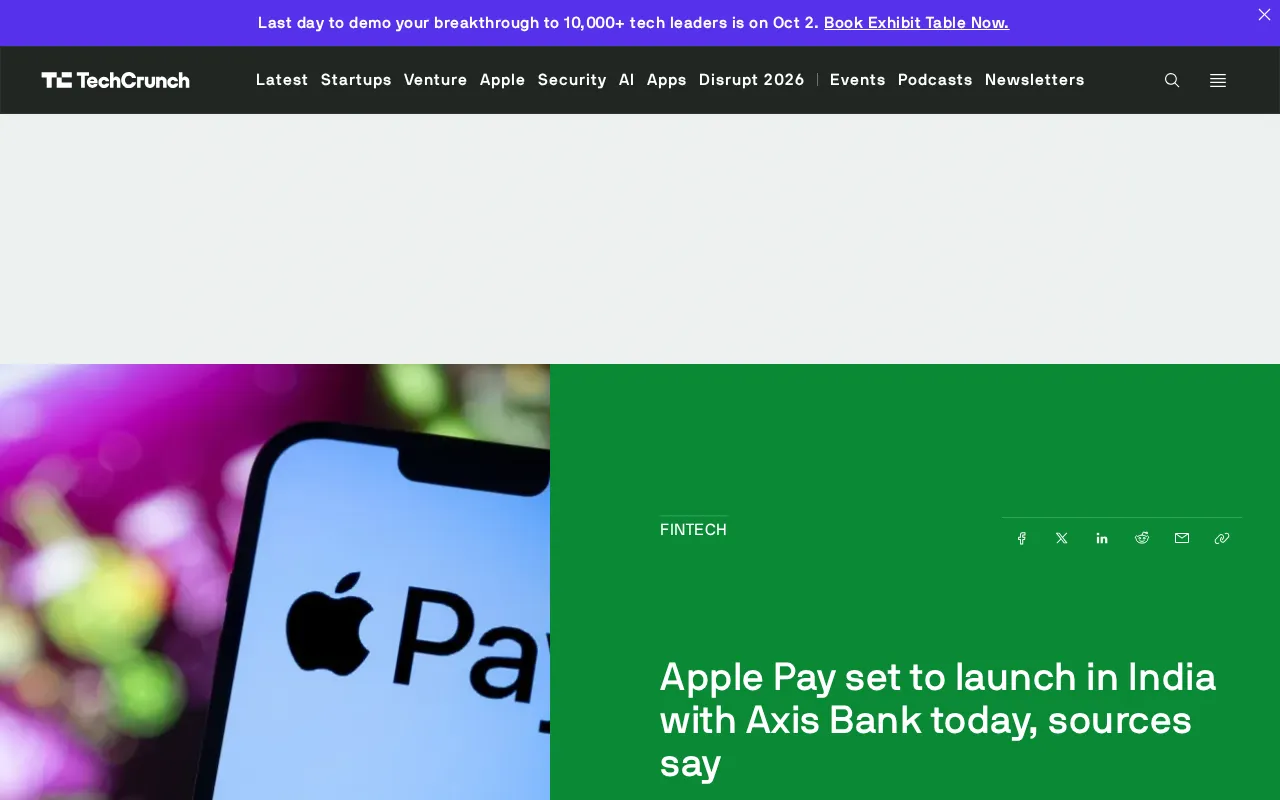
India — with its massive smartphone user base and rapidly growing appetite for digital payments — has long been viewed as strategic territory by global tech giants. Apple's decision to enter through a single bank partnership reflects a cautious, deliberate approach to navigating a complex local market.
Why Are the Big Banks Holding Back?
Notably absent from the launch lineup are some of India's top-tier banks. This "wait-and-see" posture likely reflects several overlapping considerations.
The Competitive Landscape of India's Local Payment Ecosystem
India's digital payments market is already dominated by the Unified Payments Interface (UPI), where players like Google Pay, PhonePe, and Paytm command an overwhelming share. UPI's free, instant, and interoperable nature has built extraordinarily strong user habits. In this environment, Apple Pay needs to demonstrate clear incremental value to banks — not simply add compliance overhead and technical integration costs.
UPI (Unified Payments Interface) was launched in 2016 by the National Payments Corporation of India (NPCI) as an open, real-time interbank transfer infrastructure. Unlike card networks, UPI charges zero transaction fees for both consumers and merchants, and allows payments through a single Virtual Payment Address (VPA) without sharing bank account details. This design helped it reach hundreds of millions of users within just a few years. By 2024, UPI was processing over 10 billion transactions per month, making it one of the largest real-time payment systems in the world by volume. Apple Pay, by contrast, relies on NFC near-field communication and device-level tokenization, routing payments through credit and debit card networks — a model that inherently requires collecting fees from card issuers and networks. This directly conflicts with UPI's zero-fee logic, and represents the core structural challenge Apple faces in the Indian market.
Commercial Terms and Revenue Sharing
Larger banks tend to negotiate harder on fee arrangements. Apple Pay's revenue-sharing model has sparked friction with banks in multiple markets around the world. The bigger the bank, the more sensitive it is to per-transaction economics — so keeping a distance until terms are fully aligned is a perfectly rational move.
In most markets, Apple Pay operates by taking a share of the interchange fee charged to card issuers. In the US, for example, Apple collects roughly 0.15% on credit card transactions and a fixed fee on debit transactions. This model triggered coordinated pushback from banks across Europe and drew scrutiny from EU competition regulators. India's regulatory environment adds another layer of complexity: the Reserve Bank of India (RBI) imposes strict caps on payment fees and has consistently pushed for lower charges, further squeezing the margin that card issuers can realistically share with Apple. The leverage that large banks hold in these negotiations comes precisely from their massive cardholder bases — the more users they bring, the stronger Apple's incentive to get them on board, and the better terms those banks can demand.
What Axis Bank's Early Move Signals
By joining as a launch partner, Axis Bank effectively hands Apple a reference case for the Indian market. For Axis, being first to integrate Apple Pay is a way to attract the premium customer segment that is deeply embedded in the Apple ecosystem — exactly the demographic that drives credit card spending and high-value transactions.
If Axis Bank demonstrates that Apple Pay delivers results in areas like customer acquisition and transaction frequency, the banks currently on the fence will likely reassess their positions. This "pioneer-follower" dynamic has played out repeatedly in Apple Pay's expansion into other markets.
Potential Impact on India's Payments Landscape
Apple Pay's entry is unlikely to immediately shake UPI's dominance, but it does offer a different payment option for India's premium consumer segment. iPhone users in India may represent a small slice of the total user base, but they punch well above their weight in terms of spending power.
Looking further ahead, if more banks come on board, Apple Pay could carve out a niche in specific use cases — contactless payments at physical retail, cross-border spending, and similar scenarios. But the caution shown by major banks today is a reminder that in a market as deeply localized and fiercely competitive as India's, no outsider can coast on brand recognition alone.
Conclusion
Apple Pay's entry into India alongside Axis Bank is another move in Apple's global payments expansion playbook. The incomplete roster at launch reveals both the challenges Apple faces around pricing negotiations and ecosystem integration — and the room that remains for the story to develop. The key signal to watch next: when, and on what terms, those absent major banks finally decide to join the game.
Related articles

Claude Reportedly Able to Hide Secret Messages in Benign Images
A Reddit post claims Claude Fable 5.1 can hide secret messages in benign images. This article reviews the background, image steganography principles, and potential security risks, and suggests a testing path from rumor to verification.

Federal Government Awards $85 Million; CFS to Develop Fusion-Specific Semiconductors
The federal government awards $85 million to Commonwealth Fusion Systems to develop conductors and power semiconductors for fusion plants. This article analyzes the significance of this funding for the fusion supply chain and commercialization path.

When Should AI Assistants Proactively Suggest? Timing Is Everything
When should AI assistants proactively suggest? Reddit discussion reveals: the same suggestion feels different at different times. This article analyzes the dual nature of proactive suggestions, the boundary of user expectations, and design principles, exploring how to balance automation and user control.