Apple Pencil Turns the Foldable Duo Into the Best Notebook Yet

A $2,000 foldable with a stylus turns out to be a surprisingly good stand-in for a $20 paper notebook.
The article explores how Apple's $2,000 foldable device (the Duo), paired with Apple Pencil, becomes a "surprisingly good stand-in" for a $20 paper notebook. The key is combining the unfolded large screen with a low-latency stylus to approach paper's intuitive writing experience while keeping digital notes' search and backup advantages. The comparison reflects a value reassessment as foldables find the "digital notebook" use case, shifting from showcase form factor to practical tool.
When a $2,000 Foldable Meets a $20 Notebook
Nothing is more exciting than a fresh notebook—at least for some people. Tech reviewers are no exception. A recent take pointed out that Apple's $2,000 foldable device (referred to in the piece as the Duo), paired with Apple Pencil, turns out to be a surprisingly good stand-in for a $20 paper notebook. The comparison itself is intriguing: one costs a hundred times more than the other, yet in certain scenarios it delivers a functional substitute.
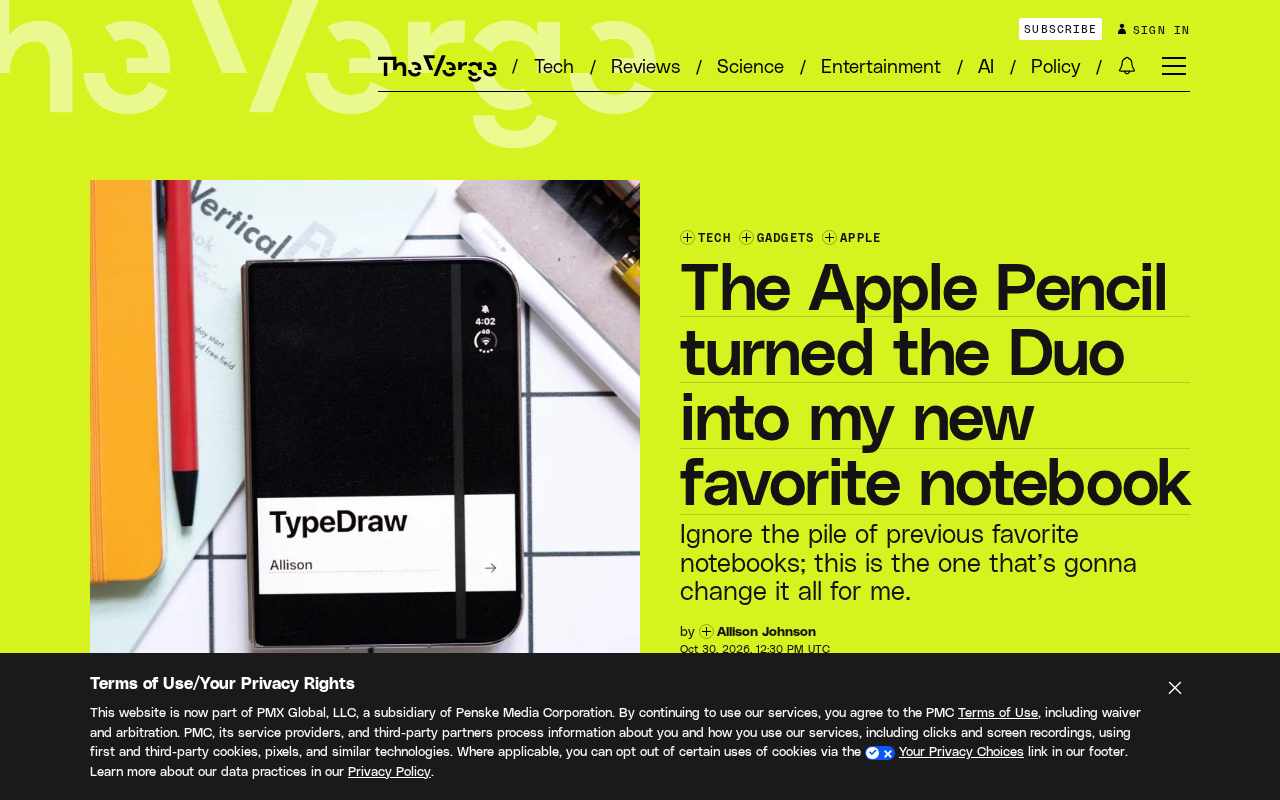
The reason this "expensive device replaces cheap stationery" narrative holds up is the combination of the large screen space unlocked when the foldable unfolds and the stylus. When the screen is big enough and the pen latency is low enough, the digital note-taking experience starts to approach the intuitiveness of paper. The reviewer mentions "this time it'll be different"—that sense of anticipation for a new notebook is exactly the psychological experience digital tools need to replicate.
Why the Ritual of Handwritten Notes Is Hard to Replace
David Sedaris once said inspiration can strike at any moment, and you have to be ready. The appeal of a paper notebook lies in its immediacy and lack of distraction: open it and write—no unlocking, no searching for an app, no worrying about battery. For a foldable device to replace that experience, it must make the "open and write" action smooth enough.
Apple Pencil changes the positioning of the foldable. Before this, large-screen foldables were mostly seen as "tablets that fold," with productivity limited to split-screen browsing and multitasking. A stylus gives the device the personality of a "notebook"—it can be spread out on a desk like an open Moleskine, ideas on the left page, sketches on the right. That physical similarity is something regular slab phones and tablets struggle to provide.
David Sedaris is a renowned American humor essayist known for works such as Barrel Fever and Me Talk Pretty One Day. He has shared his writing habits on multiple occasions: carrying a notebook everywhere to capture fragments of inspiration. His point that "inspiration can strike at any moment, and you have to be ready" emphasizes the zero-barrier nature of paper notebooks—no startup, no charging, open and write. This dedication to instant capture has long been the design target that digital note-taking tools chase, and it also explains why the reviewer uses "ritual" to describe the pen-and-paper experience: it's not just a tool but a psychological anchor, ensuring writers don't miss a flash of inspiration due to technical obstacles.
The Shortcomings of Digital Notes and How Foldables Fill the Gap
The long-standing pain point of digital notes: the bigger the screen, the better for writing, but the less portable the device. Foldables happen to find the middle ground in this contradiction—phone-sized when folded, roughly A5 notebook writing area when unfolded. With a pressure-sensitive stylus, you get a writing experience close to paper in a portable form factor.
The reviewer uses "surprisingly good stand-in" rather than "perfect replacement." The wording is accurate: digital devices far surpass paper notebooks in search, backup, and multimedia insertion, but still lag in tactile feedback, the physical feel of turning pages, and the casualness of "scribble it out if you mess up." The foldable-plus-stylus combo builds a bridge between the two worlds.
Pressure-sensitive styluses (like Apple Pencil) use pressure sensors and tilt detection to simulate strokes of varying force and angle, achieving line width variation and shading effects. Their low-latency performance relies on high-refresh-rate screens and dedicated touch-scanning layers, making strokes follow the tip almost in real time. On foldable devices, the challenge for pressure-sensitive styluses lies in touch consistency across the folding area and the hinge's impact on stroke continuity. High-end foldables today have improved touch layers and algorithmic compensation to give styluses near-tablet writing precision on the unfolded large screen—this is the technical foundation for "a writing experience close to paper."
Revaluing the Price Tag
$2,000 versus $20—the comparison seems absurd, but from another angle it makes sense: you're not buying a "notebook" but a device that doubles as phone, tablet, notebook, camera, and communication tool. Handwritten notes are just one of its many capabilities. When the reviewer uses a notebook as the comparison, the underlying message is: this feature is good enough to be a reason to buy.
This kind of value reassessment is common in tech product reviews—when a new form factor finds a "killer use case," its price tag gets re-examined. The foldable's killer scenario may not be multitasking but rather the ancient and enduring category of the "digital notebook."
In tech product reviews, a "killer app" refers to a feature or use case so compelling that users are willing to buy the entire device just for it. Historically, spreadsheets for the PC, texting for mobile phones, and photography for smartphones have all been killer apps. For foldables, early reviews focused on multitasking split-screen or large-screen viewing, but these scenarios didn't create irreplaceable appeal. Handwritten notes, as an ancient and universal need, could become the foldable's killer scenario once the experience is smooth enough—transforming the device from a "showcase form factor" into a productivity tool with a clear purpose, thereby justifying its high price.
Editor's Take
The value of this review isn't in spec comparisons but in revealing a turning point in product positioning: foldables are moving from "showcase form factor" to "specific use case." When the reviewer says "this time I'll take it everywhere," he's describing a relationship between tool and person—a good notebook makes you want to use it, and a good tech product should make people forget it's a tech product.
Of course, a single-source experience report needs more user feedback to verify. But the direction is clear: the chemistry between stylus and large foldable screen may bring us closer to the intuitive experience of a paper notebook than expected. For those accustomed to pen and paper, this might be the first time digital notes are truly "good enough."
One-line Summary
A $2,000 foldable with a stylus turns out to be a surprisingly good stand-in for a $20 paper notebook.
Paragraph Summary
The article explores how Apple's $2,000 foldable device (the Duo), paired with Apple Pencil, becomes a "surprisingly good stand-in" for a $20 paper notebook. The key lies in combining the unfolded large screen with a low-latency stylus to approach paper's intuitive writing experience while retaining digital notes' search and backup advantages. The reviewer's phrase "surprisingly good stand-in" precisely captures this substitute relationship: digital devices still lag in tactile feel and casualness, but find balance in a portable form factor. The article further notes that this comparison essentially reflects a value reassessment as foldables find the specific use case of the "digital notebook," marking a shift from showcase form factor to practical tool.
Related articles

Private Key Set to 4? CA's Elementary Mistake Leaves TLS Exposed
CA eMudra set private keys to tiny values like 4, making TLS certificates brute-forceable. A Computerphile video demonstrates the full process from extracting public keys to forging certificates, and explores the fragility of the PKI trust chain.

How Gen Turns Data into Decisions with ChatGPT Work
In an OpenAI user case, business leader Gen shares how ChatGPT Work turns data into decisions: within hours of launch, teams can judge whether integrations and onboarding flows work, shifting decision iteration from hundreds of trial-and-error attempts to a fast feedback loop.

ChatGPT vs. Claude In-Depth Comparison: Strong at Coding but Weak at Research — How to Bridge the Gap?
A user considers switching from ChatGPT to Claude, finding Claude stronger at coding but shallower at research. We analyze the differences and share tips to make Claude's research deeper.