Apple Retail Pioneer Ron Johnson: AI Shopping Can't Match the Value of People

Apple retail pioneer Ron Johnson warns AI shopping overlooks human connection as retail's core competitive edge.
Ron Johnson, the creator of the Apple Store and Genius Bar, raises a systematic challenge to Silicon Valley's AI shopping wave. His core argument: Apple's real secret weapon was never technology but employees who build genuine emotional connections with customers. Johnson doesn't reject AI in retail outright — he urges the industry to let AI handle repetitive tasks while freeing humans to deliver meaningful service, rather than stripping people from the retail experience entirely in the name of frictionless shopping.
A Retail Legend's Sober Take on AI Shopping
Ron Johnson, the legendary figure who built the Apple Store, is throwing cold water on Silicon Valley's big bet on AI-powered shopping. In his view, the true "secret weapon" behind Apple's retail success was never a technological gimmick — it was always people: the store employees who genuinely cared about customers and could offer expert advice alongside a real human connection.
This perspective carries weight precisely because Johnson is no outside observer. As the architect of Apple's retail system, he personally designed the store model that reshaped global retail, including the groundbreaking Genius Bar concept. When someone with such deep insight into the essence of retail raises doubts about AI shopping, it carries far more gravity than typical tech commentary.
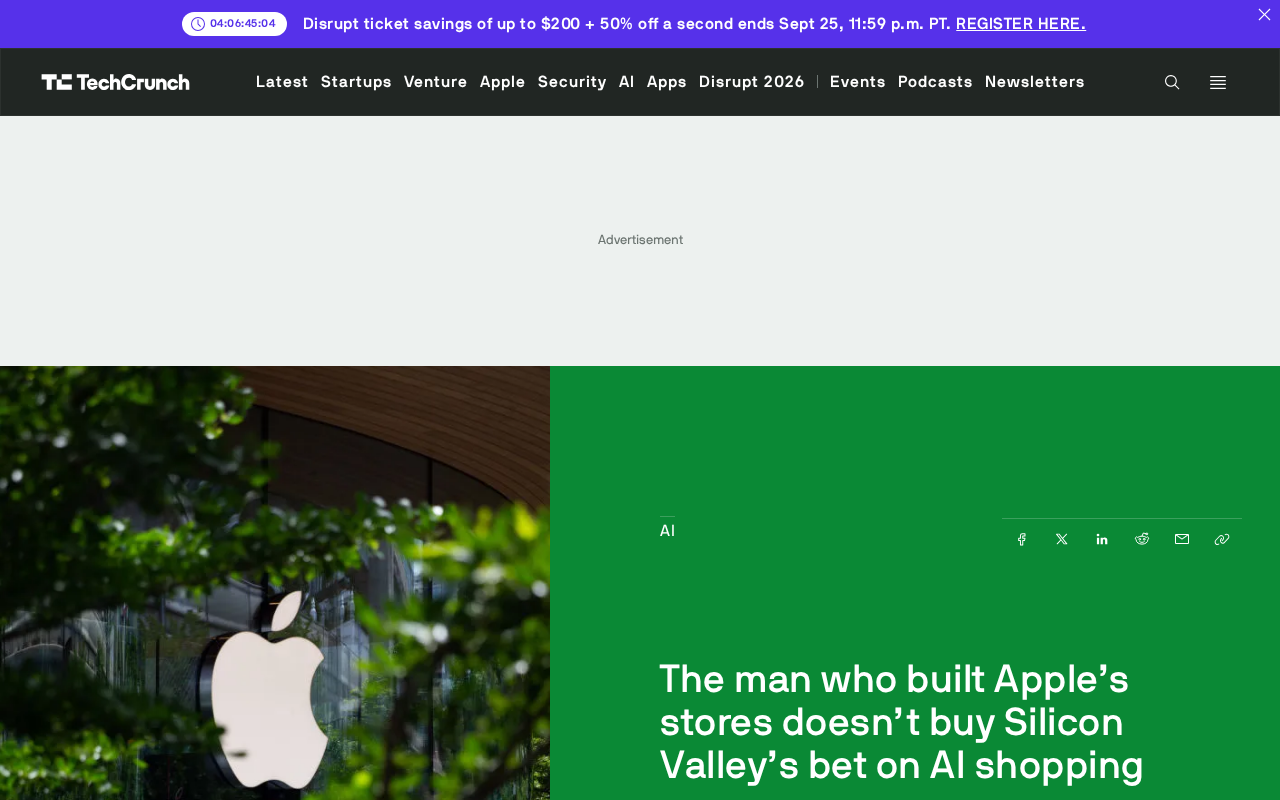
The Real "Secret Weapon" Behind Apple Retail: People
Johnson's core argument is as simple as it is powerful: Apple's success was never built on automation or algorithms — it was built on human connection. Walk into any Apple Store, and customers experience more than a product display. They feel the proactive assistance, patient explanations, and that sense of being genuinely served.
This people-first retail philosophy is precisely what Silicon Valley's current AI shopping narrative tends to overlook. While tech companies paint a vision of "frictionless shopping" — where AI agents automatically curate, compare, and purchase on your behalf — Johnson reminds us that the most valuable moments in a retail experience are often the deeply human interactions that no algorithm can replicate.
The Logic Behind the Genius Bar
Take Apple's Genius Bar as a case in point. Its value isn't just in fixing devices — it's in building trust. Customers arrive with problems and leave with solutions and goodwill. The patience, empathy, and professional judgment woven into that process form the very foundation of Apple's brand loyalty. This kind of deep service experience is exactly what pure AI solutions struggle to replicate in the near term.
The Genius Bar was born in 2001 alongside the first Apple Stores, conceived jointly by Johnson and Steve Jobs. Its design drew inspiration from the concierge desk at a luxury hotel — a space where customers could sit down and receive dedicated, face-to-face service, rather than standing at a traditional checkout counter or customer service window. The Genius Bar fundamentally changed the after-sales logic for consumer electronics: it redefined "repair" as "relationship maintenance," turning technical support into an extension of the brand experience rather than a post-sale burden. Many retailers have since tried to copy the model, but few have achieved the same results — because the hardware design is easy to replicate, while the ongoing culture of nurturing employees who truly care about customers is extraordinarily difficult to clone.
What Questions Does Silicon Valley's AI Shopping Bet Face?
Silicon Valley broadly believes AI will reshape e-commerce and retail, with AI assistants becoming the new gateway between consumers and products. From personalized recommendations to conversational shopping guides to fully automated purchasing agents, capital is flooding into this space.
Yet Johnson's skepticism highlights a critical blind spot: technical efficiency and emotional value are not the same thing. AI may be able to optimize transaction flows and boost conversion rates, but can it deliver the kind of experience that makes customers want to keep coming back to an Apple Store? In his view, placing the core bet in retail on AI may be a fundamental misreading of what retail is really about.
This disagreement is essentially a collision between two business philosophies — one that believes technology will ultimately solve everything, and another that insists certain human values are irreplaceable.
AI Shopping Agents are currently one of Silicon Valley's hottest investment categories. They refer to AI systems capable of understanding user needs, autonomously searching for products, comparing prices, and completing purchases. OpenAI, Perplexity, Google, and others have already launched or announced related products. The underlying logic is straightforward: since large language models can understand natural language instructions, consumers can replace manual browsing with conversational commands, letting AI handle information retrieval and decision support. Proponents argue this will dramatically reduce shopping "friction" and improve conversion efficiency. But critics — including Johnson — point out that for many product categories, "friction" isn't purely a negative experience. The process of selecting, comparing, and trying things out is often part of the satisfaction of buying something, and this dimension is almost entirely absent from current AI shopping solutions.
Implications for the Industry
Johnson's perspective offers a necessary counterbalance to the AI shopping frenzy. It's not a wholesale rejection of AI's role in retail — it's a reminder that technology should serve the human experience, not replace it.
For retail brands, the real opportunity may lie in letting AI handle repetitive, low-value tasks (like inventory lookups and order processing), thereby freeing employees to deliver warmer, more meaningful service. This "human-AI collaboration" approach may align better with retail's long-term value than full-scale AI automation.
For tech companies, Johnson's warning is worth taking seriously: in chasing the grand vision of AI shopping, don't overlook the subtle human factors that actually make customers happy. After all, the Apple model that changed global retail was never powered by the most advanced technology — it was powered by the people who understood customers best.
Related articles

Workbuddy for Absolute Beginners: How a Desktop AI Agent Fits Into Real Workflows
A beginner's guide to the Workbuddy desktop AI agent: installation, claiming credits, file management, and building automated workflows—compared with CodeX for fit and cost, helping professionals shift from AI question-askers to AI managers.

OpenAI's New Agent Stack: Computer Use, Decisions API, and Ultra-Fast Workflows
OpenAI Dev Day unveiled a new agent stack: Computer Use outperforms humans, Decisions API delivers ultra-low-latency classification via Luna, Agents API opens the same Computer Use capabilities, and GPT-6.1 Sol costs only one-seventh of Astra. Core updates, benchmark data, and developer insights.

Liang Wenfeng Open-Sources DeepInfo Inference Framework, Takes On U.S. Ban
DeepSeek open-sources its DeepInfo inference framework after its models, featuring GPU/CPU cross-pipelining, small-model prediction with large-model verification, and full Huawei Ascend and NVIDIA chip support—facing the U.S. federal ban head-on. This article analyzes its significance for AI deployment and open-source strategy.