Apple's First Foldable iPhone Duo Opens for Pre-order at $1,999

Apple launches its first foldable iPhone Duo with horizontal inward folding, starting at $1,999.
Apple officially launched its first foldable phone, the iPhone Duo, at the "Surprise and shine" event alongside the iPhone 18 Pro, Apple Watch Series 12, and Ultra 4, starting at $1,999 with pre-orders now open. It features a horizontal inward-folding design with a 5.4-inch outer screen and a larger display when unfolded. The article highlights three key concerns: whether the outer screen is sufficient, dual-form-factor app adaptation quality, and the high price barrier.
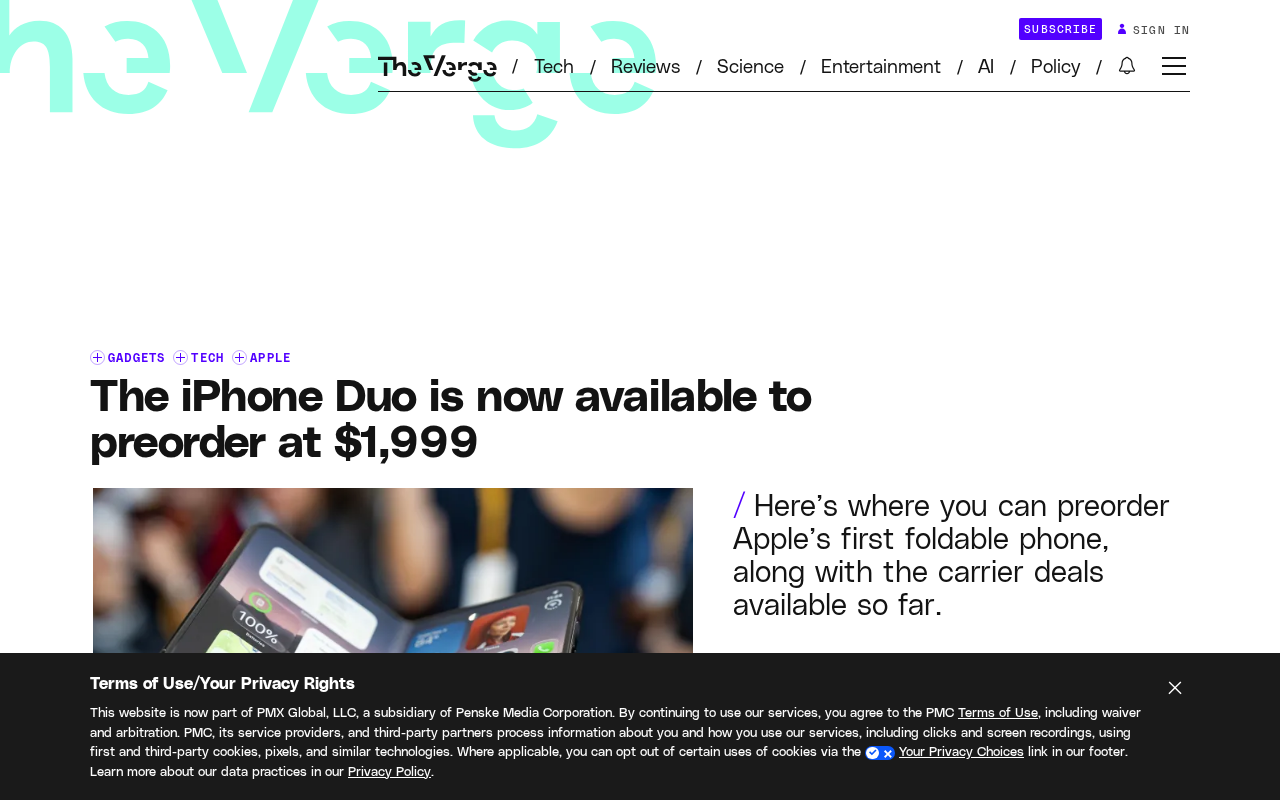
Apple has finally entered the foldable race. At its "Surprise and shine" event, Apple officially unveiled its first foldable phone, the iPhone Duo, sharing the stage with the iPhone 18 Pro, Apple Watch Series 12, and Ultra 4. The device is now available for pre-order, starting at $1,999.
A long-awaited foldable iPhone
Rumors of a foldable iPhone have circulated for years, and interest has never waned. Based on current information, the iPhone Duo uses a horizontal inward-folding design: a 5.4-inch screen on the outside, and a larger display area when unfolded. Apple's decision to enter the market now suggests it believes the hinge, screen durability, and software adaptation of foldables have reached a standard suitable for mass production and a deliverable experience.
The $1,999 price tag also makes its positioning clear — this is an ultra-premium product, not a volume driver. It targets users willing to pay for an "iPhone + big screen" two-in-one form factor, as well as loyal users who have long waited for Apple to deliver a folding solution.
Horizontal inward folding is one of the most mainstream form factors for foldable phones today, referring to a design where the screen folds along the horizontal direction and tucks inward when folded. The alternatives are vertical inward folding (like the Samsung Galaxy Z Flip series) and outward folding. The advantage of horizontal inward folding is that when unfolded, it delivers a large-screen ratio close to a tablet, ideal for split-screen multitasking and media consumption; the trade-off is a thicker body when folded, plus the need for a separate outer screen to handle everyday light tasks. The core challenge lies in the hinge — it must maintain screen flatness and consistent damping after hundreds of thousands of open-and-close cycles, while also balancing water and dust resistance. Apple's long absence from the market is widely believed to stem from waiting for hinge durability, UTG (ultra-thin flexible glass) yields, and system-level large-screen adaptation to mature simultaneously.
Launch cadence and product lineup
The iPhone Duo didn't appear alone, but launched alongside the iPhone 18 Pro, Apple Watch Series 12, and Apple Watch Ultra 4. This combination reveals Apple's long-standing strategy: use mature product lines to hold the base, and use new form factors to generate buzz and incremental growth.
For Apple, foldables are a product line it must fill. The Android camp has iterated through multiple generations of foldables, and Apple's late entry means it needs to deliver a more mature hinge solution and more complete ecosystem adaptation to convince users in the high-end market to spend nearly two thousand dollars.
A few issues worth watching
Is a 5.4-inch outer screen enough? This size is close to the discontinued iPhone mini series — friendly for one-handed use — but whether the daily information-feed browsing experience satisfies users still needs real-device verification.
How is app adaptation? The core experience of a foldable depends largely on app layouts in the large-screen state. Whether Apple can push developers to adapt well to both form factors will directly determine whether this product is "an iPhone that can fold" or "a genuinely good foldable device."
The price barrier. A starting price of $1,999 means it's outside the mass-consumption range. Whether the market accepts this price depends on whether Apple can clearly demonstrate the unique value the foldable form factor brings.
App adaptation for foldables is far more complex than for regular phones, because it requires the same app to remain usable in both folded and unfolded states. The common approach in the Android camp is to leverage system-level split-screen, flex mode, and adaptive layout capabilities, letting developers complete adaptation at relatively low cost; Apple's ecosystem adaptation typically relies on SwiftUI's adaptive layouts, Size Classes, and multi-window experience accumulated on iPadOS. The real test is third-party apps: if food delivery, social, and video apps simply stretch their interfaces, the large screen will instead look empty or have broken layouts. So the floor of the foldable experience is set by the system, while the ceiling is set by the developer ecosystem.
Who should consider this product
If you've long used the iPhone ecosystem and want to reduce the number of devices you carry, the "phone + small tablet" combination offered by the iPhone Duo has some appeal. But if you care more about thinness, battery life, or value for money, first-generation foldables usually warrant waiting one or two generations before deciding.
Pre-orders are already open. Given the scarcity of Apple's first foldable, first-batch supply and real-world experience feedback will be the two most noteworthy signals.
One-line Summary
Apple unveils its first foldable phone, the iPhone Duo, with a horizontal inward-folding design, starting at $1,999 and positioned as ultra-premium.
Paragraph Summary
At its "Surprise and shine" event, Apple officially launched its first foldable phone, the iPhone Duo, alongside the iPhone 18 Pro, Apple Watch Series 12, and Ultra 4. It starts at $1,999 and pre-orders are now open. The iPhone Duo features a horizontal inward-folding design with a 5.4-inch outer screen and a larger display area when unfolded, with grip dimensions close to the discontinued iPhone mini series. The $1,999 price tag confirms its ultra-premium positioning, targeting users willing to pay for an "iPhone + big screen" two-in-one form factor. The article notes that Apple entered later than the Android camp and needs to deliver a more mature answer on hinge solutions and ecosystem adaptation; whether the outer screen is sufficient, the quality of dual-form-factor app adaptation, and the price barrier are the three issues most worth watching before buying.
Related articles

Chain of Thought Isn't Just for AI: How Humans Can Use CoT to Improve Thinking Quality
Chain of Thought isn't just a prompt trick for large models. Starting from a Hacker News discussion, this article analyzes why CoT works for human thinking too, breaks down actionable ways to transfer it, and highlights the key differences between human CoT and machine CoT.
Cloudflare Teams Up with OpenAI: Closi…
Cloudflare Teams Up with OpenAI: Closing the Loop from Vulnerability Discovery to Defense with AI
Cloudflare uses OpenAI Daybreak to investigate security vulnerabilities and generate reviewable remediation plans, while developers use Codex to boost coding efficiency and quality.

Orca Multi-Agent Orchestration in Practice: A Guide to Parallel Collaboration with Claude and Codex
Orca is Stable AI's free open-source agent workbench supporting 34 agents like Claude Code and Codex in parallel. Learn its Git worktree isolation, multi-model orchestration, and mobile management.