Apple's HomeView Takes Another Shot at Smart Homes: Facing Off Against Echo Show and Nest Hub

Apple launches smart display home hub HomeView, targeting Echo Show and Nest Hub, with ecosystem and privacy as key differentiators.
Apple has finally launched its smart display home device HomeView, directly targeting Amazon Echo Show and Google Nest Hub. The article analyzes why Apple is entering now and examines HomeView's potential competitiveness through ecosystem integration and privacy protection. The competitive focus of smart homes is shifting toward the home automation hub role, and HomeView faces a pricing paradox that will determine its commercial success.
Title
Apple's HomeView Takes Another Shot at Smart Homes: Facing Off Against Echo Show and Nest Hub
Meta Description
Apple launches HomeView to enter the smart display market, directly targeting Amazon Echo Show and Google Nest Hub. This article analyzes Apple's competitive strategy, ecosystem advantages, and core challenges.
Article Content
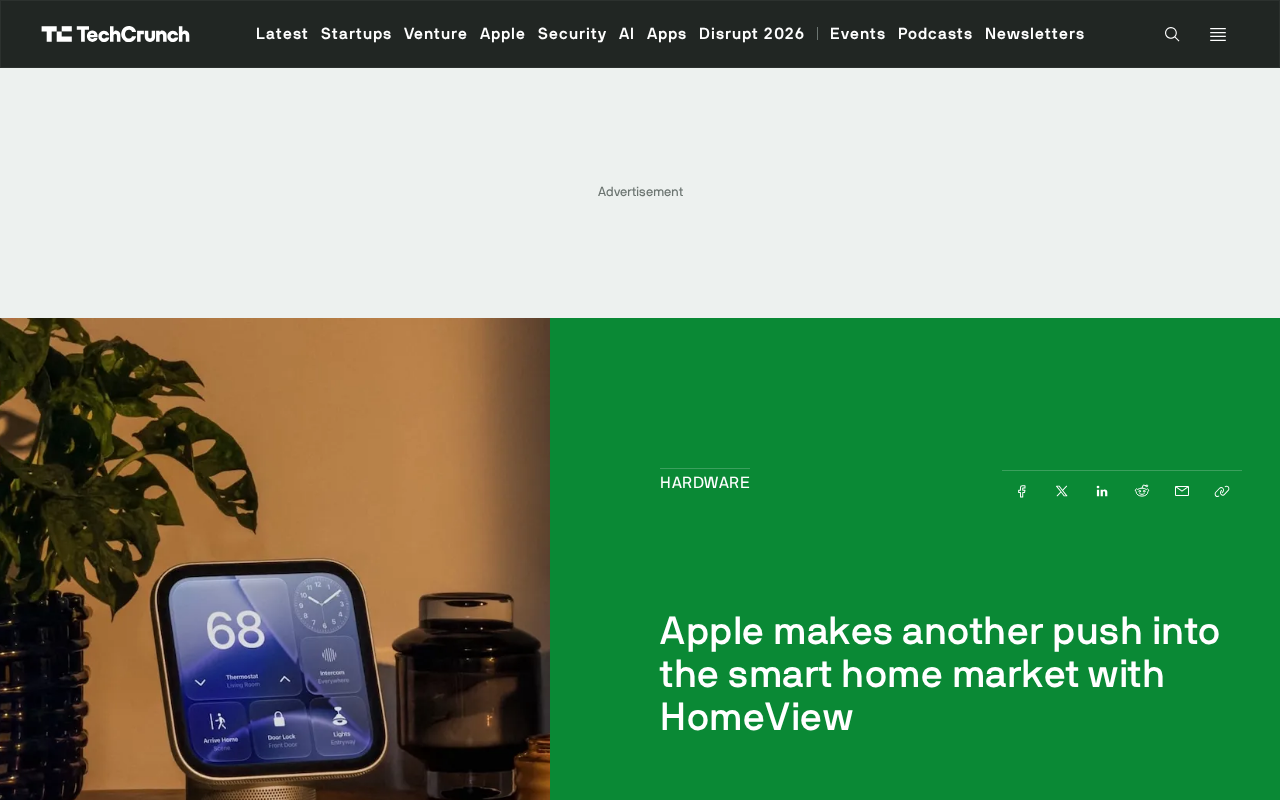
In the smart home hub race, Apple has long been missing a true "smart display" product. Years after Amazon Echo Show and Google Nest Hub established themselves on kitchen counters and nightstands, Apple has finally offered its response — HomeView.
Why Apple Is Making Its Move Now
Apple's presence in the smart home space is far from absent. The HomeKit ecosystem, the HomePod speaker lineup, and the home hub functionality on tvOS all demonstrate that Apple has been participating in this market. But on one thing, Apple has consistently lagged behind its competitors: a desktop device that combines a screen, voice assistant, and home control in one.
The user value of Echo Show and Nest Hub lies in being an "always-at-hand information panel + voice interaction terminal." Glance at a recipe while cooking, check the weather and traffic before heading out, turn off all the lights before bed. This use case has been validated by a large number of users, and Apple previously could only rely on the iPad to marginally cover it — but the iPad's positioning and price point were clearly not designed for the kitchen counter.
According to RSS feed reports, HomeView is precisely Apple's direct response to this gap, explicitly targeting Amazon Echo Show and Google Nest Hub.
The relationship between HomeKit and Matter is key background for understanding Apple's smart home strategy. HomeKit is the smart home framework Apple launched in 2014. Third-party manufacturers must obtain MFI certification to integrate, which ensures device quality but also raises the barrier to entry, causing the number of HomeKit-supported devices to lag behind Amazon Alexa and Google Home for a long time. In 2022, Apple joined forces with Amazon, Google, and Samsung to launch the Matter standard, aiming to enable cross-platform interoperability of smart home devices across different ecosystems. This means HomeKit devices can now be controlled by Alexa and Google Assistant simultaneously, and vice versa. For Apple, Matter is both an opportunity and a challenge: it reduces the stickiness of users being locked into an ecosystem, but it also gives HomeView an opportunity to build a new moat through the role of "hub" rather than "exclusive device."
The product logic of smart displays deserves separate explanation. Echo Show and Nest Hub are essentially not "speakers with screens" but "always-on home information terminals." Their typical use cases include: viewing recipes and timers in the kitchen, video calls in the living room, alarms and sleep monitoring in the bedroom, and checking doorbell cameras at the entryway. The core metric for these devices is not sound quality or processor performance, but "at-hand usability" — wake-up response speed, screen readability under natural light, and whether high-frequency micro-tasks can be completed without pulling out a phone. If Apple wants HomeView to gain a foothold, it must deliver an experience that matches competitors in this dimension, not just rely on ecosystem integration.
The Core Problems HomeView Must Solve
From a competitive landscape perspective, the challenges facing HomeView go beyond hardware specifications.
Ecosystem Integration Is Apple's Trump Card
Apple's greatest advantage lies in coordination between devices. If HomeView can seamlessly connect with iPhone, Apple Watch, AirPods, and Mac, the friction of switching between devices will be far lower than cross-platform solutions. While Siri's reputation as a voice entry point has fluctuated, its response speed and on-device processing capabilities on Apple's own hardware can theoretically be better than third-party integrations.
Siri's on-device processing capability is the technical prerequisite for whether HomeView can deliver on its experience promises. Starting with the A-series chips, Apple has gradually migrated Siri's speech recognition and some natural language processing to the device side, reducing reliance on the cloud. On HomePod and iPhone, this means faster responses and better privacy protection. For a smart display home hub, on-device processing is particularly critical: if every "turn on the light" or "close the curtains" requires a round trip to the cloud, latency will noticeably impact the experience. Apple's self-developed Neural Engine and the on-device AI capabilities soon to be strengthened on M-series and A-series chips can theoretically allow HomeView to complete most home control commands and simple queries offline — something Amazon and Google struggle to do on some low-end devices.
Can the Privacy Narrative Justify a Premium?
Apple has consistently used privacy protection as a differentiation selling point. For an always-on smart display placed in a bedroom or living room, privacy concerns are indeed sensitive. If HomeView makes clearer commitments than competitors on on-device processing and camera privacy, this could be what sets it apart from Echo Show and Nest Hub.
Balancing Price and Content Ecosystem
Smart display devices typically range from $100 to $250. Apple's brand premium means HomeView is likely positioned at a higher price point. The question is whether users are willing to pay a premium for a "Siri + screen" device, especially when the iPad can already handle most functions.
Apple's "accessory premium" strategy may face stricter scrutiny with HomeView. The reason Apple Watch and AirPods can sustain high pricing is that they provide experiences the iPhone cannot replace — health monitoring on the wrist, seamless audio switching in the ears. HomeView's dilemma is that the iPad can already handle screen display, video calls, and some home control functions, and has a massive user base. If HomeView is priced close to an entry-level iPad, consumers will ask "why not just use an iPad?"; if priced far below the iPad, it would cannibalize Apple's own profit margins. This pricing paradox is the biggest uncertainty in HomeView's commercialization.
The Competitive Logic of the Smart Home Market Is Changing
Early smart speaker competition revolved around voice assistant accuracy, and later smart displays shifted focus to information display and video calls. Now, the competitive focus is shifting toward the "home hub" role — whoever becomes the central node for home automation rules controls user stickiness.
Amazon and Google have first-mover advantages in this direction, with a massive number of integrated third-party devices. While Apple's HomeKit ecosystem generally has higher device quality, it still lags in absolute numbers. Whether HomeView can close this gap depends on whether Apple is willing to lower the HomeKit integration barrier and whether HomeView can truly become the default brain for home automation.
The technical implications of a "home automation hub" deserve elaboration. A hub is a core node capable of running automation rules, coordinating devices across different protocols, and executing scene linkages locally or in the cloud. Amazon's Alexa and Google's Home have deep expertise here: they support multiple protocols including Zigbee, Thread, and Matter, and can implement conditional triggers like "if the door lock opens and it's after sunset, then turn on the hallway lights and play a welcome message" through Routines. Apple's HomeKit also supports automation, but previously relied on Apple TV or HomePod as the home hub, and rule configuration was relatively complex. If HomeView includes a built-in Thread border router and strengthens its local automation engine, it has the opportunity to transform the "hub" from a hidden background role into a user-perceivable desktop device — the most noteworthy variable in this shift in competitive logic.
A Key Variable to Watch
When Apple enters any market, it never just launches a piece of hardware. HomeView is more likely the starting point of a new interaction paradigm — similar to the evolution path of Apple Watch from accessory to standalone device. If Apple positions HomeView as "the Siri terminal in the home space," subsequent iteration directions may include stronger on-device AI processing, deeper health and home security integration, and even spatial computing linkage with visionOS.
In the short term, HomeView's primary task is to prove it is not a "follow-the-leader product." With Echo Show and Nest Hub having already educated the market, Apple needs to answer one question: why does a user need an Apple version of a smart display? The answer won't be hardware specifications, but an experience loop that only the Apple ecosystem can provide.
For readers interested in smart homes and the Apple ecosystem, what's worth tracking about HomeView is not the spec sheet at launch, but whether it can become that "always-at-hand" device in real home scenarios.
One-line Summary
Apple launches smart display home hub HomeView, targeting Echo Show and Nest Hub, with the deciding factor being ecosystem and privacy rather than hardware.
Paragraph Summary
Apple has finally launched its smart display home device HomeView, directly targeting Amazon Echo Show and Google Nest Hub. The article analyzes why Apple is entering now: HomeKit, HomePod, and iPad all fall short of perfectly covering the "at-hand information panel" needs of kitchen counters, nightstands, and similar scenarios. HomeView's core competitiveness may come from the Apple ecosystem's seamless coordination and privacy protection narrative, rather than hardware specifications. The competitive focus of smart homes is shifting from voice assistant accuracy to the battle for the role of home automation hub, where Amazon and Google have first-mover advantages. The key challenge facing HomeView is the pricing paradox — whether users are willing to pay a premium for a "Siri + screen" device rather than choosing an existing iPad or competitor product. The article suggests HomeView is more likely the starting point of a new Apple interaction paradigm, and worth tracking for its performance in real home scenarios.
Related articles

@ai-sdk/vue 3.0.306 Patch Release Syncs with [email protected] Update
@ai-sdk/vue 3.0.306 released, synced with [email protected]. A routine patch release for the Vercel AI SDK ecosystem with no public API changes; the Vue adapter layer stays version-aligned with the core package.

Gemini 4 Argon API Launches: The Era of Million-Token Output Begins
Google launches Gemini 4 Argon with sparse MoE architecture, up to 1M output tokens, and a 68.90% Vals Index score, available across API, AI Studio, and the Gemini app.

DukaanAI: Turning Product Photos into Inventory Lists with Open-Source AI
DukaanAI is an AI inventory tool for small retailers that turns product photos into inventory entries using the open-source Gemma 3 model, with local inference, editable fields, and CSV export.