Apple's New iPad Mini Upgrade: 8.5-inch OLED Display, Starting at $699

Apple quietly updates the iPad Mini with an 8.5-inch OLED screen, same body, starting at $699.
Apple quietly updated its iPad Mini lineup days before the "Pro and tell" event, with the biggest change being an 8.5-inch OLED display and a $699 starting price for the Wi-Fi model. OLED brings higher contrast, purer blacks, and a wider color gamut, while narrower bezels and optimized internal stacking keep the overall size essentially unchanged, preserving the Mini series' core portability advantage. The Mini sits in the mid-to-high-end small tablet segment, with its premium coming from extreme portability and the new OLED screen. Apple chose to launch ahead of its major event to set a new screen standard for the small tablet market in advance. Details on performance, battery life, and cameras remain unannounced, but on screen and pricing alone, it's a core experience upgrade.
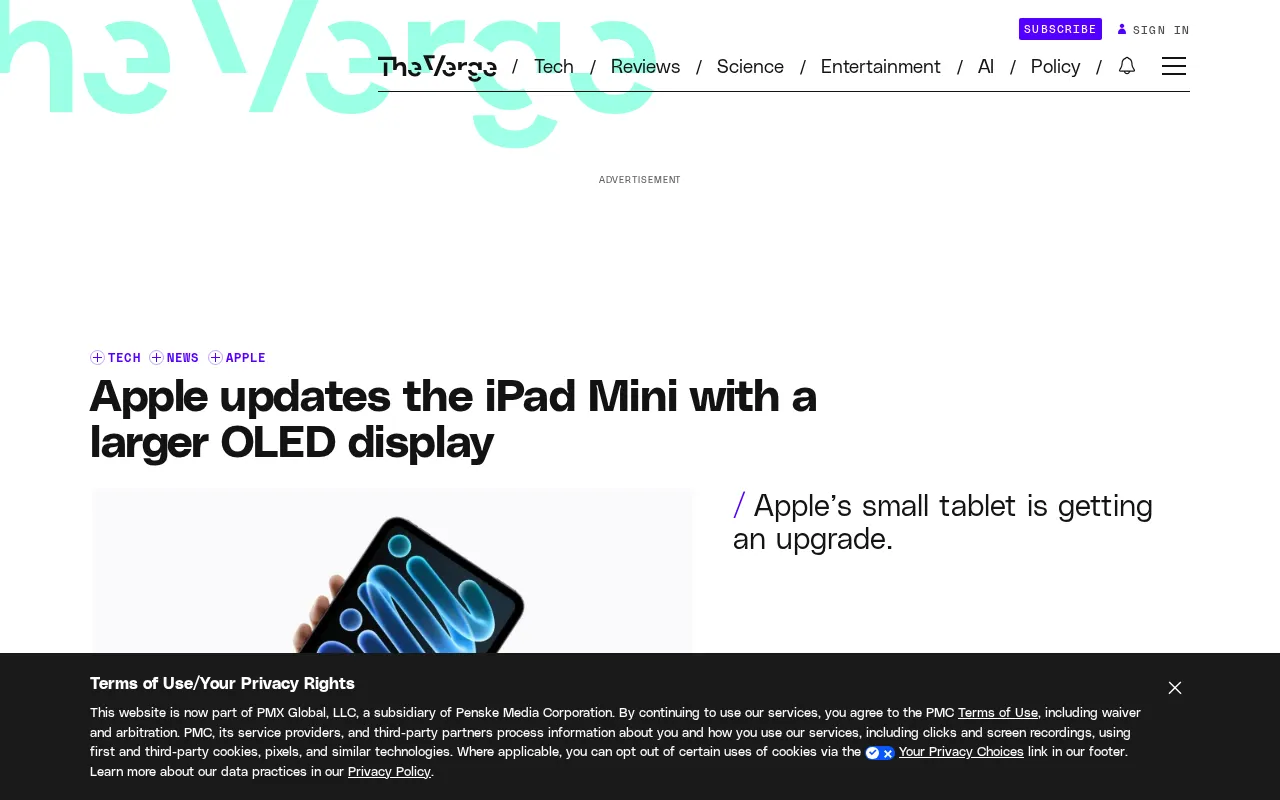
Apple quietly updated its iPad Mini lineup just days before Wednesday's "Pro and tell" event. The biggest change is a larger 8.5-inch OLED display, with a starting price of $699 (Wi-Fi model only). Although the screen has grown, Apple says the device retains the same compact body as its predecessor.
Display and Size: Bigger View, Same Portability
The core upgrade of the new iPad Mini lies in its display technology. On paper, the 8.5-inch OLED panel is not only slightly larger than before, but the OLED material itself means higher contrast, purer blacks, and a wider color gamut. For users who habitually read, take notes, or enjoy entertainment on the go with an iPad Mini, this is a direct improvement in visual experience.
Apple specifically emphasizes that despite the larger screen, the overall form factor is virtually unchanged. This is thanks to further slimming of the bezels and optimization of the internal stacking. In other words, users get more display area without sacrificing the one-handed portability that has always been the iPad Mini line's core competitive advantage.
OLED (organic light-emitting diode) differs fundamentally from common LCD panels in how they work: LCD relies on a backlight module to illuminate the liquid crystal layer to form an image, while each pixel in OLED can emit and turn off light independently. This brings two direct benefits—when displaying black, the pixels are completely off, so blacks are purer and contrast theoretically approaches infinity; and because no backlight is needed, the panel can be made thinner, which also benefits internal stacking design. In addition, the self-emissive nature of OLED pixels delivers more saturated colors, wider viewing angles, and faster response times. However, OLED also has potential issues such as lifespan and burn-in (ghost images left by static content displayed for long periods), which manufacturers typically compensate for through algorithms like pixel shifting and brightness limiting. For small tablets, OLED's thin and light characteristics perfectly align with the design goal of "bigger screen, same body."
Pricing and Market Positioning
The $699 starting price (Wi-Fi model) places the new iPad Mini in the mid-to-high-end small tablet segment. Compared with Apple's own iPad Air and standard iPad, the Mini's premium comes mainly from its ultra-portable body design and the newly added OLED screen. For those who need a device that slips easily into a coat pocket or small bag without compromising on performance, this price point remains attractive.
In terms of product timing, Apple chose to "jump the gun" ahead of its major event—on one hand avoiding a fight for attention with the event's headliners (expected to be the Pro series), and on the other hand setting a new screen standard for the small tablet market in advance.
The iPad lineup now has a fairly clear price gradient: the standard iPad targets the entry-level and education markets, the iPad Air sits in the mid-range all-rounder position, the iPad Pro is aimed at professional creation and high-performance needs, and the iPad Mini is the only "small-size" branch. The Mini's premium logic doesn't come entirely from performance, but from the fact that it almost exclusively owns a niche market—a full-featured tablet that can be held in one hand and fits in a coat pocket. In the Android camp, choices for small high-performance tablets are equally scarce, which gives the iPad Mini strong bargaining power among "portability-first" users. The $699 starting price (Wi-Fi only) also means cellular versions will cost more, and users should factor in hidden costs such as storage capacity and accessory compatibility (e.g., Apple Pencil support) when comparing.
What It Means for Users
If you're holding an older iPad Mini, the appeal of this upgrade depends mainly on how sensitive you are to display quality. The visual improvement from OLED is immediate, especially when watching videos, reading comics, and viewing dark-mode content. For first-time Mini buyers, the 8.5-inch OLED plus the unchanged compact body makes it nearly unmatched in the "portable tablet" niche.
As for details like performance, battery life, and cameras, Apple didn't elaborate in its brief announcement—more information will likely only be confirmed through later reviews and official page updates. But judging from just the screen and pricing, the new iPad Mini has completed a clean and decisive upgrade to its core experience.
One-line Summary
Apple quietly updates the iPad Mini with an 8.5-inch OLED screen, same body, starting at $699.
Paragraph Summary
Apple quietly updated its iPad Mini lineup days before the "Pro and tell" event, with the biggest change being an 8.5-inch OLED display and a $699 starting price for the Wi-Fi model. OLED brings higher contrast, purer blacks, and a wider color gamut, while narrower bezels and optimized internal stacking keep the overall size essentially unchanged despite the larger screen, preserving the Mini series' core portability advantage. In terms of pricing, the Mini sits in the mid-to-high-end small tablet segment, with its premium coming from extreme portability and the new OLED screen. Apple chose to launch ahead of its major event, both to avoid competing for attention with the Pro series and to set a new screen standard for the small tablet market in advance. Details on performance, battery life, and cameras haven't been announced, but on screen and pricing alone, it represents a core experience upgrade.
Related articles

How Did Da Vinci Prove the Sun Is Hot? A Neglected Chapter in Science History
How did da Vinci use a concave mirror experiment to overturn Aristotle's cold sun theory? This article traces this neglected chapter in science history, revealing the embryo of scientific thinking in the 15th century and da Vinci's cold observations on solar heat and the nature of life.
SharpLogic: Formalizing Bug Detection for LangGraph Routing Graphs with k-CNF
SharpLogic, an open-source project, maps LangGraph-style multi-agent routing and retry graphs to k-CNF, using a Rust kernel to count deadlocks and failing paths (#F counting), offering a Python AgentGuard hook and CLI for pre-release formal gate checks. This article analyzes its principles, its complementary relationship with evals, and the community's concern about modeling costs.
PPO Training of a Franka Robotic Arm for Pick-and-Place: A Reinforcement Learning Starter Project
A reinforcement learning project using PPO to train a Franka Panda robotic arm for pick-and-place in PyBullet, covering tech stack choices, task design challenges, and future text/voice command interaction plans—a good reference for beginners.