Apple's New Rule: Dating and AI Companion Apps Mandated 18+ Rating

Apple's new rule mandates 18+ ratings for dating and AI companion apps with sexual or romantic content.
Apple has updated its App Store rules to require dating apps and AI companion apps offering sexual or romantic content to carry an 18+ age rating. The new rule targets content attributes rather than imposing a blanket ban, meaning social matching tools and romantic AI companions will be treated differently. Apple's move aims to address the risk of uncontrolled content boundaries amid the rapid expansion of AI companion apps, using a lightweight rating approach to shift judgment responsibility to users and parents. For developers, this means a narrower user reach and pressure for consistency in rating declarations, and the AI companion sector may split into two paths: narrowing content boundaries or focusing on adult users. Specific enforcement details such as content determination standards and transition arrangements have not yet been disclosed.
Apple is tightening age controls on dating apps and AI companion apps. Under the latest App Store rules, any dating app or AI companion app that offers sexual or romantic content must carry an 18+ age rating. This change means that related apps previously listed with lower age ratings will now face a mandatory age threshold.
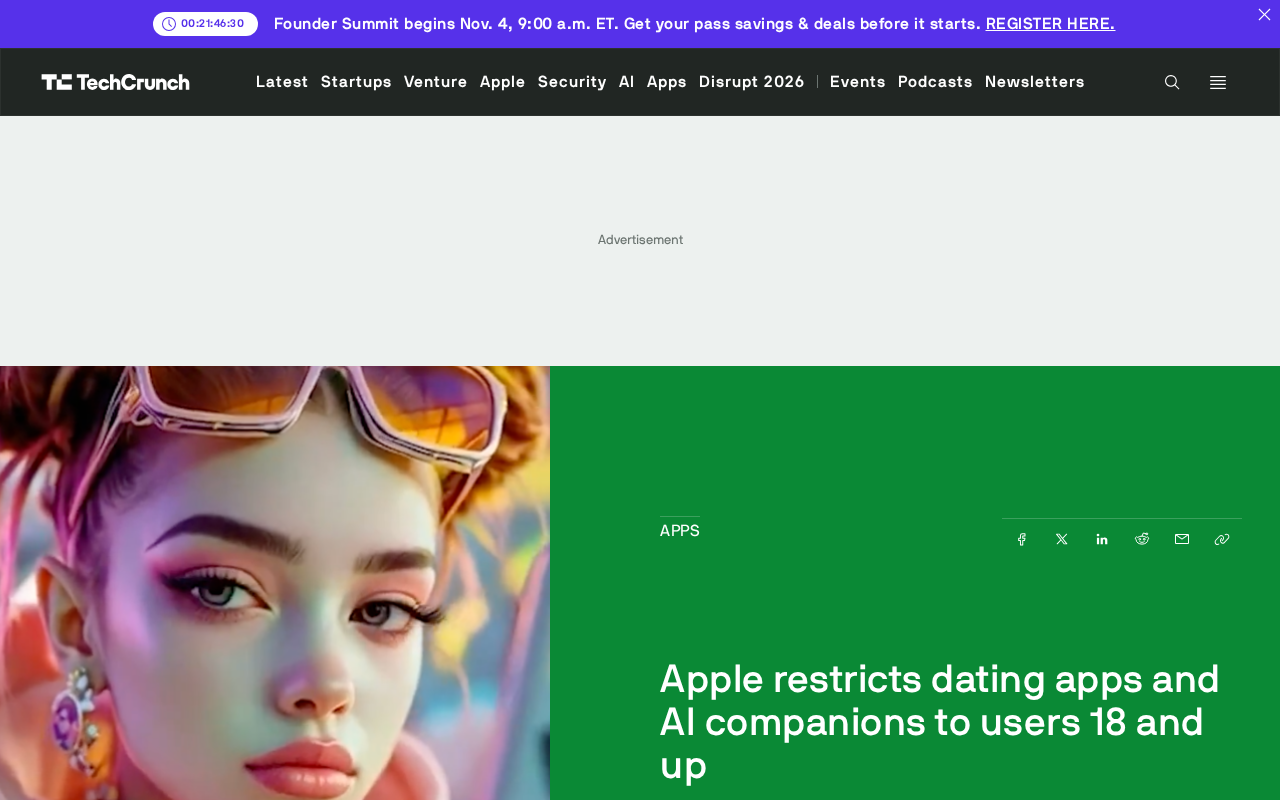
Which Apps the New Rule Specifically Covers
According to reports, Apple's new rules explicitly target two categories of products: dating apps, and AI companion apps that offer sexual or romantic content. The key phrase is "offers sexual or romantic content"—this is not a blanket ban on all dating or AI chat apps, but rather a rating requirement based on content attributes.
This means that pure social matching tools and AI companions with romantic or sexually suggestive conversational capabilities will be treated differently at the review level. For the AI companion sector, this is a clear signal: once a product's "emotional companionship" positioning involves romantic or sexual content, it can no longer avoid review through a lower age rating.
Why Tighten Ratings Now
Apple's move is closely tied to the rapid expansion of AI companion apps in recent years. These apps typically center on conversations with virtual characters, allowing users to form emotional or even romantic relationships with AI characters. As generative AI capabilities improve, the boundaries of conversational content become harder to control, and platforms need a more upfront set of rules to allocate responsibility.
From an app store governance perspective, an 18+ rating is a relatively "lightweight" intervention: it does not prohibit apps from being listed, but instead shifts content risk to the judgment of users and parents through an age label. For Apple, this both responds to external concerns about minors' exposure to inappropriate content and avoids the heavy cost of reviewing specific conversational content line by line.
App Store's age rating system is not a simple label, but a mechanism deeply tied to parental controls, content filtering, and store display. Apple divides ratings into tiers such as 4+, 9+, 12+, and 17+, where 17+ corresponds to "frequent/intense adult/sexually suggestive content" or "unrestricted web access." In Apple's system, the 18+ rating in this new rule actually falls under the 17+ category, which typically requires apps to declare the presence of adult content, gambling, violence, and other sensitive elements. Rating information directly affects an app's visibility in the "Kids" category and also triggers purchase and download restrictions in parental controls. Therefore, classifying a certain type of app as 18+ is essentially using an automated, scalable compliance tool to replace line-by-line manual review of massive amounts of conversational content.
Practical Impact on Developers
For developers of dating and AI companion apps, the most direct change is the rating declaration process. Apps must accurately describe their content attributes when submitting for review, and once deemed to contain sexual or romantic content, an 18+ rating becomes a mandatory requirement.
This brings two chain effects. First, the reachable user base narrows, especially for products whose primary growth source is younger users. Second, rating information affects an app's display and recommendation logic on the App Store, requiring developers to make clearer trade-offs in product positioning and content strategy.
In the App Store review process, age ratings are completed through the rating questionnaire in App Store Connect, and developers must self-declare content attributes. If the declaration does not match actual content, it may trigger review rejection, app removal, or developer account penalties. For AI companion apps, the difficulty lies in the dynamic and unpredictable nature of generative dialogue output, making it hard for reviewers to exhaustively enumerate all conversation scenarios. In practice, Apple tends to make judgments based on product descriptions, interface design, and typical interaction samples rather than reviewing every conversation in real time. This means that traces left by developers in product copy, character settings, and sample dialogues become key evidence for rating determinations.
A Compliance Watershed for the AI Companion Sector
AI companion apps have long operated in a gray area between social tools and adult content. Apple's new rule effectively draws a dividing line: romantic and sexual content is no longer a gray zone, but an 18+ attribute that must be explicitly labeled.
For the industry, this may drive a split into two categories. One type of product actively narrows its content boundaries to maintain a lower age rating and reach a broader user base; the other openly accepts the 18+ positioning and focuses on the emotional companionship needs of adult users. Whichever path is chosen, developers need to maintain consistency between content design and rating declarations, or they will face review risks.
Currently, the specific enforcement details of the rule have not been fully disclosed, including content determination standards, appeal mechanisms, and transition arrangements. But what is certain is that the "wild growth" phase of AI companion apps in Apple's ecosystem is coming to an end, and rating compliance will become a prerequisite for product listing.
AI companion apps are typically built on large language models to construct character personas, controlling conversational style through system prompts and fine-tuning. The core risk of such products lies in "jailbreak"-style conversations: users may induce AI characters to output romantic or sexual content, even if the product's default settings are relatively restrained. Platforms often focus more on a product's "design intent" and "typical usage scenarios" during rating rather than extreme individual cases. Therefore, if developers wish to maintain a lower age rating, they not only need to set content boundaries at the prompt level, but also need to form a verifiable compliance evidence chain in user agreements, reporting mechanisms, and conversation filtering. Conversely, products that accept the 18+ positioning need to ensure their content strategy is consistent with their rating declaration to avoid triggering review risks due to "under-reporting."
One-line Summary
Apple's new rule requires dating and AI companion apps containing sexual or romantic content to carry a mandatory 18+ rating.
Related articles
 Tech Frontiers
Coldframe: A Honeypot Disguised as a Supermarket Freezer Controller
Coldframe is a honeypot disguised as Danfoss AK-SM 800A and Dixell XWEB freezer controllers, built as a single Python file that detects CVE-2025-41450 attempts and is identified as real devices on Shodan.
 Tech Frontiers
GRFNet: A Lightweight PyTorch Model Designed for Multichannel Time-Series Classification
GRFNet is a lightweight PyTorch model for multichannel time-series classification, originating from EEG decoding research. With only 3,847 parameters, it is based on the ROCKET architecture, combining random convolution kernels with learnable spatial filters, supports arbitrary input lengths, and will soon be evaluated on the PhysioNet dataset.
 Tech Frontiers
CUDA-Accelerated Rocket League Simulator: A Player-Made Hardcore Experiment
A Reddit post shows a "100% Accurate" Rocket League simulator accelerated with CUDA. We analyze its technical context, CUDA's value in game physics simulation, and the significance and limitations of such community projects.