Apple's Record-Breaking iPhone Revenue: How Did It Grow 17% Without a Standard Model Launch?

Apple didn't launch a standard iPhone, yet iPhone revenue still grew 17% to set a Q4 record.
Apple's Q4 earnings show iPhone revenue reached $57.58 billion, up 17% year-over-year and setting a fourth-quarter record — achieved without launching a new standard iPhone. The article attributes this to the continued success of Apple's premiumization strategy: the Pro series attracts premium-paying users with high pricing and exclusive features, while older standard models cover the mid-range, forming a new-and-old product matrix. The standard model's absence may also reflect a deliberate product-cycle adjustment, supported by longer replacement cycles and consumers' greater willingness to pay for premium devices. The article cautions that a prolonged absence of the standard model could lose mid-range users, so Apple must balance premiumization with market share.
Apple's latest earnings report shows iPhone revenue reached $57.58 billion, up 17% year-over-year, setting a fourth-quarter record. One detail worth noting: this growth occurred without Apple releasing a standard-edition iPhone — its latest refresh only introduced the Pro series. Behind this anomaly lie subtle shifts in premium strategy, product cycles, and market demand.
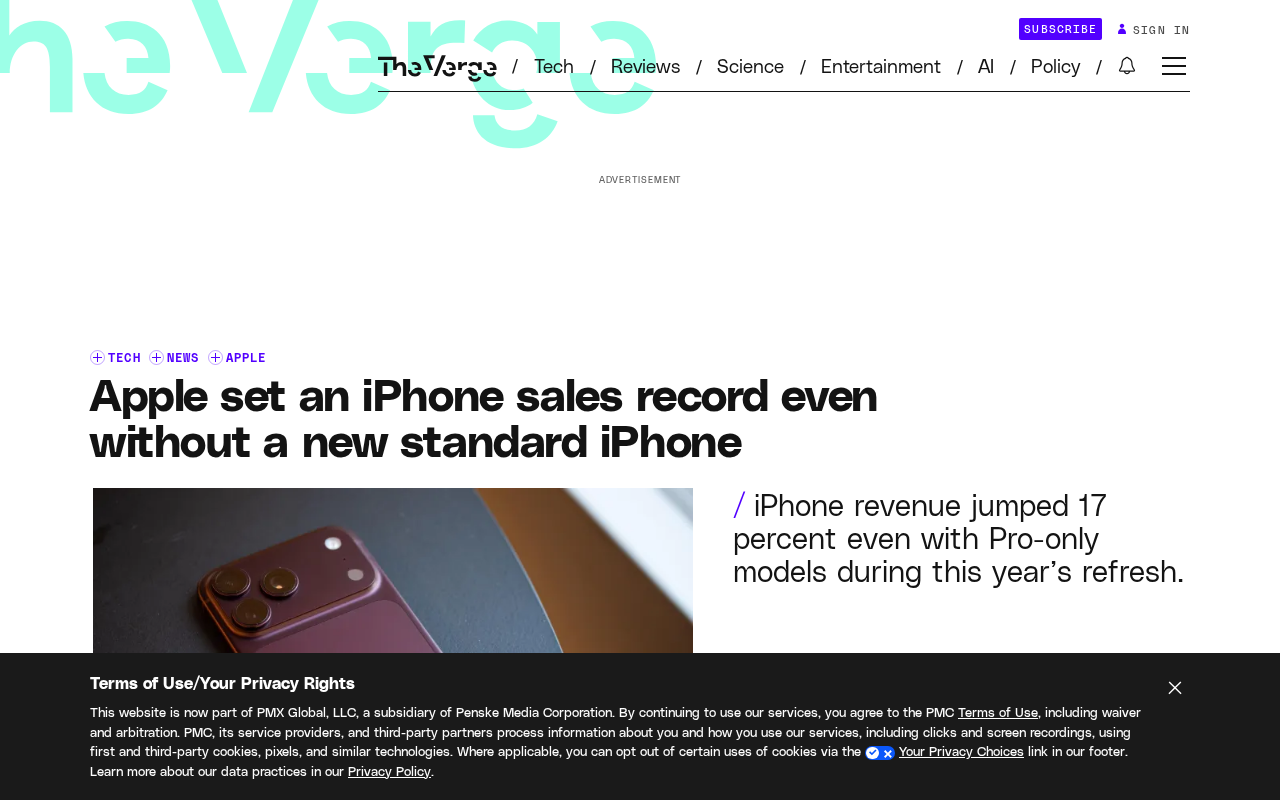
No Standard Model — So Why a Record?
According to Apple's fourth-quarter earnings, iPhone business revenue was $57.58 billion, up 17% from the same period last year. Typically, Apple releases both standard and Pro versions of the iPhone in the fall, but this refresh cycle saw the standard model absent, with only the Pro series making an appearance. Yet revenue rose rather than fell, indicating strong demand for the Pro series and a likely increase in average selling price.
This phenomenon challenges the conventional wisdom that "the standard model is the volume driver." Through the Pro models' premium pricing and differentiated features (such as better cameras, materials, and chips), Apple successfully attracted users willing to pay a premium. Meanwhile, older standard-edition iPhones remained on sale, covering the mid-range market and forming a new-and-old product matrix.
Average Selling Price (ASP) is the key metric for understanding this phenomenon. ASP refers to a vendor's total smartphone revenue divided by total unit sales over a given period, reflecting the overall price level of the product mix. When higher-priced Pro models account for a larger share and lower-priced standard models are absent, ASP is structurally pushed up even if total unit sales are flat or slightly down — thereby driving revenue growth. Apple never discloses iPhone unit sales, so observers typically derive ASP trends by dividing revenue by third-party shipment estimates. This time, the Pro series exclusively holding the new-product slot while older standard models absorbed mid-range demand is a classic "price-for-volume" combination — and a key reason revenue could still hit a record despite the absence of a new standard model.
The Premium Strategy Continues to Pay Off
Apple's strategy in recent years has clearly tilted toward the high end. The Pro series not only commands a higher price but also exclusively features multiple new capabilities, prompting consumers to trade up. This earnings data shows the strategy is paying off: even without a new standard model, users are still willing to pay for the Pro.
From an industry perspective, the smartphone market overall is slowing, but the premium segment remains resilient. Apple has solidified its position in the high-end market through the Pro models while using older models to maintain its volume base. This "dual-track" approach has enabled Apple to achieve revenue growth even without a new standard-edition iPhone.
Replacement cycle refers to the average time from when a user buys a phone to when they upgrade to the next one. Market research firms generally estimate that the global smartphone replacement cycle has lengthened from an early 18–24 months to 30–40 months or even longer. A longer replacement cycle means each purchase decision is more deliberate, and consumers are more inclined to "go straight for the top" and choose premium models to extend their usage lifespan. This precisely explains why demand for premium models is more resilient against a backdrop of weak overall shipments — and provides the demand foundation for Apple's high Pro-series pricing.
Misalignment Between Product Cycles and Market Demand
The absence of the standard iPhone may stem from Apple's adjustment to its product cycle. Some analysts believe Apple may have delayed the standard model's update to a later date to extend the product's market momentum. This strategy is common in the auto industry but relatively rare in the phone industry.
On the other hand, changes in market demand cannot be overlooked. Consumers are extending their smartphone replacement cycles but are willing to pay more for premium models. Apple met this demand through the Pro series, while older standard models attracted price-sensitive users. This combination delivered Apple an impressive scorecard in the fourth quarter.
Product matrix refers to a vendor's portfolio strategy of covering multiple market segments with multiple products at different price points and positionings. Apple's current iPhone matrix roughly divides into: the latest Pro series leading the high end with exclusive new technology, the previous generation or older standard models covering the mid-range, and entry-level models serving price-sensitive users. The benefit of this tiering is that a new-product launch doesn't need to cover every price point — older models naturally move downstream through price cuts, creating a pairing where "new models lift ASP while old models hold volume." What the article calls "new-and-old pairing" is essentially the flexibility of the product matrix at work.
Implications for Apple's Future Strategy
This earnings report provides an important reference for Apple's product strategy. First, strong demand for the Pro series proves there is still room in the premium market, and Apple can continue to double down. Second, the absence of the standard model did not affect overall revenue, showing that Apple's brand loyalty and the flexibility of its product matrix are strong enough.
However, this strategy also carries risks. If the standard model is absent for an extended period, Apple could lose some mid-range users, especially in highly competitive markets. Apple needs to find a balance between premiumization and market share. Whether Apple will adjust the release cadence of the standard model in the future is worth watching.
Conclusion
Apple has proven the effectiveness of its premium strategy with a record-breaking earnings report. Without a new standard model, iPhone revenue still grew 17%, driven by strong demand for the Pro series, the continued contribution of older models, and Apple's flexible management of product cycles. For the industry, Apple's case demonstrates the possibilities of premiumization and product matrix management — but also serves as a reminder of the importance of balance.
One-line Summary
Apple didn't launch a standard iPhone, yet iPhone revenue still grew 17% to set a Q4 record.
Paragraph Summary
Apple's fourth-quarter earnings show iPhone revenue reached $57.58 billion, up 17% year-over-year and setting a fourth-quarter record. Notably, this growth occurred when Apple only launched the Pro series and did not release a new standard iPhone. The article argues this reflects the continued success of a premiumization strategy: the Pro series attracts premium-paying users through high pricing and differentiated features, while older standard models cover the mid-range market, forming a new-and-old product matrix. At the same time, the standard model's absence may reflect Apple's deliberate adjustment of product cycles, while consumers' longer replacement cycles and greater willingness to pay for premium models provide additional support. The article concludes by cautioning that a prolonged absence of the standard model could lose mid-range users, and Apple needs to maintain a balance between premiumization and market share.
Related articles

Claude Code + Agent: Building a Fully Automated AI Testing Loop
Bilibili course breakdown: how test developers can use Claude Code terminal-based Agents to build a fully automated AI testing loop. Compares permission boundaries of terminal vs. device Agents, explains why enterprise projects choose Claude Code over Open Claude-type tools, and outlines the Node.js environment setup and DeepSeek model integration path.

Working with AI Agents Requires Nerves of Steel
The more autonomous AI agents become, the heavier the user's psychological burden. Drawing from a Hacker News discussion, this article analyzes black-box anxiety, behavior drift, and monitoring fatigue in agent collaboration, and offers practical approaches like sandbox isolation, permission control, and task granularity management to reduce cognitive load.

To Replace Adobe Acrobat, I Built My Own Open-Source PDF Reader Folio
A developer unhappy with Adobe Acrobat's bloat built Folio, a lightweight open-source PDF reader. Learn the design philosophy and use cases of this alternative.