Apple Tightens Mac Full Disk Access: The Security Risks Posed by AI Agents
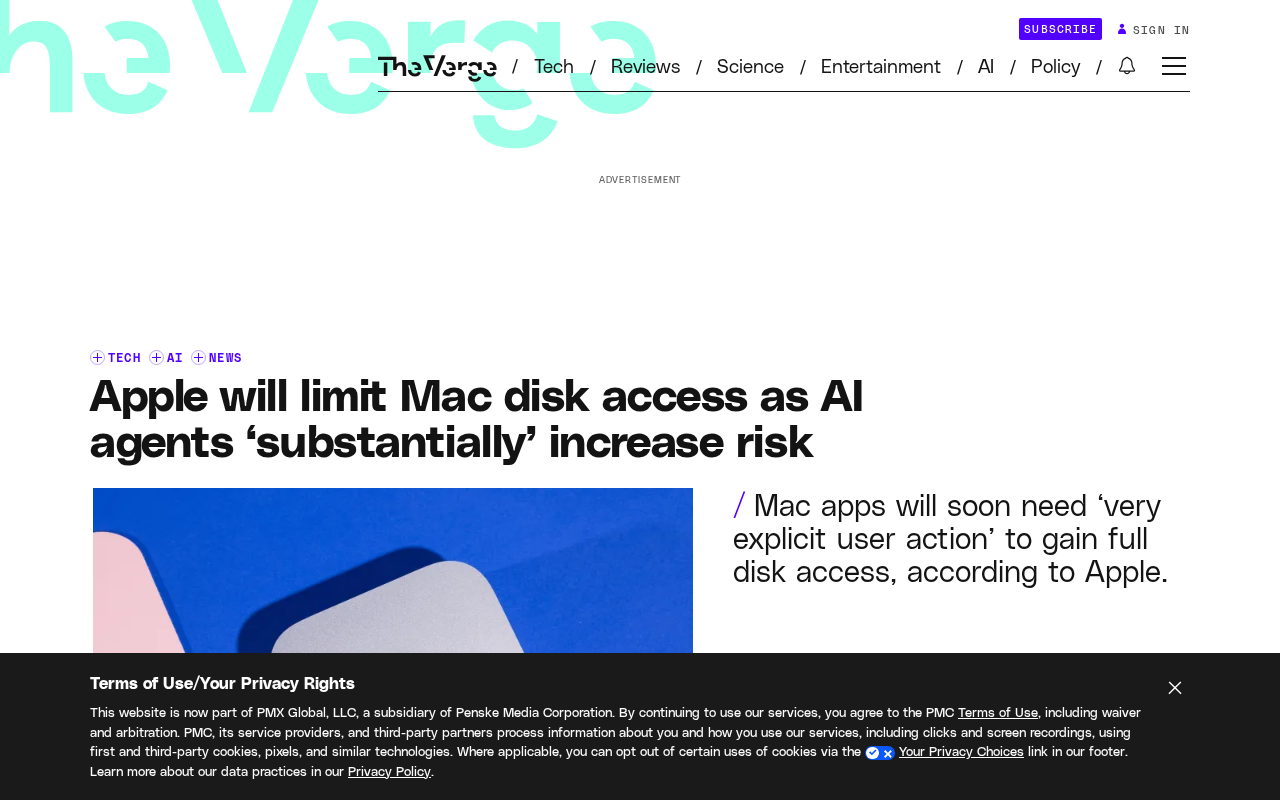
Apple tightens Mac Full Disk Access permissions to counter new data security threats from autonomous AI agents.
Apple has announced stricter controls over macOS's Full Disk Access permission, driven by the rapid proliferation of AI agents. Full Disk Access lets apps read nearly all user data — emails, messages, browser history, and more — and was previously reserved for trusted tools. AI agents with autonomous execution capabilities pose far greater risks if granted this permission. Rather than an outright ban, Apple's approach raises the authorization bar through added friction, ensuring users authorize access with genuine, informed intent. This sends a clear signal to AI agent developers: platforms are now actively addressing the security boundaries of autonomous AI programs.
Apple is cracking down on macOS's "Full Disk Access" permission, and the culprit is the rapid rise of AI agents. As first reported by TechCrunch, Apple stated in an update that new control mechanisms will ensure only users who genuinely intend to grant an app this "extraordinary level of access" can complete the authorization.
While this may look like a minor system permission tweak, it reflects a much deeper problem: when AI agents can autonomously read and modify any file on disk, the traditional permission model faces unprecedented challenges.
Why Full Disk Access Has Become a Security Focal Point
"Full Disk Access" is one of the highest-privilege authorizations in macOS. Once an app is granted this permission, it can read nearly any file on the user's disk — including email databases, message histories, browser history, system configurations, and private data from other apps.
In the past, this permission was primarily granted to trusted applications like backup tools, security software, or developer utilities. Users manually toggled it on in System Settings, and the process was relatively controlled because the authorized entity was a well-defined, static program.
AI agents have changed that assumption entirely. The defining characteristic of agentic applications is autonomous execution — they can decide on their own to manipulate files, run commands, and invoke system resources based on instructions. When a program with this kind of autonomous capability obtains full disk access, the range of sensitive data it can touch — and the potential damage it can cause — far exceeds that of traditional apps. Apple chose the word "substantially" to describe the increased risk posed by AI agents, and the stance is clear.
The fundamental difference between AI agents and traditional applications lies in their "plan-and-execute" loop: upon receiving natural language instructions, they can autonomously break down tasks, invoke tools, and carry out multi-step operations continuously — all without requiring step-by-step user confirmation. Take Anthropic's Claude, OpenAI's Operator, or locally-run open-source agent frameworks as examples: within a single session, these programs can sequentially read files, modify content, and send emails, with the entire chain driven autonomously by the model. This autonomy is the root of the risk. Traditional permission models assume application behavior is predictable and static, but an AI agent's behavioral path is highly dynamic — determined by model reasoning and external inputs — making it nearly impossible to audit in advance. Security researchers categorize this type of risk as prompt injection attacks: an attacker can embed malicious instructions in files or web pages to trick an agent — armed with full disk access — into exfiltrating or destroying data, entirely without the user's knowledge.
Apple's Approach: Raising the Authorization Bar
According to Apple's explanation, the new control mechanism doesn't outright prohibit granting full disk access — it raises the "bar" and requires clearer "intent confirmation." The core goal is to ensure that when users grant this extreme permission, they do so out of genuine, fully-informed intent, rather than being manipulated or authorizing it unknowingly.
This design philosophy aligns with Apple's longstanding privacy strategy: rather than blanket-banning features, it introduces friction to make high-risk operations harder to abuse. The same logic has appeared before in previous tightenings of screen recording permissions and accessibility permissions.
For AI agents, this means that obtaining deep system access on Mac will no longer be as straightforward as it once was. Developers may need to guide users through more explicit confirmation flows, and some agentic apps that rely on full disk access for core functionality may need to rethink their permission request design.
Apple's "adding friction" strategy is a well-documented security intervention technique in UX design. Its theoretical basis is the default effect: the vast majority of users tend to accept default settings or take the path of least resistance, so inserting an additional confirmation step before high-risk operations effectively filters out authorizations that happen through inertia or manipulation. macOS has employed this strategy multiple times historically: the screen recording permission prompt introduced with Catalina in 2019, and the tightened microphone/camera indicator mechanism in Monterey in 2021, both follow the same logic. Notably, this is consistent with how the principle of least privilege is implemented in engineering — rather than assuming users understand the full risks of a given permission, the system uses interface design to force users to perceive the risk level before authorizing.
Potential Impact on the AI Agent Ecosystem
The timing of this change is telling. As AI agent tools accelerate into the mainstream, more and more applications want greater operational freedom on user devices — reading files, organizing documents, automating tasks — all of which typically require elevated system permissions.
Apple's tightening sends a clear signal to the entire AI agent ecosystem: platform vendors are beginning to take seriously the security boundary issues posed by autonomous AI programs. For users, this is an additional layer of protection; for developers, it's a new compliance hurdle.
From a broader perspective, this may also foreshadow how OS vendors will approach permission management in the AI era — building constraint mechanisms that scale alongside AI's growing capabilities. How to strike the right balance between agent utility and user data security will be a challenge that platforms and developers must navigate together in the months ahead.
Summary
Apple's tightening of Mac's Full Disk Access is, on the surface, a permission settings adjustment — but in substance, it's a direct response to the risks introduced by AI agents' autonomous capabilities. It preserves an authorization pathway for users with genuine needs, while raising the bar to reduce the potential for abuse. As AI agents increasingly become a standard feature of desktop applications, this kind of system-level security hardening may well be just the beginning.
Related articles

How Big Can Stars Really Get? The Physical Limits of the Largest Stars
Red supergiants are the largest stars by volume, with radii up to 2,000 times the Sun, engulfing the inner solar system. But there is no precise upper limit on stellar size—models predict up to 15,000 solar radii. The most massive blue stars are far smaller than red supergiants—biggest and heaviest are two different things.

Apple HomeView Smart Display Full Feature Breakdown: Wall-Mount or Desktop, $299
Apple launches HomeView, a $299 smart display with wall-mount and desktop options, 12MP camera for facial recognition, smart home control, music playback, and recipe step-by-step cooking. Full breakdown of watch faces, apps, privacy, and cooking integration.

Where Did the Promised New Studio Go? Craft Computing Answers After Five Years
Craft Computing's host responds to viewer questions: the new studio promised five years ago was shelved as construction costs soared from $30,000 to $75,000, and was replaced by a 168-square-foot garage conversion.