Apple Tightens macOS Full Disk Access — Taking Aim at New AI Agent Risks

Apple tightens macOS Full Disk Access permissions to address privacy risks posed by autonomous AI agents.
Apple has announced stronger controls over macOS Full Disk Access, driven by the rise of AI agents. Unlike traditional apps, AI agents autonomously traverse files, read emails, and analyze browsing history — making high-level system permissions far more prone to abuse. New attack vectors like prompt injection could allow hijacked agents to silently exfiltrate sensitive data. The move signals a shift from static, coarse-grained permissions toward finer-grained, context-aware dynamic authorization, with clear implications for developers building AI agent products.
Why Apple Is Suddenly Tightening macOS Permission Controls
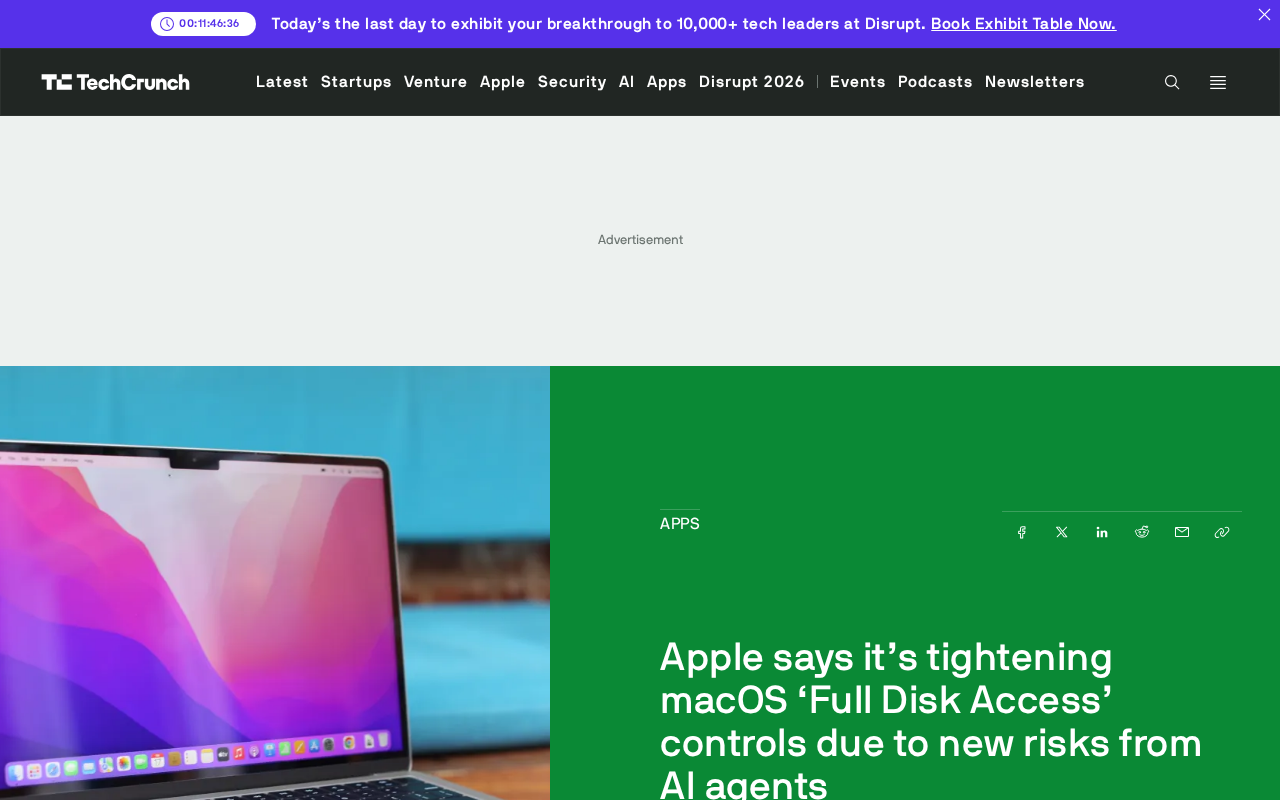
Apple has announced new controls over macOS's Full Disk Access permission mechanism. The official rationale points squarely at one of today's hottest technology trends: increasingly capable AI agents are making broad application access to users' files, messages, emails, and browsing history far more dangerous than before.
The reasoning behind this move isn't hard to follow. Full Disk Access is one of the highest-privilege grants in macOS — once an app receives it, the app can read nearly all sensitive data on the user's device. In traditional app ecosystems, this type of permission was typically granted manually by users to clearly trusted tools like backup software or sync utilities. But the rise of AI agents is fundamentally redrawing the permission boundary.
Why AI Agents Make "Full Disk Access" More Dangerous
AI agents are intelligent programs capable of autonomously executing multi-step tasks on behalf of users. They are no longer passive tools that respond to single commands — they can proactively traverse file systems, read email content, analyze browsing history, and make decisions and take actions based on what they find.
The problem is that when an AI agent with Full Disk Access starts operating autonomously, the scope of data it can touch — and the potential for abuse — far exceeds that of any traditional application. Apple's concerns center on several key areas:
Dramatically Expanded Data Exposure
In the past, granting Full Disk Access to an app gave users a reasonable sense of what it would do. But AI agent behavior is far harder to predict — an agent might, while executing a seemingly harmless task, simultaneously read, aggregate, or even exfiltrate large volumes of sensitive information. Users have no practical way to assess how far this "capability" might be exercised at the time of authorization.
The Loss-of-Control Risk That Comes with Autonomy
The core value of AI agents lies in their autonomy — but that is precisely the source of the security risk. If an agent is maliciously exploited, or manipulated through attack techniques like prompt injection, an agent with Full Disk Access could become a channel for leaking user privacy.
Prompt injection is one of the most critical security threats facing AI agents today. The attack works by hiding malicious instructions inside content that an agent will process — such as an ordinary-looking email, a webpage, or a document. When the agent reads that content, the hidden instructions are mistakenly interpreted as legitimate task commands, effectively hijacking the agent's behavior. Similar in concept to traditional code injection attacks, prompt injection exploits the fundamentally blurry boundary between "data" and "instructions." For an agent with Full Disk Access, a successful prompt injection attack could cause the agent to silently exfiltrate the contents of local sensitive files via network requests — entirely without the user's knowledge. No mature, universal defense exists in the industry yet, which is precisely why restricting permissions at the operating system level is considered a more reliable line of defense.
What This Shift Signals About Permission Architecture
Apple's adjustment sends a clear signal: operating system-level permission models are being forced to adapt to the new threat landscape of the AI era.
For a long time, macOS's security architecture was built on a relatively static trust relationship among apps, users, and data. The introduction of AI agents inserts a highly dynamic, autonomously decision-making new actor into that equation. The existing coarse-grained model of "authorize once, valid indefinitely" is plainly no longer adequate.
It's reasonable to expect that future permission design will move toward finer granularity and stronger context-awareness — distinguishing between "human-initiated operations" and "agent-initiated operations," restricting the types of data and time windows agents can access, and adding real-time monitoring and auditing of autonomous behavior. Apple moving first as a platform owner also suggests that other OS vendors will likely follow with similar tightening measures.
The Principle of Least Privilege (PoLP) is a classic design principle in information security: any program or user should be granted only the minimum permissions necessary to complete their current task — not one bit more. This principle is relatively straightforward to implement in traditional software, where application functionality has clear, defined boundaries. The challenge with AI agents is that their task boundaries are inherently dynamic and difficult to fully define in advance — an agent may need to dynamically discover required resources as it executes. This transforms "least privilege" from a static configuration problem into a dynamic, real-time authorization problem. The approach Apple's adjustment appears to be introducing — distinguishing between human operations and agent operations — is essentially an attempt to build a new least-privilege enforcement framework for AI agents, decomposing the blunt instrument of "Full Disk Access" into more granular, revocable, time-bounded authorization units.
What This Means for Users and Developers
For everyday users, this change may manifest in the short term as more frequent permission confirmation prompts and a need to reassess previously authorized applications. By tightening controls, Apple is returning more of the initiative for privacy protection to users themselves.
For developers — especially teams building AI agent products — this is a clear warning: product design philosophies that rely on broad system permissions to achieve "do anything" capabilities will face increasingly high compliance hurdles. A more sustainable approach is to design agent capabilities around the principle of least privilege, and to clearly communicate to users the purpose and scope of each authorization request.
The currently available information only reflects Apple's directional statement; the specific details of the new controls, their effective date, and their impact on existing applications have not yet been clarified. Regardless, this marks a moment when AI security concerns are permeating downward from the model layer into operating system fundamentals — and permission management is set to become an unavoidable infrastructure challenge of the AI era.
Related articles

ChatGPT Space Launches: Team Collaboration and New Pages Features Explained
ChatGPT Space is OpenAI's new team collaboration feature with Pages, real-time collaboration, and Slack/Google Drive sync. We break down its privacy design, multi-platform integration, and the full workflow from conversation to document.

Migrating Apache Spark UDFs to GPU Acceleration with AI Agents
NVIDIA developer blog explains how AI Agents rewrite Apache Spark UDFs for GPU acceleration, covering migration criteria, agent rewriting and verification workflows, plus pitfalls like result consistency and CPU-GPU transfer overhead.

Zed Editor v0.40.4-rc2 Released: Usage Credits Now Available Without Upgrading
Zed editor releases v0.40.4-rc2, allowing users to use usage credits for AI features without upgrading to a paid plan, lowering the trial barrier.