Apple Watch Audio Intelligence First Impressions: Hands-On with watchOS 27.3 Developer Beta
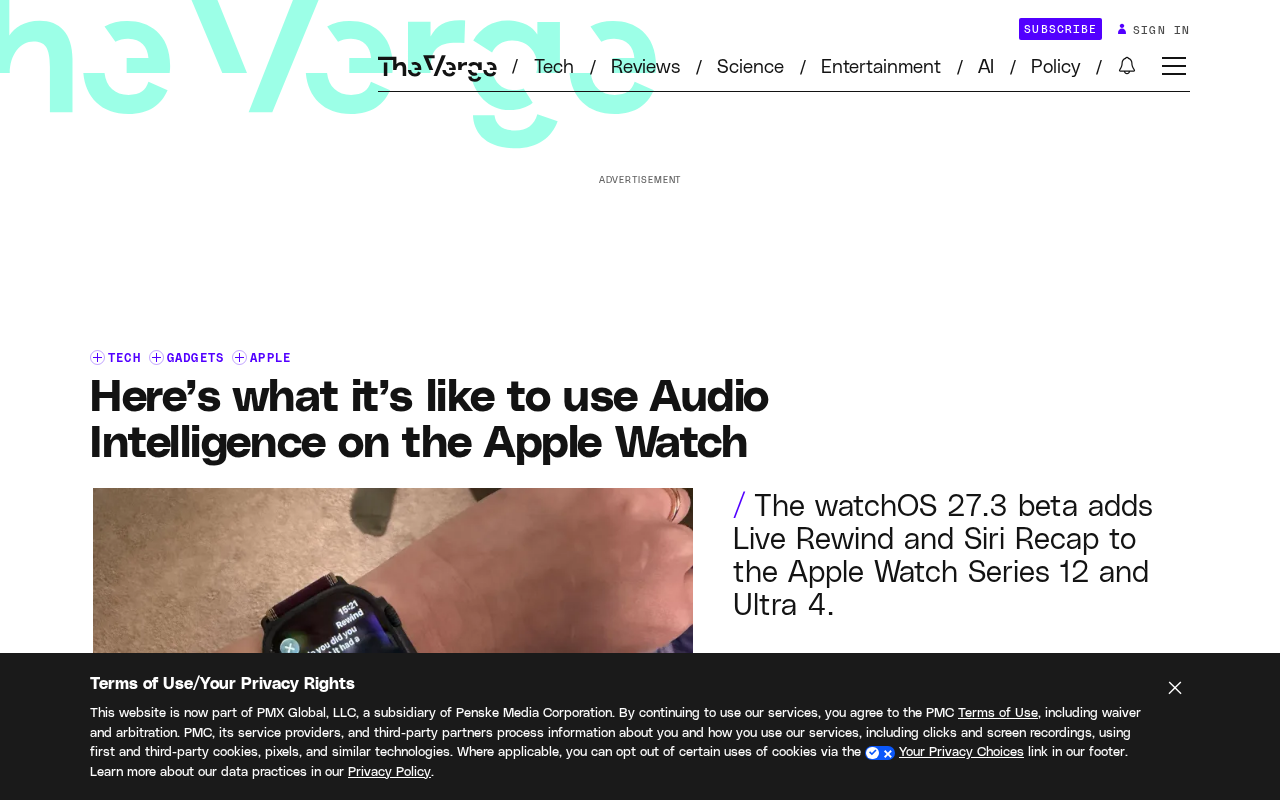
watchOS 27.3 beta makes Apple Watch Audio Intelligence available to try for the first time, but a full evaluation still requires long-term experience.
Based on first-day hands-on with the watchOS 27.3 developer beta, the article discusses the preliminary form of "Audio Intelligence" on Apple Watch Series 12 and Ultra 4. The author notes that the feature is designed to blend into long-term daily use rather than be judged by short-term testing, so at this stage we can only confirm that "it has arrived" and cannot evaluate whether it's good or bad. The article outlines Audio Intelligence's technical positioning from "capturing sound" to "understanding sound locally," emphasizing that its value depends on how computing is allocated between on-device and cloud, and the resulting privacy and latency costs. It also reminds readers that the developer beta does not represent the final form—stability, power consumption, and interaction will still be adjusted. The article concludes by distilling three signals: AI capabilities are moving down to the watch form factor, an experience-first product orientation, and the fact that the evaluation window has not truly opened yet.
What exactly can "Audio Intelligence" on Apple Watch Series 12 and Ultra 4 deliver? With the watchOS 27.3 developer beta that just rolled out, this question finally has an answer we can verify firsthand—though only a preliminary one.
An "Incomplete" Release: Why We Can Only Scratch the Surface for Now
According to this hands-on report from an RSS source, we still can't fully map out Audio Intelligence on Apple Watch Series 12 and Ultra 4. The reason is straightforward: the watchOS 27.3 developer beta only rolled out that afternoon, and this kind of feature is designed to blend into daily life and be "lived with" over the long term—not to be judged by running a few test cases on launch night.
The author explicitly states they will keep using these features over the coming period to observe how they perform in real-world scenarios. In other words, this is an "opening statement" kind of report: it confirms the feature is available to try, but doesn't yet offer a complete evaluation. For readers interested in Apple's wearable AI capabilities, this restraint is actually noteworthy—the value of Audio Intelligence depends heavily on everyday context, not lab metrics.
What Does Audio Intelligence Mean? From "Hearing" to "Understanding"
The original article doesn't lay out a specific feature list for Apple's Audio Intelligence, but judging from the product naming, it's a natural extension of on-device intelligence on wearables: turning the watch from a mere microphone that captures sound into a computing unit that can understand sound content locally.
The significance of this shift lies in the scenarios. A watch is the consumer electronic device closest to the user's body, making it naturally suited to handling ambient sound, conversation, and voice input—but constrained by size and power, it has long been limited to a "capture—upload—cloud processing" pipeline. If Audio Intelligence truly lands, what changes is how this pipeline is allocated: which processing happens on the wrist, which requires the phone or cloud, and how much privacy and response latency the user pays for it.
On-device AI refers to completing model inference locally on the device rather than uploading data to the cloud for processing. For devices like Apple Watch, the core constraints of on-device AI are power consumption and heat dissipation: watch batteries typically hold around 300mAh, and the sustained compute of the SoC is far below that of a phone. Apple therefore usually adopts a "tiered computing" strategy—lightweight models (such as voice wake and ambient sound classification) run locally on the watch, while complex tasks (such as long voice transcription and semantic understanding) are handled by the paired iPhone or the cloud. This allocation directly determines the response latency, offline availability, and privacy boundaries of Audio Intelligence, and is the technical dimension most worth watching when evaluating its actual experience.
The Limitations of the Developer Beta and the Observation Window
It's important to emphasize that the current state is a developer beta, which means two things. First, feature performance does not represent the final form; stability, power consumption, and interaction details may all be adjusted in subsequent versions. Second, the current hands-on experience mainly serves developers and early adopters—ordinary users should not use beta performance as a basis for purchase decisions.
This is also why the original article chose "experience first, conclusions later." For a feature that needs to be "lived into," short-term hands-on testing can answer only a limited set of questions: whether the interface is intuitive, whether triggers feel natural, whether there are obvious stutters or abnormal battery drain. As for how Audio Intelligence truly performs in noisy environments, multi-person conversations, and during prolonged wear, only time will tell.
Developer Beta is a pre-release version Apple pushes to registered developers before the official release, usually accompanied by new SDK and API changes, with the goal of letting developers adapt in advance and report issues. Compared with the public beta, developer betas have a higher probability of crashes, abnormal battery drain, and missing features, and do not promise data compatibility. Apple typically iterates on a "version number + 0.1" cadence (such as 27.3 beta 1 to beta 4), during which features may be added, removed, or redesigned. Therefore, hands-on experience with a beta can only be used to judge the direction of features and the prototype of interactions—not as a basis for product maturity or purchase decisions.
A Few Signals Worth Watching
From this brief hands-on report, a few signals useful for future observation can be distilled.
First, the pace of feature rollout. Audio Intelligence appearing in the watchOS 27.3 developer beta shows that Apple is gradually pushing AI capabilities down to the watch form factor, rather than keeping them only on phones and headsets.
Second, an experience-first orientation. The original article repeatedly emphasizes that such features are "meant to be lived with," suggesting that Apple positions Audio Intelligence not as a showy feature but as a capability that needs to blend into the rhythm of daily use.
Third, the evaluation window has not yet opened. At this stage, any judgment about whether Audio Intelligence is "good to use" lacks a sufficient sample size; a truly valuable review must wait until long-term usage data has accumulated.
After the First Impressions
The first impression of Apple Watch Audio Intelligence can currently only stay at the level of "it has arrived." The watchOS 27.3 developer beta provides an observation entry point, but between the entry point and a conclusion lies a large number of real-world usage scenarios. For those following wearable AI, the actual experience feedback over the coming weeks will be more informative than any short take on launch day.
One-line Summary
watchOS 27.3 beta makes Apple Watch Audio Intelligence available to try for the first time, but a full evaluation still requires long-term experience.
Paragraph Summary
Based on first-day hands-on with the watchOS 27.3 developer beta, the article discusses the preliminary form of "Audio Intelligence" on Apple Watch Series 12 and Ultra 4. The author notes that the feature is designed to blend into long-term daily use rather than be judged by short-term testing, so at this stage we can only confirm that "it has arrived" and cannot evaluate whether it's good or bad. The article outlines Audio Intelligence's technical positioning from "capturing sound" to "understanding sound locally," emphasizing that its value depends on how computing is allocated between on-device and cloud, and the resulting privacy and latency costs. It also reminds readers that the developer beta does not represent the final form—stability, power consumption, and interaction will still be adjusted. The article concludes by distilling three signals: AI capabilities are moving down to the watch form factor, an experience-first product orientation, and the fact that the evaluation window has not truly opened yet.
Related articles

Gemini 4 Neon Released: A Balance Between Frontier Intelligence and Efficient Task Execution
Google DeepMind releases Gemini 4 Neon, focused on frontier intelligence and fast end-to-end task execution. This article breaks down its benchmark performance in coding, enterprise analysis, scientific reasoning, and cybersecurity, its four thinking levels, pricing, and safety alignment data.

Is AI the Culprit Behind Global Outages? The Trust Crisis Behind the NSA and FAA Failures
Fourth major failure in five days hits NSA classified network. Microsoft blames a software bug, FAA denies its new AI system, NSA says routine maintenance. Senator Warner suggests AI accelerates vulnerability discovery, leading to rushed fixes — while 39% of Americans already view AI negatively, exposing a deepening trust crisis.

Robot Developer Builds Custom B-rep Kernel with 3,487 Tests
A robot developer builds a custom B-rep geometry kernel with 3,487 tests, exploring why robotics needs dedicated CAD tools and the barriers to building one.