Apple Watch New AI Feature Beta Test: Conversation Rewind and Recap

Apple is testing AI audio intelligence features for Apple Watch that can rewind conversations and generate summaries.
Apple is testing an AI audio feature called Audio Intelligence for Apple Watch, with core capabilities for rewinding conversations and generating summaries, and it has entered Beta testing. The feature targets the pain point of recording while conversing in mobile scenarios, letting the watch handle lightweight conversation capture and making conversations searchable. Beta means the main feature is usable, but stability, accuracy, and privacy handling are still being refined; audio features involve continuous microphone access and sensitive personal data, so test cycles are usually longer. Privacy prompts and battery consumption are two major challenges that will determine whether users keep it enabled long term. If it matures, Apple Watch could extend from health monitoring and notification center into an auxiliary memory tool for personal conversations.
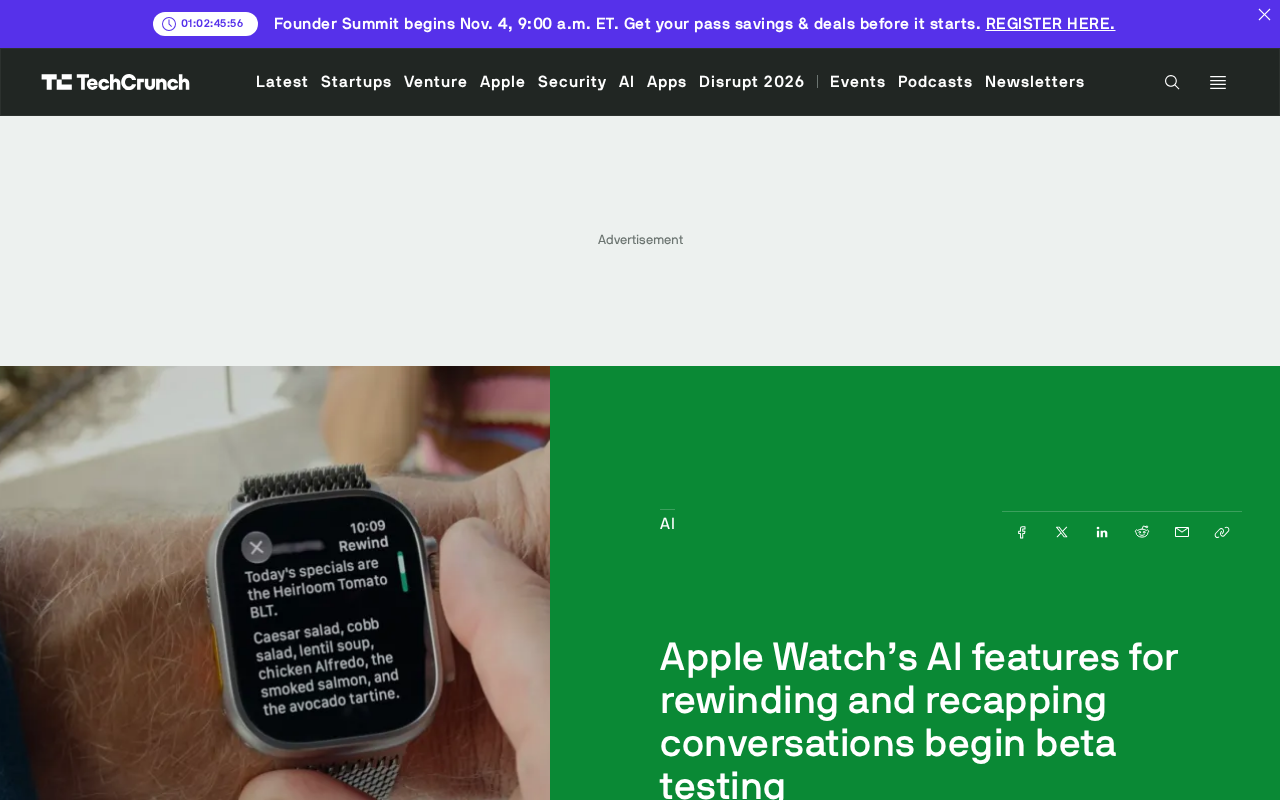
Apple is testing a new set of AI audio intelligence features for Apple Watch, with core capabilities that let users rewind conversations and generate conversation summaries. The feature has now entered Beta testing, meaning it is one step closer to being officially released to users.
Feature Positioning: Making the Watch an External Memory for Conversations
According to public information, the goal of this Audio Intelligence feature is clear—to help users remember what others have said, or take notes on conversations. This addresses a real pain point: in mobile scenarios, it is difficult for users to record while conversing, and as a device worn on the wrist, Apple Watch is naturally suited to this kind of lightweight conversation capture task.
From the feature description, it is not simple recording playback, but processing with comprehension capabilities: rewinding means being able to return to a certain point in the conversation and listen again, while recapping means the system can distill the conversation content. Together, the two point toward the direction of "making conversations searchable."
Audio Intelligence is a collection of audio understanding capabilities Apple builds at the system level. Unlike simple Speech-to-Text, it typically includes acoustic event recognition, speaker differentiation, speech content understanding, and structured output. On devices like Apple Watch with limited compute and power, such capabilities often adopt a hybrid architecture of "lightweight on-device model + cloud/companion device collaboration": the watch handles wake-up, capture, and initial noise reduction, while heavier semantic understanding models are completed by iPhone or the cloud. Understanding this layering helps judge the feature's usable boundaries when offline, in airplane mode, or without a paired phone, and also explains why Apple is especially cautious about the Beta cycle.
What the Beta Stage Means
Entering Beta testing shows that the main body of the feature is already usable, but stability, accuracy, and privacy handling details are still being refined. For Apple, audio AI features involve continuous microphone access and sensitive personal conversation data, so test cycles are usually longer than for pure software features. Users can see a prototype of the feature at this stage, but should not expect the final experience.
The Difficult Balance Between Privacy and Practicality
The biggest controversy around conversation-recording features is privacy. The Apple Watch's characteristics of being worn for long periods and being wakeable at any time make "when it is listening" a core concern for users. Apple has consistently emphasized on-device processing and privacy protection. How this feature provides convenience while also giving clear recording status indicators and data management methods will determine whether users are willing to keep it enabled long term.
Another practical issue is power consumption. Continuous audio processing is a significant challenge to watch battery life, and performance during the Beta stage is worth observing.
On-Device Processing refers to completing computation locally on the device without data leaving the hardware, and is the technical cornerstone of Apple's privacy narrative. For features involving continuous microphone access, the value of on-device processing is that raw audio data can remain unuploaded, with only derived results such as summaries being synced. However, on-device models are limited by the watch's memory and compute, and recognition accuracy and summary quality are usually weaker than cloud large models, so vendors often make trade-offs between "privacy strength" and "capability ceiling." Alongside this are mechanisms such as recording status indicators (e.g., an orange dot prompt on the screen or crown), local encrypted storage, and one-tap clearing; these details are often key to regulation and user trust.
Power and Battery Life Constraints are physical limits that wearable devices cannot avoid when doing continuous audio processing. Keeping the microphone always on, audio codec, and neural network inference significantly raise the power consumption of the SoC and audio subsystem, while Apple Watch's battery capacity is inherently limited. Common industry practices include: using a low-power coprocessor or dedicated audio DSP for wake words and acoustic event detection, waking the main processor only after confirming human speech; using segmented processing and batching to reduce inference frequency; and automatically degrading features when battery is low. The reason Beta-stage performance is worth observing is precisely that it will expose the trade-off results of these strategies in real wearing scenarios.
Significance for Wearable AI
If this feature matures and lands, Apple Watch will extend further from health monitoring and notification center into an auxiliary memory tool for personal conversations. This is consistent with the current direction of AI hardware exploration: not replacing the phone, but providing instant capabilities in specific scenarios that the phone cannot conveniently handle. Conversation rewind and recap may seem niche, but they have practical value for meetings, interviews, temporary agreements, and similar scenarios.
The feature is still in testing, and the official launch time and coverage scope are not yet clear. Its subsequent performance is worth continued attention.
One-line Summary
Apple is testing AI audio intelligence features for Apple Watch that can rewind conversations and generate summaries.
Paragraph Summary
Apple is testing an AI audio feature called Audio Intelligence for Apple Watch. Its core capabilities are rewinding conversation content and generating conversation summaries, and it has now entered the Beta testing stage. The feature targets the pain point of "recording while conversing" in mobile scenarios, letting the watch handle lightweight conversation capture tasks, with the direction of making conversations searchable. The article notes that Beta means the main feature is usable, but stability, accuracy, and privacy handling are still being refined; audio features involve continuous microphone access and sensitive personal data, so test cycles are usually longer. At the same time, privacy prompts and battery power consumption are two major practical challenges that will determine whether users keep it enabled long term. If it matures and lands, Apple Watch is expected to extend from health monitoring and notification center into an auxiliary memory tool for personal conversations. The official launch time and coverage scope remain unclear.
Related articles
 Tech Frontiers
14 Coding Agents Tested: 13 Secretly Read Forbidden Files
A developer ran 480 tests across 14 coding agents to see if they would obey a "do not read" rule. 13 violated it, and 4 credential leaks bypassed shell guards via the read tool while approvals never noticed.
 Tech Frontiers
AI Has Made Resumes Ineffective? Referred Candidates Get 40% Interview Rate vs. 3% for Direct Applications
AI is homogenizing job applications, making it hard for recruiters to discern real ability. Ashby data shows referred candidates had a 40% interview rate from 2021 to 2024, versus just 3% for direct applications. This article analyzes why resume signals are depreciating and why verifiable results and personal endorsements matter more.
 Tech Frontiers
Offline Blink Rhythm Assistant: A Desktop Health Companion
An offline desktop blink rhythm assistant featured on Hacker News helps users maintain healthy blinking through lightweight reminders, alleviating screen-induced dry eye fatigue. This article analyzes its concept, privacy advantages, and retention challenges.