Apple "Welcome Home" Event Roundup: First Smart Home Hub Leads the Lineup

Apple launches its first smart home hub, completing the core piece of the HomeKit ecosystem
Apple officially entered the smart home hub race with its "Welcome Home" event, unveiling its first hub-class device that provides a unified control and automation core for HomeKit. HomePod Mini and Apple TV 4K also received long-awaited refreshes, and Apple partnered with third parties to launch smart home and security accessories. The event focused on completing the ecosystem puzzle across four layers: hub, audio, big screen, and security.
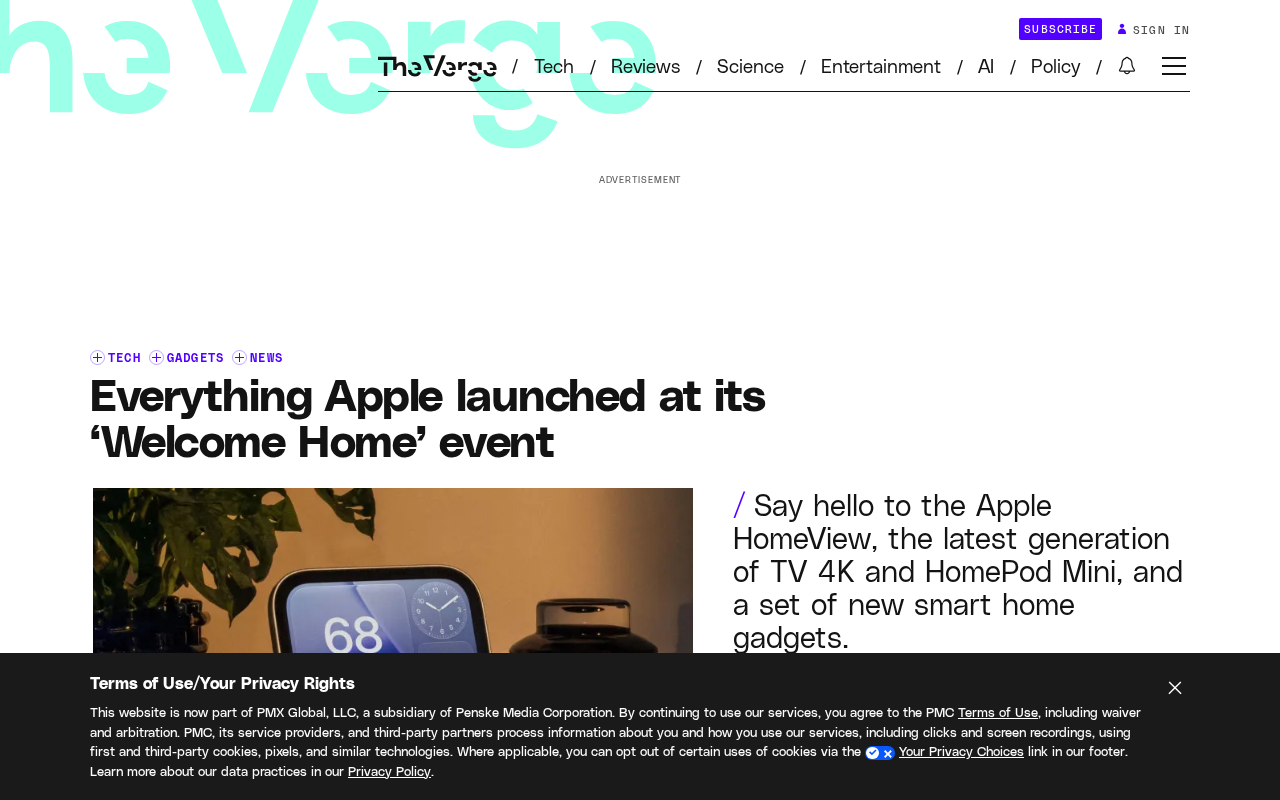
Apple has officially dropped a major piece on the smart home chessboard with an event called "Welcome Home." At the heart of the showcase was the debut of Apple's first smart home hub device — a product the industry has long anticipated, marking Apple's shift from "accessory supplier" to "home ecosystem leader."
Smart Home Hub: Apple Completes a Key Piece of Its Ecosystem
The long-rumored Apple smart home hub has finally arrived. As Apple's first hub-class product in the smart home space, its significance lies not in piling up individual features, but in providing a unified control and automation core for scattered HomeKit devices.
Previously, Apple's smart home strategy relied mainly on iPhone and iPad as control terminals, lacking a always-on "brain" that operates independently within the home. The launch of this hub device signals that Apple is now taking the concept of "whole-home intelligence" seriously. For users already invested in the HomeKit ecosystem, the hub's arrival provides hardware-level assurance for the reliability and responsiveness of automation scenes.
What Is a Smart Home Hub?
A smart home hub is an always-on device that serves as the "brain" of a smart home system, responsible for connecting, coordinating, and orchestrating various smart devices in the home. Its core functions include: unified management of different communication protocols (such as Wi-Fi, Bluetooth, Zigbee, Thread, and Matter), running automation rules (like "turn on lights at sunset"), and maintaining local scene operation even when the network goes down.
Unlike phone or tablet control, a hub device stays online 24/7 and doesn't depend on the user carrying it around. Apple previously lacked this piece, which caused HomeKit automation rules to often fail when the controlling iPhone left the home. The hub's launch essentially solves HomeKit's "headless operation" pain point, and is also a necessary prerequisite for Apple to compete head-on with Amazon Echo (with built-in Zigbee hub) and Google Nest Hub.
HomeKit and Matter: The Protocol Foundation of Apple's Ecosystem
HomeKit is Apple's smart home framework launched in 2014, enabling device control and automation through the "Home" app and Siri. Third-party manufacturers must obtain HomeKit certification to integrate, which ensures consistent experience but also limits the variety of device categories.
Matter is a next-generation interoperability standard jointly promoted by Apple, Google, Amazon, and others, aimed at breaking down platform barriers and making devices universally compatible across ecosystems. Apple has supported Matter since iOS 16.1. The launch of hub devices and the proliferation of Matter work in tandem: the former provides a hardware-level local control core, while the latter solves cross-brand device compatibility. Together, they will directly determine whether the HomeKit ecosystem can evolve from "niche and refined" to "accessible to the masses."
HomePod Mini and TV 4K: Long-Awaited Hardware Refresh
Joining the hub on stage were updated versions of HomePod Mini and Apple TV 4K. Both products have gone a considerable time since their last iteration, making this refresh a routine upgrade that users have long called for.
As Apple's "audio entry point" for the smart home, HomePod Mini's update has a direct impact on voice control and home audio experience. The TV 4K refresh relates to Apple's competitiveness in the living room — as the core node of the home's big screen, its performance improvements will drive better experiences across home entertainment and smart control.
The simultaneous update of both products shows that Apple isn't betting on a single category when building its smart home ecosystem, but rather creating synergy between audio and big-screen entry points.
Smart Home and Security Accessories: Launched with Partners
The event also showcased a series of new smart home and security accessories, designed by Apple in collaboration with trusted partners.
Strategically, Apple chose to partner with third parties rather than develop everything in-house, which both ensures rapid expansion of product categories and maintains consistent experience through partnership standards. The addition of security accessories responds to home users' core concerns about privacy and safety — a differentiator Apple has long emphasized in its smart home narrative.
What This Event Means for the Smart Home Landscape
Apple's positioning for this event was clear: not a showcase of individual product tricks, but a concentrated effort to complete the ecosystem puzzle. Hub, audio entry point, big-screen entry point, and security accessories — four layers covering the main interaction scenarios of the smart home.
For users, the most direct change will be a noticeable improvement in the usability and completeness of the HomeKit ecosystem. For the industry, Apple's formal entry will further raise attention for the smart home hub category and may pressure other platforms to follow suit on privacy protection and cross-device collaboration.
Of course, whether the products can truly deliver on their experience promises depends on automation stability in real-world use, third-party device compatibility, and pricing strategy. Hardware launches are just the starting point — ecosystem operation is the long-term test.
One-line Summary
Apple launches its first smart home hub, completing the core piece of the HomeKit ecosystem
Paragraph Summary
Apple officially entered the smart home hub race with its "Welcome Home" event, unveiling its first hub-class device that provides a unified control and automation core for the scattered HomeKit ecosystem. Meanwhile, HomePod Mini and Apple TV 4K received long-awaited hardware refreshes, strengthening the audio and big-screen entry points respectively. Apple also partnered with third parties to launch smart home and security accessories, maintaining consistent experience through partnership standards. The entire event focused on completing the ecosystem puzzle, covering four layers: hub, audio, big screen, and security. For users, HomeKit's usability and completeness will improve noticeably; for the industry, Apple's entry will boost attention for the hub category and may push other platforms to follow on privacy protection and cross-device collaboration.
Related articles

Cursor Can Now Control Your Computer: AI Agents Can Drive Desktop Apps for Testing
Cursor adds desktop control: AI agents can drive desktop apps like the iOS Simulator to test their own features. We analyze the impact on dev workflows, possible technical approaches, and reliability concerns.

Vibecoding a Custom Inference Engine: High Hopes, Harsh Reality
A Reddit developer shares the real experience of vibecoding a custom inference engine: running GGUF Q4 models in the browser with WebGL2 and GLSL, only to fall into tokenizer debugging hell. This article analyzes the engineering challenges of browser-side LLM inference and why cloning llama.cpp is the more rational choice.

How High Are Anthropic's Early Investor Paper Returns Ahead of IPO?
Anthropic's early investor paper returns draw attention ahead of IPO. This article analyzes sources of book gains, capital structure, pre-IPO games and risks, and implications for the AI startup ecosystem.