Approve Effects, Not Invocations: The Closure Blind Spot in AI Pipeline Security

Approve effects, not invocations — closure metrics must replace coverage in AI pipeline security.
The article centers on a recurring security failure pattern: existing approval systems verify only the legitimacy of invocations while ignoring the effect closures they trigger. Three cases — a package install with hidden lifecycle hooks, a compliant skill that formed a harmful composition, and a 98.4%-coverage provenance repair that missed all 32 critical lines — all point to the same structural gap between component-level approval and system-level harm. The author concludes that by mid-2027, consequence-bearing AI pipelines will adopt closure metrics over coverage metrics, and engineering teams must shift their security focus from entry-point approval to end-to-end effect auditing.
A Recurring Failure Pattern
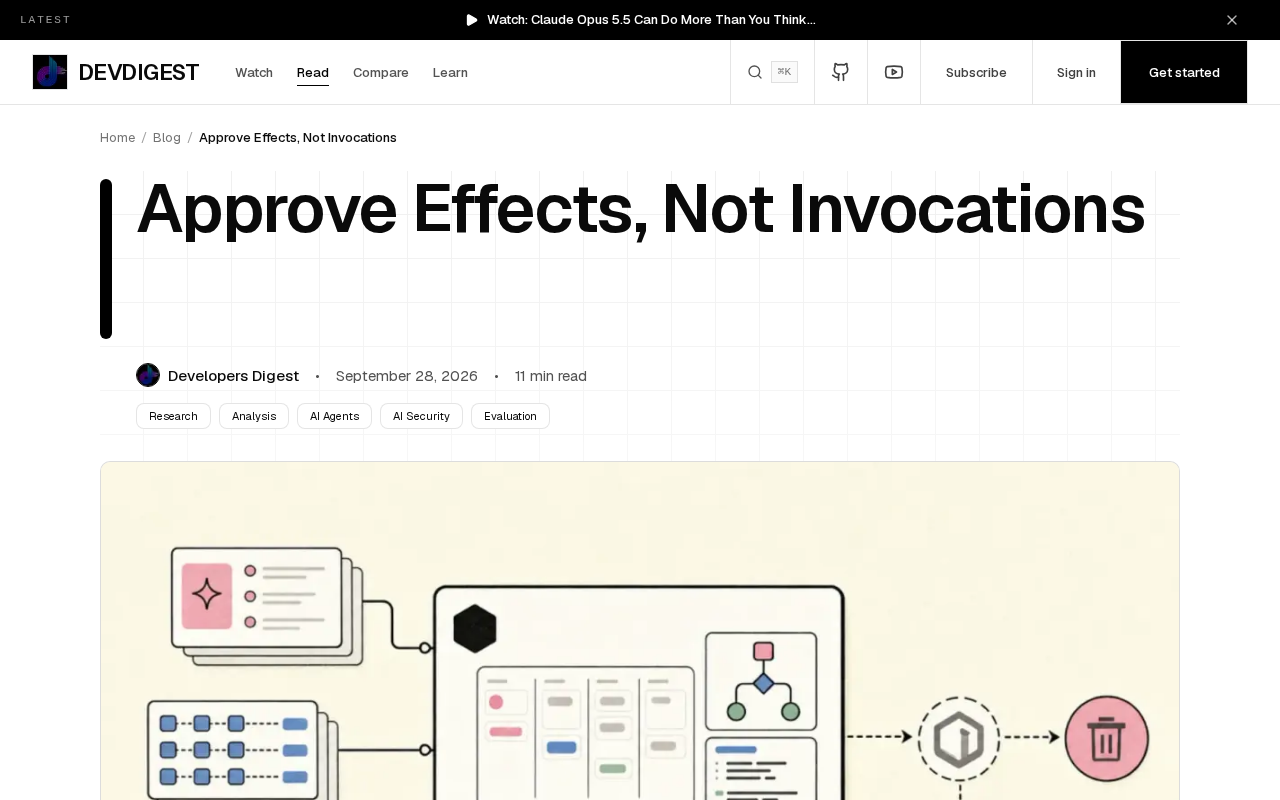
Three independent measurements this week all point to the same root problem: safety records are scoped to individual components, while real harm hides in closures. In other words, we approve the invocation itself while ignoring the chain of effects that invocation triggers.
This misalignment is especially dangerous in AI pipelines and automated systems. When we authorize an operation, we typically verify only its immediate identity and permissions — without tracking the actual consequences it produces upstream or downstream in the execution chain. The original author uses three concrete cases to expose how widespread this blind spot really is.
Three Cases, One Common Crack
An Approved Installation That Ran Someone Else's Lifecycle Hooks
The first case involves an "approved installation." On the surface, the installation action itself passed review — but during execution, it ran third-party lifecycle hooks. The approval record stopped at "is this package trustworthy?" while the harm occurred inside hidden code triggered by the installation process. The invocation was approved; the effects that actually ran were far beyond what was expected.
Lifecycle hooks are scripts that package managers (such as npm or pip) automatically trigger during install, update, or uninstall operations. Common names include preinstall, postinstall, and prepare. These hooks are defined by the package publisher, and the installing party typically cannot anticipate their behavior without auditing the source code. Attackers can embed malicious code in a postinstall script inside an apparently harmless dependency — once a downstream project installs it, the malicious code executes silently in the user's environment, completely invisible to any review process that only checks package names and version numbers. The 2021 ua-parser-js supply chain attack and several PyPI poisoning incidents all followed this path. This is the textbook real-world example of "approving the invocation (the install action) while letting through the effect (hook execution)."
A Vetted Skill That Formed a Harmful Combination
The second case involves a "vetted skill." Examined in isolation, the skill had no issues and passed review. But when combined with other components, it formed a harmful composition. This exposes an inherent limitation of component-level approval: every individual part may be compliant while the whole system goes out of control. Security is not the sum of its parts — the interaction effects within a closure are where the real risk lives.
A 98.4% Provenance Repair That Missed All 32 Lines Actually Read by the Decision
The third case is the most ironic. A provenance repair achieved 98.4% coverage — which sounds nearly perfect. The problem: it happened to miss all 32 lines of data that the decision actually read. The coverage metric looked impressive while being completely disconnected from what actually mattered. High coverage masked a total failure on the critical path.
The Fundamental Flaw of Coverage Metrics
Taken together, these three cases reveal a deep flaw in how we currently measure security: we habitually use coverage to gauge safety, while ignoring that closure is where harm actually lives.
Coverage answers the question "how many components did I check?" Closure asks "what effects did these operations actually produce, and who consumed them?" The reason 98.4% coverage is meaningless is that the remaining 1.6% happened to be the core that the decision depended on. When the measurement standard is misaligned with the actual harm path, no number — however large — is anything more than false reassurance.
This shift in thinking requires us to redefine what we approve: not who is invoked, but what effects are produced. The former focuses on identity and permissions; the latter focuses on the propagation chain of actual consequences.
"Closure" here does not refer narrowly to the programming-language concept of a function capturing external variables. Rather, it borrows the idea of a "closed scope" to describe the complete boundary of effects touched by a single operation — including the state it directly modifies, the side effects it indirectly triggers, and the data ultimately consumed by downstream decisions. By contrast, traditional coverage metrics (line coverage, branch coverage) count "how many code units were reached by tests or review" — fundamentally an input-side tally that cannot reflect what those code units did to the outside world at runtime, or where those impacts flowed. The core difference is one of perspective: coverage is centered on the inspector; closure metrics are centered on the consequence propagation path. When harm hides at the tail end of a high-frequency but low-visibility propagation chain, the higher the coverage number climbs, the stronger the false sense of security it gives operators.
A 2027 Prediction: Closure Metrics Will Become the Standard
The author makes a clear prediction: by mid-2027, consequence-bearing pipelines will report closure metrics rather than coverage metrics.
The logic behind this prediction is straightforward. As AI systems increasingly take on decisions with real-world consequences — from package installation to skill composition to data provenance — component-level verification alone can no longer provide reliable safety guarantees. What systems need to track is the complete propagation path of effects: what code an approved operation ultimately touches, what behaviors it composes into, and what data it influences that gets read by downstream decisions.
For engineering teams building AI pipelines and automated systems, this means shifting the center of gravity in security design from entry-point approval to effect auditing. Rather than investing effort in verifying the legitimacy of every individual invocation, the priority should be building end-to-end traceability of operational consequences.
"Consequence-bearing pipelines" refers specifically to AI workflows whose outputs directly trigger real-world actions — such as automatically executing code changes, initiating financial transfers, modifying production configurations, or generating legally binding documents. Unlike recommendation systems where a human reviews the output before anything happens, errors in these pipelines cannot be intercepted manually before final execution. This places far higher demands on explainability and auditability. As LLM-driven agent frameworks (such as LangChain, AutoGen, and CrewAI) rapidly land in enterprise environments, more and more decision chains are acquiring consequence-bearing properties — which is the industry backdrop that leads the author to believe demand for closure metrics will move from niche to mainstream within the next two years.
Implications for Practitioners
The principle "approve effects, not invocations" is concise, yet it challenges the existing security audit paradigm. It reminds us that:
- A component passing review does not mean the system is safe; compositional effects from interactions can introduce entirely new risks.
- High coverage numbers must be aligned with actual decision paths — otherwise they are pure data illusion.
- Hidden execution contexts like lifecycle hooks are high-risk blind spots in any approval process.
As AI systems take on increasingly critical decisions, this way of thinking deserves serious attention from every team building consequence-bearing pipelines. Real security isn't about how many invocations you've approved — it's about whether you have control over all the effects they produce.
Related articles

JobRunner MCP Server: AI Agents Can Now Fix Failed Java Jobs
JobRunner launches an open-source MCP server enabling AI agents to view cluster status, diagnose failures, and recover Java jobs—incident response from any cloud coding environment or existing agent.

MLAI Digital Launches 9 Security Agents: MCP Server Safeguards the Full Lifecycle of Agentic AI
MLAI Digital launches Security MCP Server with nine built-in specialized security agents covering vulnerability discovery, attack simulation, prompt injection detection, API and infrastructure assessment, and accelerated remediation—embedding security validation across the full Agentic AI lifecycle from development to production.

Running Isaac Lab on H100 GPUs: Exploring Better Approaches
Exploring optimization methods for running Isaac Lab on NVIDIA H100 GPUs, including MIG configuration, mixed precision, TensorRT acceleration, and community experience to improve robotics simulation and reinforcement learning efficiency.