Appxiom: Giving AI Coding Assistants Production Context

Appxiom gives AI coding agents production runtime context so they can locate and fix real production defects.
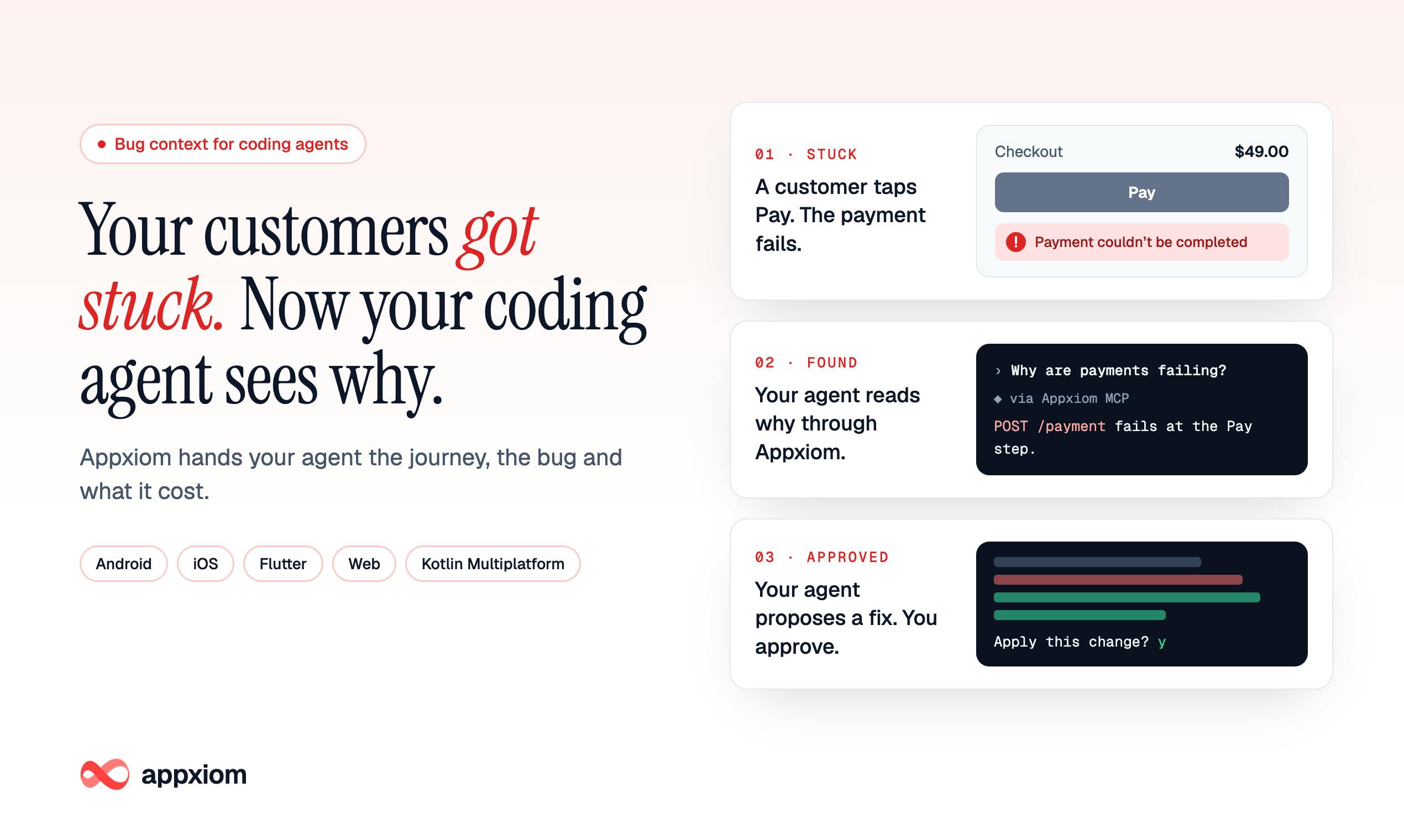
Appxiom is a developer tool debuting on Product Hunt, positioned as a "context layer" for AI coding agents. It converts production signals—crashes, jank, memory leaks, network failures, and broken user journeys—into context agents can reason about. Its Goal Friction Impact ranks bugs by blocked business goals rather than severity, fitting limited context windows. It covers Android, iOS, Flutter, KMP, and all web JS/TS frameworks, bridging the manual gap between APM and AI agents.
AI coding assistants are getting increasingly skilled at writing code, but they falter when they hit real production environments: crashes, stuttering, memory leaks, failed network requests, and interrupted user flows are hard to solve with code completion tools alone. Appxiom, which debuted on Product Hunt, aims to fill this gap—providing AI coding agents with the missing production context so they can not only write code but also locate and fix real defects.
Why AI coding assistants need a "context layer"
The capability boundary of mainstream AI coding tools today is clear: they excel at generating snippets based on codebases and prompts, but they know almost nothing about how the application behaves at runtime. An app crashes after a button tap, a list drops frames while scrolling, an endpoint repeatedly times out on a weak network—the root causes of these issues often lie in logs, call chains, memory snapshots, and user behavior paths, not in the source code itself.
Appxiom's positioning is precisely this "translator" layer: converting crashes, stuttering, memory leaks, failed network calls, and interrupted user journeys in production into context that AI agents can understand and reason about. In other words, agents no longer merely "read code"—they can "see the runtime."
APM (Application Performance Monitoring) is key background for understanding this problem. APM refers to a category of tools for monitoring application performance in production, with typical capabilities including collecting crash rates, response times, throughput, error rates, and distributed tracing. Common products include Sentry (focused on error monitoring), Datadog, New Relic, and Firebase Crashlytics. The core value of APM lies in "discovering and displaying problems," but the raw data it produces—logs, stack traces, flame graphs—is not friendly to non-human consumers, especially AI agents: low information density, diverse formats, and high noise. What Appxiom fills is precisely the layer that structures and semantically translates the raw runtime signals collected by APM into context that agents can directly reason about.
Goal Friction Impact: Prioritizing bugs by business goals
Appxiom has a notable entry point in its feature design: Goal Friction Impact. Rather than ranking by traditional defect severity (P0/P1), it measures which user goals each bug costs you—such as "complete a purchase," "upload an avatar," or "submit a form."
This logic is especially important for AI agents. An agent's context window is limited, so it cannot analyze hundreds of defects at once; ranking by the degree to which business goals are blocked lets it prioritize issues on critical paths that actually affect conversion. For mobile and web applications, this user-journey-centric attribution approach is closer to how product teams make decisions than simply looking at crash rates.
Context window is the upper limit of tokens a large model can process in a single inference pass, directly constraining how much information an AI agent can "see" at once. Current mainstream models have context windows ranging from tens of thousands to millions of tokens, but even with a large window, stuffing in the full stack traces, logs, and call chains of hundreds of defects leads to higher costs, diluted attention, and degraded reasoning quality. Therefore, how to prioritize input information becomes a key part of agent workflow design. Goal Friction Impact is essentially an agent-oriented input pruning strategy: ranking by business impact rather than defect severity ensures that issues affecting core user journeys are presented first within a limited window—a clear departure from the traditional P0/P1 alert-level approach.
Multi-stack coverage: from native to cross-platform
According to the official description, Appxiom's integration scope is quite broad:
- Android: Kotlin, Jetpack Compose, Java
- iOS: Swift, SwiftUI, Objective-C
- Cross-platform: Flutter, Kotlin Multiplatform
- Web: All JavaScript/TypeScript frameworks, with dedicated support for React
This coverage means it doesn't want to be a plugin for just one ecosystem but rather a universal cross-stack context layer. For teams maintaining native apps, Flutter modules, and React frontends simultaneously, a unified problem view is less hassle than multiple monitoring tools.
Which part of the AI coding toolchain it fills
Looking at Appxiom within the existing toolchain, it is neither a code generator nor a traditional APM (Application Performance Monitoring) tool. A more accurate analogy: APM collects and displays runtime data, while Appxiom "feeds" that data to AI agents.
This link was previously disconnected. Developers use APM to discover problems, then manually paste logs and stack traces to AI assistants, with humans doing the information transfer in between. Appxiom aims to automate this step, letting agents start diagnosis and remediation suggestions directly from production context. For AI coding workflows that pursue a "closed loop," this is essential infrastructure.
Distributed tracing is one of the important sources of production context. In microservices and frontend-backend separated architectures, a single user action often spans multiple services and clients. Distributed tracing assigns a unified trace ID to requests, linking the latency and status of each step across networks, services, and databases into a traceable call tree. Together with crash logs, memory snapshots, and user behavior paths, it forms the core evidence for diagnosing issues like "an endpoint repeatedly times out on a weak network" or "a certain step slows down the entire flow." For AI agents, call chains provide cross-component causal ordering, which supports root-cause reasoning better than scattered log fragments—making it one of the more technically sophisticated types of data in the "runtime context" that Appxiom emphasizes.
Early signals and what to watch
On Product Hunt, Appxiom received 121 upvotes and 11 comments, ranking 4th for the day and categorized under SaaS, Developer Tools, and Artificial Intelligence. This result shows the concept of "AI agents + production context" has appeal, but the sample is still small.
The questions to watch are clear: integrating with production environments means sensitive data enters the AI reasoning pipeline—how will permission and privacy boundaries be designed? Is the actual depth of multi-stack support consistent? And what is the accuracy of the agent's remediation suggestions in real codebases? These can only be judged after more teams actually use it.
For developers, the trend Appxiom represents is more noteworthy than the product itself: AI coding tools are moving from "completing code" to "understanding the runtime," and the battle for the context layer may determine the shape of the next generation of development tools.
One-line Summary
Appxiom provides AI coding agents with production runtime context, enabling them to locate and fix real production defects.
Paragraph Summary
Appxiom is a developer tool that debuted on Product Hunt, positioned as a "context layer" for AI coding agents. Today's AI coding assistants excel at generating code but know almost nothing about application runtime, making it hard to handle production issues like crashes, stuttering, memory leaks, network failures, and interrupted user flows. Appxiom aims to convert these production signals into context agents can reason about, and introduces a Goal Friction Impact mechanism that ranks bugs by the degree to which business goals are blocked rather than traditional defect severity, adapting to agents' limited context windows. It covers Android, iOS, Flutter, Kotlin Multiplatform, and all JS/TS frameworks on the web, filling the gap between APM and AI agents where logs are currently moved manually. The product received 121 upvotes and ranked 4th for the day; the concept has drawn attention, but privacy boundaries and the depth of multi-stack support remain to be verified.
Related articles

OpenAI to Shut Down Agent Builder and Two Other Services on November 30, Developers Must Migrate Urgently
OpenAI will shut down Agent Builder, the evals dashboard, and reusable prompts on November 30; evals is already read-only. Here's the scope, OpenAI's migration paths (Agent SDK, PromptFu, your own code), and what developers should export and rebuild this week.
RankSpot: A Pay-Per-Use SEO & AI Search Execution Layer That Lets Agents Write, Publish, and Build Backlinks for You
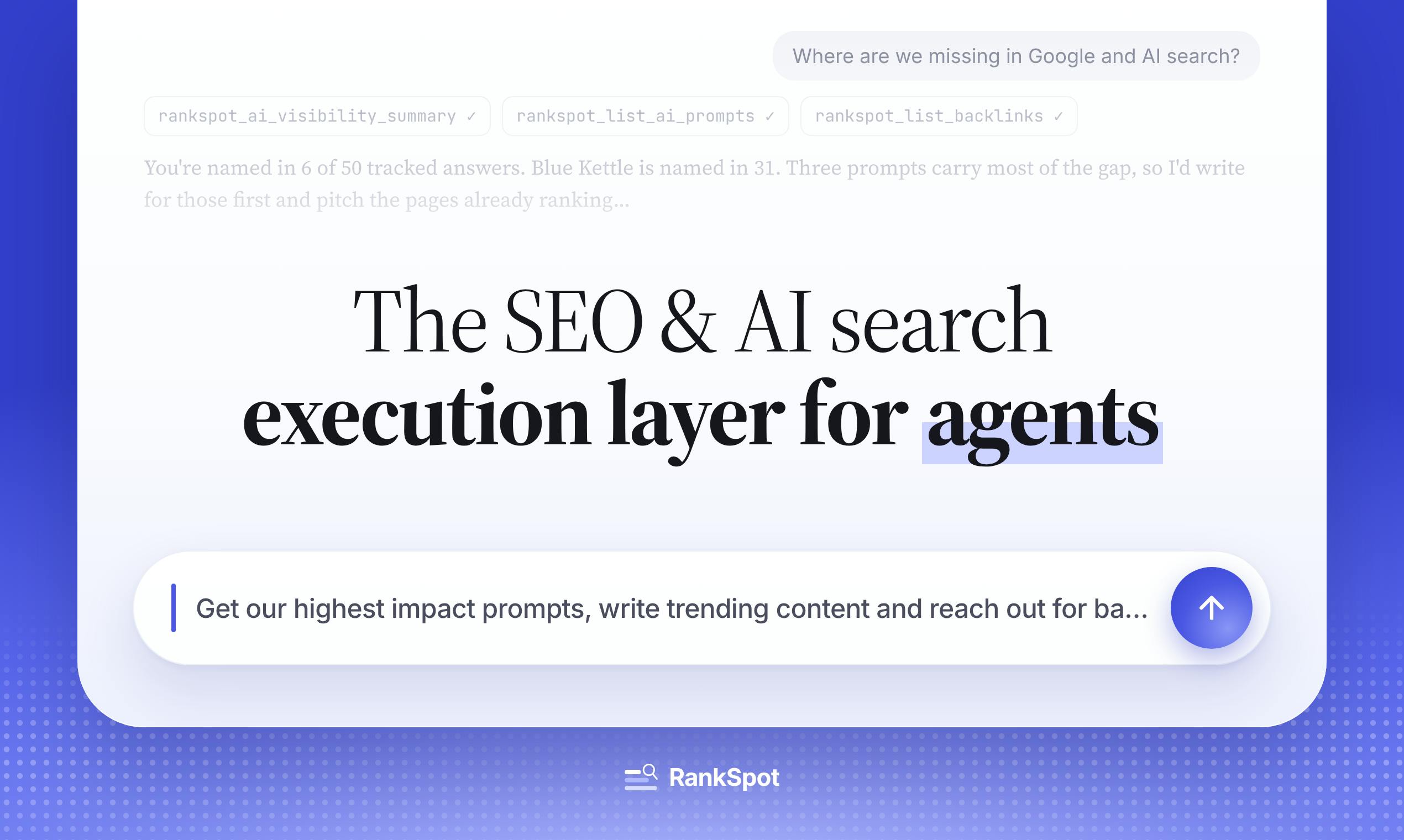
RankSpot is an SEO & AI search execution layer for AI Agents. Connect via MCP to Claude or ChatGPT to write, publish & build backlinks. Pay-per-use, $3/article.

Creatify Max: Your Paid-Ad AI Teammate, from Strategy to Launch
Creatify Max is an AI paid-ad assistant from Product Hunt: enter a product link or brief to generate video ads, build Meta and TikTok campaigns, and monitor performance 24/7—all launches need human approval.