RankSpot: A Pay-Per-Use SEO & AI Search Execution Layer That Lets Agents Write, Publish, and Build Backlinks for You
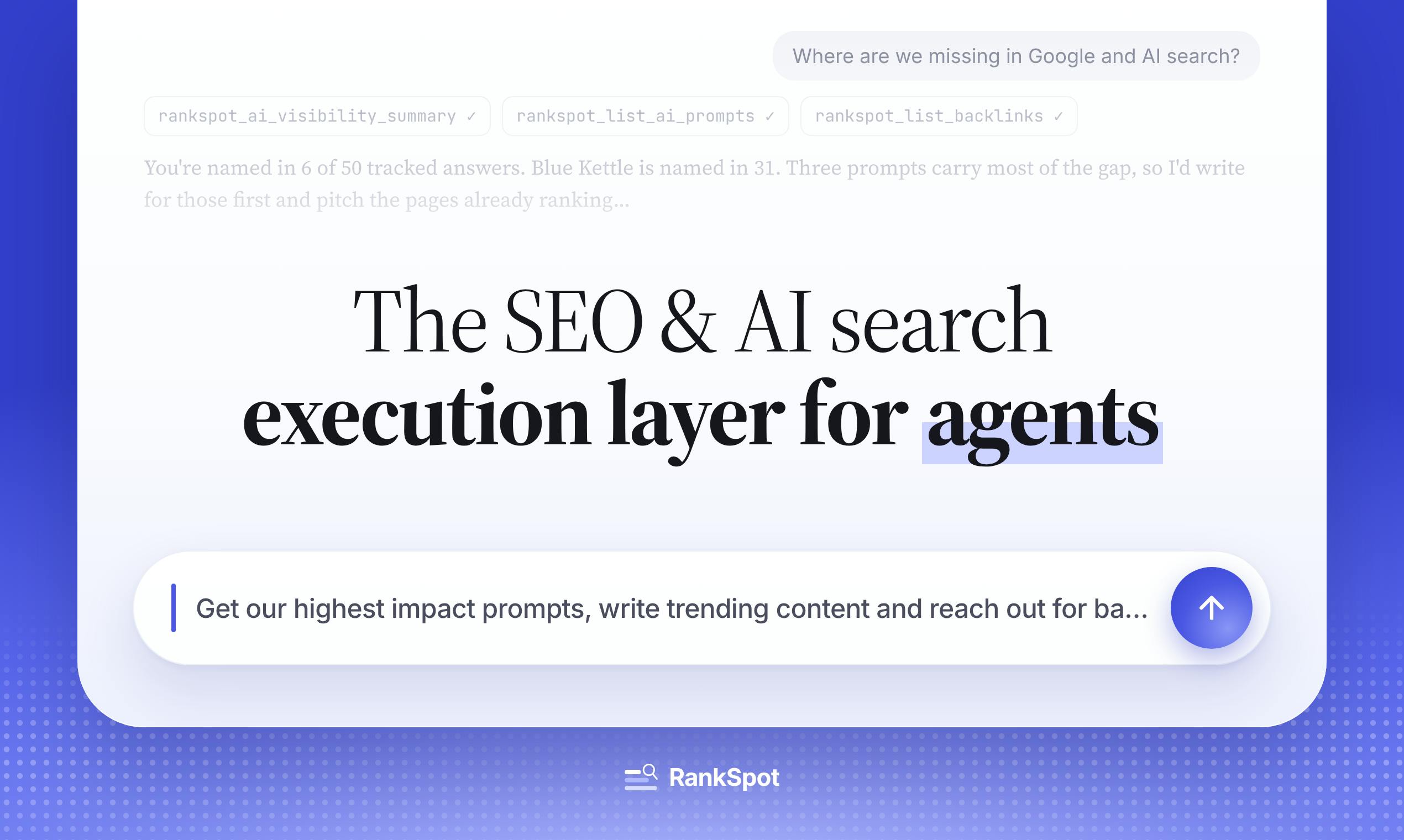
RankSpot lets AI Agents execute SEO writing, publishing, and backlink acquisition via MCP, with pay-per-use pricing.
RankSpot is positioned as "the execution layer for SEO and AI search." It connects to Claude or ChatGPT via MCP, letting AI Agents complete the full workflow from topic selection and writing to publishing and backlink acquisition in a conversation, rather than just offering an analytics dashboard. It writes based on top-ranking Google content, supports 100+ languages, and uses a pay-per-use model: $3/article, $0.004 per prompt check, free data reading, plus a $1 credit and one free article for new users. It hit #1 on Product Hunt, but content quality, email compliance, and MCP permission boundaries need real-world verification.
SEO work has long been slowed down by two things: content production and link building. RankSpot aims to hand both off to AI Agents—not by giving you a dashboard to operate manually, but by plugging execution capabilities directly into Claude or ChatGPT via MCP, so the Agent can handle the entire workflow from topic selection and writing to publishing and link exchange, all within a conversation.

Product Positioning: The Agent's SEO Execution Layer
RankSpot positions itself as "the execution layer for SEO and AI search." The key word here is "execution." Most SEO tools on the market stay at the analysis level—they tell you keyword difficulty, competitor traffic, and backlink gaps, but the actual work of writing articles, publishing content, and sending outreach emails for backlinks is still done by humans. RankSpot picks up the second half.
Onboarding is lightweight: connect the MCP to Claude or ChatGPT, and it claims configuration takes just 2 minutes. After that, the Agent can read data under your account (reading data is free), write articles based on content that already ranks well on Google, supports 100+ languages, publishes directly once written, and can reach out from your email inbox to contact ranking sites for backlink exchanges. All clients or business lines can be managed and switched within a single conversation.
This "conversation-as-console" format is especially appealing to agencies and multi-business operators—no jumping between multiple tools, and no need to open a separate subscription for each client.
MCP (Model Context Protocol) is an open protocol proposed by Anthropic in late 2024 to standardize how AI models connect to external tools and data sources. Think of MCP as "the USB port for AI": models don't need to build a separate integration for every third-party service—as long as the service side implements MCP, clients like Claude and ChatGPT can call its capabilities and read its data in a unified way. RankSpot packages its SEO execution capabilities as an MCP service; once users add that service to their AI client, the Agent gains the invocation permissions for actions like "writing articles, publishing content, and sending emails." The value of MCP lies in freeing tool capabilities from dedicated interfaces and embedding them directly into the conversation flow—which is also the technical prerequisite that makes "conversation-as-console" possible.
Pay-Per-Use: Breaking Subscriptions Down into Execution Costs
RankSpot makes a clear anti-subscription choice in its pricing: no monthly fee, billed by actual execution volume. The listed prices are $3 per article, $0.004 per prompt check, and free data reading. New users can start with a $1 credit and one free article.
This model is friendlier to low-frequency or fluctuating users. Traditional SEO tools charge monthly regardless of whether you use them; RankSpot ties cost to execution actions, so you pay less if you use less. For Agent scenarios, pay-per-use is also more natural—each Agent invocation is a clear execution event, and the cost is traceable and measurable.
However, pay-per-use also means costs grow linearly with usage. Heavy users need to estimate the actual input-output ratio per article themselves, rather than paying once for unlimited use under a subscription model.
Pay-per-use (usage-based pricing) differs from subscriptions in its core cost structure: subscriptions are "prepay a fixed fee in exchange for usage rights," while pay-per-use is "settled by actual invocation volume." For AI Agent products, usage-based billing is a natural fit—each Agent invocation is a measurable execution event, and costs can be attributed directly to specific tasks. But this model also brings two hidden costs: first, unit price fluctuation risk, as the service provider may adjust prices in line with model invocation costs; second, budget unpredictability, as costs rise linearly with usage growth and there's no cost ceiling like with subscriptions. When evaluating, users should factor in "$3 per article" together with actual output quality and manual editing time to arrive at a true ROI.
Capability Breakdown: Write, Publish, Exchange Links in Three Steps
Based on the product description, RankSpot's core capabilities can be broken down into three layers:
Content production: The Agent doesn't generate articles out of thin air—it writes by referencing content that already ranks well on Google. This approach is closer to "data-driven content replication," reducing the problems of pure generative AI going off track and failing to match search intent. Support for 100+ languages means the same workflow can serve multilingual markets.
Publishing execution: Once the article is written, the Agent publishes it directly, eliminating copy-paste and formatting adjustments. This is the most direct embodiment of the "execution layer" positioning.
Backlink acquisition: The Agent reaches out from your email inbox to contact ranking sites for backlinks. This step is the most labor-intensive and hardest to standardize part of the traditional SEO process. Handing it to an Agent offers room for efficiency gains, but the materials provide no data on email reply rates or actual link exchange success rates—only real-world use can verify that.
Link building is one of the most human-dependent parts of SEO. The basic logic is: links pointing to your pages from other websites (backlinks) are treated as "votes of trust," and high-quality backlinks can improve the search rankings of the target page. Traditional methods include guest posting, resource page inclusion, broken link building, and digital PR, with email outreach as the core action—sending messages to editors or site owners of target sites to persuade them to add a link. This process typically has low reply rates and depends heavily on the sender's reputation and the value of the content. RankSpot has the Agent send emails from the user's own inbox, effectively automating the execution of outreach—but sender domain reputation, degree of email personalization, and recipient filtering strategy remain the key variables determining success, and they're also where this kind of automation most easily runs into trouble.
Points Worth Noting
RankSpot got 160 upvotes and 53 comments on Product Hunt and ranked #1 for the day, showing that the "Agent + SEO execution" combination hits a real pain point for quite a few people. But there are a few questions worth thinking through before diving in:
First, the quality ceiling of Agent-written articles. Writing by referencing ranking content can improve search intent matching, but it may also produce homogeneous content. Whether that helps search rankings in the long run depends on how platform algorithms judge AI-generated content.
Second, the compliance and reputation risks of backlink emails. Automatically sending emails from your inbox—without control over sending frequency, content quality, and recipient filtering—could affect your email domain reputation.
Third, the actual experience of MCP integration. "2-minute setup" is marketing language; the actual permission boundaries and data reading scope after connecting to Claude or ChatGPT need to be confirmed during the trial phase.
For individuals or small teams looking to test the waters of Agent-driven SEO at low cost, the starting point of a $1 credit plus a free article is low enough—you can run one piece of content through the full pipeline first, then decide whether to migrate client business over.
One-line Summary
RankSpot lets AI Agents directly execute SEO writing, publishing, and backlink acquisition via MCP, with pay-per-use pricing.
Paragraph Summary
RankSpot is a product positioned as "the execution layer for SEO and AI search." It connects to Claude or ChatGPT via the MCP protocol, enabling AI Agents to complete the entire workflow—from topic selection and writing to publishing and backlink acquisition—within a conversation, rather than just providing an analytics dashboard. Its content production is based on content that already ranks well on Google, supports 100+ languages, and aims to reduce the risk of generative AI drifting from search intent. On pricing, it adopts an anti-subscription pay-per-use model: $3 per article, $0.004 per prompt check, free data reading, and new users get a $1 credit and one free article. The product ranked #1 for the day on Product Hunt, but the quality ceiling of Agent-written articles, the compliance and reputation risks of backlink emails, and the actual permission boundaries of MCP integration still need to be verified through real-world use.
Related articles

OpenAI to Shut Down Agent Builder and Two Other Services on November 30, Developers Must Migrate Urgently
OpenAI will shut down Agent Builder, the evals dashboard, and reusable prompts on November 30; evals is already read-only. Here's the scope, OpenAI's migration paths (Agent SDK, PromptFu, your own code), and what developers should export and rebuild this week.

Appxiom: Giving AI Coding Assistants Production Context
Appxiom gives AI coding agents production context—crashes, jank, memory leaks, failed network calls—across Android, iOS, Flutter, KMP, and Web, ranking bugs by Goal Friction Impact.

Creatify Max: Your Paid-Ad AI Teammate, from Strategy to Launch
Creatify Max is an AI paid-ad assistant from Product Hunt: enter a product link or brief to generate video ads, build Meta and TikTok campaigns, and monitor performance 24/7—all launches need human approval.