apra-fleet: An Open-Source Solution That Turns Idle Devices into an AI Agent Fleet

Open-source MCP server that turns idle machines into a cost-optimized AI agent fleet.
apra-fleet is an open-source MCP server project that lets developers combine multiple idle devices into a collaborative AI agent cluster. It supports multi-model hybrid scheduling across Claude, Codex, Copilot, and local models, routes tasks by cost tier to minimize expenses, and enables durable, multi-hour, observable workflows for long-running autonomous tasks.
An Open-Source Project That Transforms Idle Machines into an AI Fleet
As AI agents gradually move from concept to real-world implementation, a new open-source project called apra-fleet has caught attention on Product Hunt. Its positioning is straightforward: "Run a fleet of AI agents across your machines" — letting you assemble your existing machines into a fleet of AI agents.
At its core, apra-fleet is an open-source MCP (Model Context Protocol) server that transforms multiple devices you already own into a collaborative AI agent cluster. MCP is an open protocol introduced by Anthropic in late 2024, designed to standardize how AI models interact with external data sources and tools. Think of it as the "USB-C port" for AI — enabling different AI applications to access file systems, databases, APIs, and other external resources through a unified protocol, without writing custom integration code for each data source. By choosing MCP as its underlying protocol, apra-fleet is inherently capable of interoperating with other MCP-compatible tools in the ecosystem.
On its launch day, the project received 79 upvotes, ranking #20 on the daily leaderboard, and was categorized under Open Source, Developer Tools, Artificial Intelligence, and GitHub.
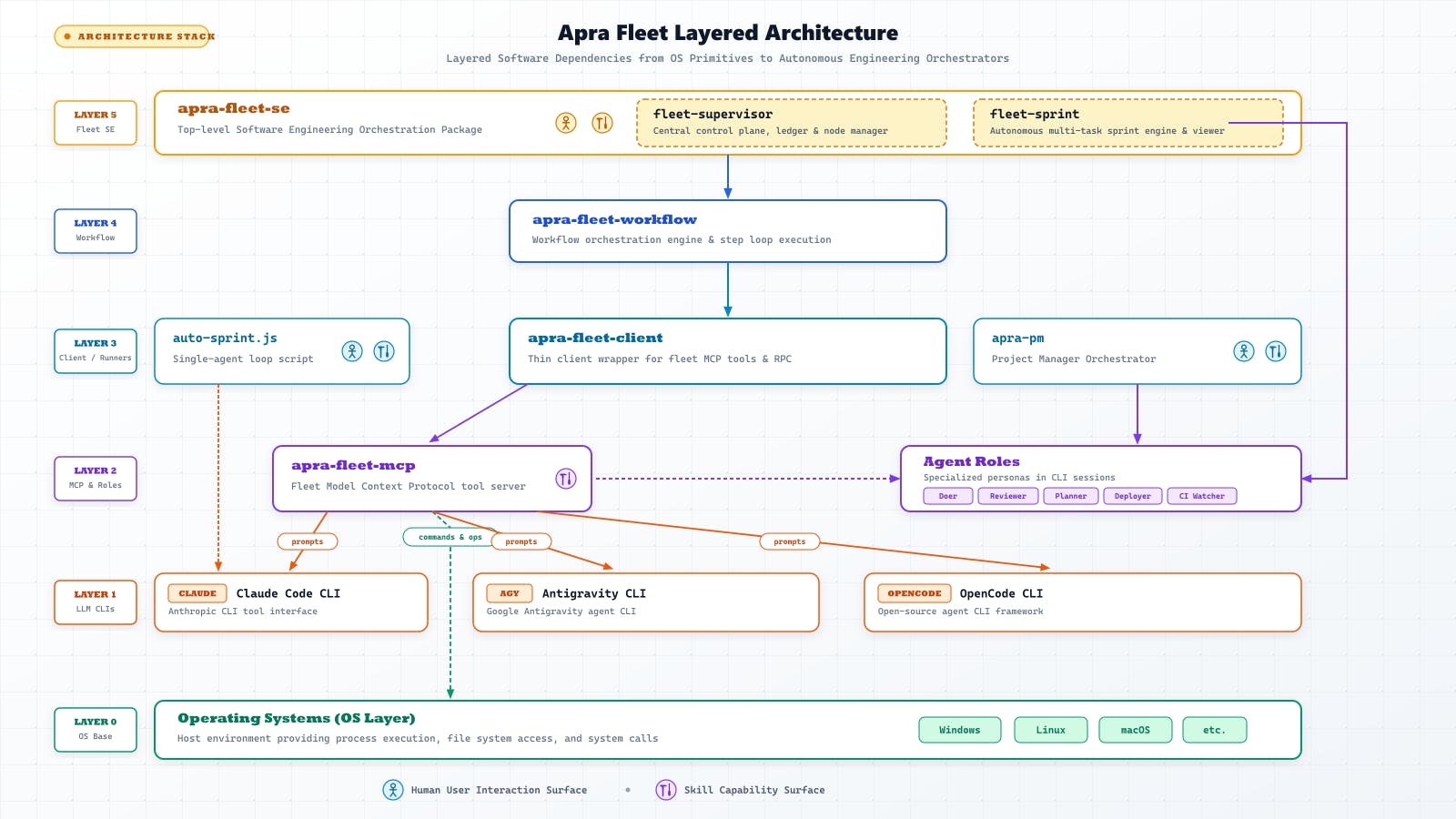
For developers, the project's biggest appeal lies in making full use of existing resources — instead of relying on a single cloud API, you can put old laptops, desktops, or even servers sitting around your home or office to work together on AI tasks. The idea of combining multiple heterogeneous devices into a computing cluster has a long history in computer science, from the early SETI@home project that used volunteers' idle computers worldwide to search for extraterrestrial signals, to federated learning widely used in privacy-preserving scenarios in recent years. However, in AI inference scenarios, the challenge is that computing power varies enormously between devices — a desktop with a dedicated GPU and a five-year-old ultrabook might differ by orders of magnitude in inference capability — requiring smarter task scheduling strategies to properly match workloads.
Multi-Model Hybrid Scheduling: apra-fleet's Core Highlight
apra-fleet's most noteworthy design feature is its hybrid support for multiple AI models. According to the project description, it can unify Claude, Antigravity, Codex, GitHub Copilot, and local models into a single workflow through OpenCode.
Routing Tasks by Cost Tier
A highly practical concept in this architecture is "route work by cost tier" — routing tasks based on cost levels. Specifically:
- Simple, highly repetitive tasks can be handled by low-cost local models;
- Complex tasks requiring strong reasoning capabilities are dispatched to more powerful commercial models like Claude or Codex;
- Through intelligent allocation, performance and cost are balanced to the greatest extent possible.
To understand the value of this strategy, consider the current cost differences between AI models. Among mainstream commercial models, Claude Sonnet 4's API costs approximately $15 per million output tokens, while running open-source small-parameter models like Llama or Qwen on local devices has virtually zero marginal cost beyond electricity. For AI agents that need to run continuously, if all tasks indiscriminately call high-end commercial models, monthly API expenses can easily reach thousands or even tens of thousands of dollars. Therefore, having 80% of simple tasks handled by free local models and only calling commercial APIs when strong reasoning is truly needed could compress overall costs to a fraction of the original amount.
Durable Workflow Design for Long-Running Tasks
A major pain point for most current AI agent applications is the difficulty of supporting long-duration, multi-step complex tasks. apra-fleet addresses this by emphasizing its ability to run "durable, multi-hour, observable workflows".
Breaking Down Durability and Observability
These three keywords deserve unpacking:
- Durable: Workflows won't lose progress due to a single session interruption, making them suitable for automation tasks requiring extended execution. This design borrows from the "durable execution" concept in distributed systems, similar to workflow engines like Temporal and Durable Functions — persisting the state of each execution step so that even if a process crashes or a machine restarts, execution can resume from the last checkpoint rather than starting over;
- Multi-hour: Supports continuous operation spanning several hours, not limited to short Q&A-style interactions. This is critical for scenarios like codebase-level refactoring, large-scale data processing, and multi-iteration creative tasks;
- Observable: Provides monitoring capabilities for task execution, allowing developers to track agent behavior and state.
Observability is particularly important. In software engineering, observability typically encompasses three pillars: Logs, Metrics, and Traces. As AI agents become more autonomous, they may execute hundreds of operational steps without human supervision, making it a widely discussed industry concern how humans can maintain control and audit capabilities over their behavior. apra-fleet's inclusion of observability as a core feature reflects its commitment to production-grade reliability.
The "Self-Building" Autonomous Design Philosophy
The project description includes an imaginative statement: "It builds itself autonomously" — suggesting that apra-fleet possesses some degree of self-evolution or automated setup capability, allowing AI agents not only to execute tasks but also to participate in the system's own construction and optimization.
While limited public information makes it difficult to assess the exact boundaries of this "self-building" capability, the concept aligns with cutting-edge explorations in "AI writing AI" and "agent self-improvement." In academia, this type of research is called "Recursive Self-Improvement" — where a system can analyze its own shortcomings and generate improvement code. Similar practices already exist in the industry; for example, Cognition's Devin can debug and optimize its own toolchain, and Anthropic is exploring having Claude write and improve its own system prompts. If apra-fleet truly achieves this capability, it means the system can automatically adjust scheduling strategies and optimize configurations based on actual runtime conditions after deployment, further lowering the operational barrier.
Building an Open Ecosystem on the MCP Protocol
apra-fleet's choice of MCP as its technical foundation is strategically significant. MCP (Model Context Protocol), as a standardized context interaction protocol, is gradually becoming a universal interface connecting different AI models and tools. Since its release, MCP has gained support from major AI vendors including OpenAI, Google DeepMind, and Microsoft, with thousands of MCP Server implementations emerging in the ecosystem, covering capabilities from database queries and code repository operations to web browsing.
Being built on MCP means apra-fleet can more easily integrate with other tools in the ecosystem and aligns with the open, interoperable technology trend. Combined with its fully open-source nature, developers can freely audit code, customize features, and contribute improvements, ensuring the project's long-term viability.
Summary: A Valuable Experiment in Distributed AI Agent Scheduling
The emergence of apra-fleet reflects the trend of AI agent applications evolving from "single-point cloud calls" toward "distributed collaborative scheduling." It attempts to solve three practical problems: how to fully utilize idle computing power, how to control costs of multi-model invocations, and how to support long-running reliable autonomous tasks.
As a newly launched open-source project, its actual stability, usability, and community activity remain to be proven over time. However, the "machine fleet" concept it proposes offers individual developers and small teams a new path worth exploring for building their own AI infrastructure. For developers focused on the engineering implementation of AI Agents, apra-fleet is worth keeping an eye on.
Related articles

Python 3.15 New Feature: Is the sentinel Type Better Than None?
Python 3.15 adds the sentinel type, using named unique sentinel objects to replace None and bare object(), resolving confusion among missing values, explicit emptiness, and invalid input while avoiding type hint failures.

Deep Learning's Three Architectures and the Universal Approximation Theorem: A Complete Guide to MLPs, CNNs, and Transformers
Explaining the inductive bias differences among MLP, CNN, and Transformer, the existence meaning of the Universal Approximation Theorem (UAT), and the role of Taylor expansion in approximation analysis, while clearing up common misconceptions.

GitLab Emergency Patch Release: Analysis of Critical Security Fixes
GitLab releases critical patch 19.5.1, sparking 355 points of discussion on Hacker News. This article analyzes the background, upgrade steps for self-hosted instances, and verification points to help DevOps teams respond quickly to security updates.