APSW: The Underrated Advanced Python SQLite Wrapper
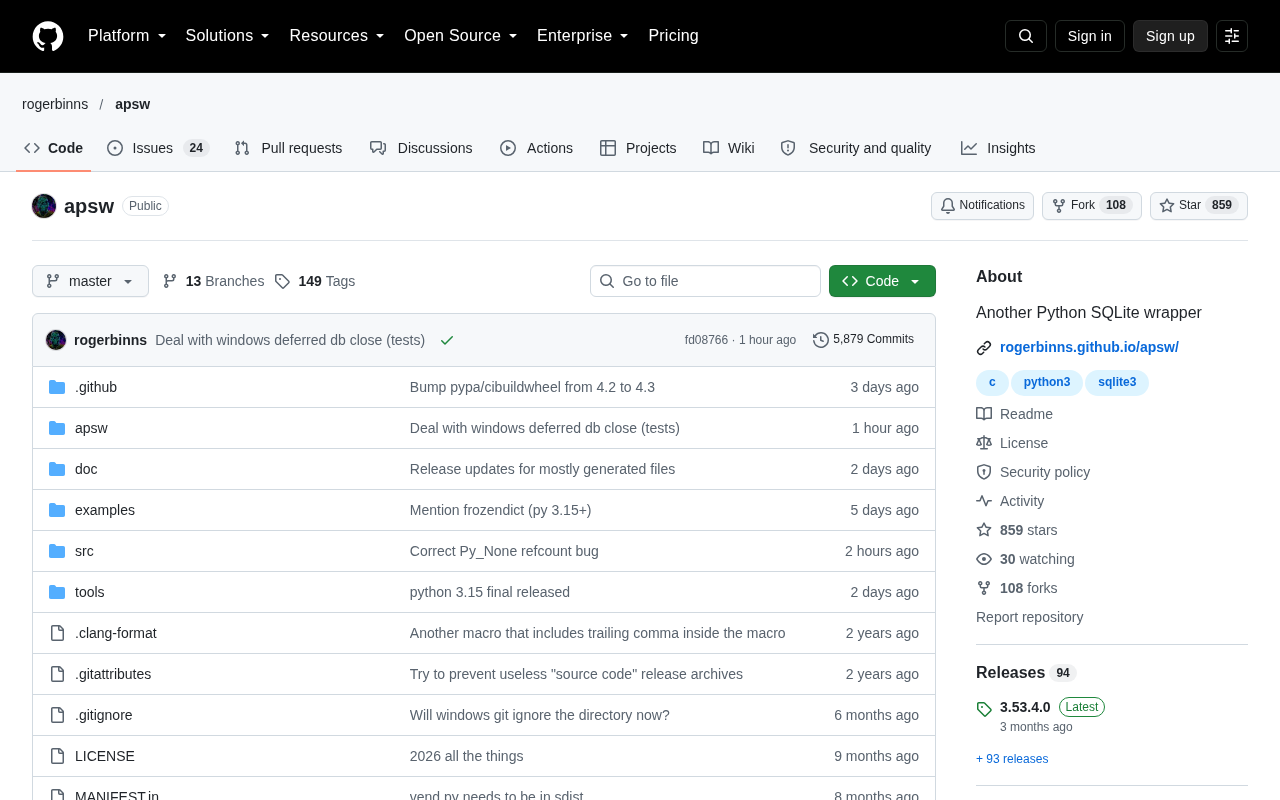
APSW maps SQLite's C API directly to Python, built for advanced use cases beyond the standard library.
APSW (Another Python SQLite Wrapper) is a Python binding that deliberately skips DB-API compliance in favor of closely following SQLite's C API. Compared to the standard `sqlite3` module, its key advantages include full exposure of SQLite's low-level capabilities: custom virtual tables, fine-grained compile-time and runtime configuration, direct access to raw error codes, and the ability to link against a developer-specified SQLite version — bypassing the version lag common in Python distributions. The trade-off is a steeper learning curve and the loss of DB-API conveniences. APSW is not a replacement for `sqlite3`, but rather the go-to advanced option when a project's SQLite requirements exceed what the standard library can handle.
What Is APSW
APSW (Another Python SQLite Wrapper) is a Python binding library focused on fully exposing SQLite's underlying capabilities. Unlike the standard library's sqlite3 module, APSW is not designed to provide a DB-API-compliant generic database interface. Instead, its philosophy is to map SQLite's C API as faithfully as possible. This means that virtually any feature SQLite itself supports can be accessed directly by Python developers through APSW.
For most everyday use cases, Python's built-in sqlite3 is more than sufficient. But when developers need to reach into SQLite's deeper features, the abstraction layer of the standard library often becomes an obstacle. This is exactly where APSW earns its place — it doesn't try to be a general-purpose ORM or abstraction layer, but rather acts as a faithful "pass-through" to SQLite itself.
Core Differences from the Standard sqlite3 Module
Understanding APSW's positioning requires a clear look at how it differs from the sqlite3 module.
Different Design Goals
sqlite3 follows Python's DB-API 2.0 specification, aiming to make SQLite look and feel consistent with other relational databases (like PostgreSQL or MySQL) to facilitate code portability. The trade-off is that SQLite's unique capabilities get "smoothed over" by the specification.
APSW takes the opposite approach — it deliberately does not conform to DB-API, and is instead designed to closely follow SQLite's C API. Developers gain fine-grained control over SQLite version, compile-time options, virtual tables, custom functions, hooks, and other low-level mechanisms.
DB-API 2.0 (PEP 249) is a unified database access specification defined by the Python community. It standardizes connection objects, cursor objects, transaction commit and rollback, and more. Its core value is "interchangeability": code following the spec can theoretically migrate from SQLite to PostgreSQL or MySQL by simply swapping the driver. Libraries like
sqlite3,psycopg2, andpymysqlall implement this spec. However, this abstraction inherently involves trade-offs — the spec can only cover the common subset across databases, and database-specific features (such as SQLite's WAL mode control or virtual file system interface) often cannot be exposed through the standard interface, forcing workarounds or outright omission.
Where the Use Cases Diverge
If you're doing simple CRUD operations or reading and writing local data files, sqlite3 is completely sufficient and requires no additional dependencies. But APSW's advantages become clear in the following scenarios:
- You need to use SQLite's Virtual Table mechanism to define custom data sources
- You need precise control over SQLite's compile-time and runtime configuration
- You need to register custom SQL functions, aggregate functions, or collations
- You need access to features introduced in newer SQLite versions that the standard library hasn't yet caught up with
Virtual Tables are one of SQLite's most distinctive extension mechanisms. By implementing a set of C interface callbacks, developers can make any data source — such as CSV files, REST APIs, or in-memory data structures — queryable as a standard SQL table. SQLite's built-in FTS5 full-text search engine and R*Tree spatial index are themselves implemented as virtual tables. On the Python side, the standard
sqlite3library exposes no interface for creating custom virtual tables, while APSW fully maps this mechanism to Python through classes likeVTTableandVTCursor. This is one of the sharpest capability boundaries between the two.
Why Developers Choose APSW
One often-overlooked reality is that the SQLite version bundled with Python's standard sqlite3 module depends on the build environment of the Python interpreter, and tends to lag behind. SQLite itself is actively developed, with new versions frequently bringing performance improvements and new features. APSW allows developers to link against a specific SQLite version of their own choosing, breaking free from the constraints of the Python distribution.
Additionally, APSW is more transparent in its error handling. It passes through SQLite's error codes and extended error information directly, rather than re-wrapping them the way the standard library does. For production environments that require precise diagnostics, this transparency is quite valuable.
Of course, this "stay close to the metal" philosophy also means a steeper learning curve. APSW won't handle the convenient conventions that DB-API provides, and developers need a solid understanding of SQLite itself to make full use of it.
The SQLite version lag issue has concrete real-world consequences. For example, the
RETURNINGclause introduced in SQLite 3.35.0 (2021), the->>JSON operator introduced in 3.38.0, and ongoing query optimizer improvements — all depend on the actual SQLite shared library version linked at runtime. The SQLite versions bundled across different Python distributions (including CPython official builds, various Linux distro packages, Homebrew, etc.) vary widely and typically trail the latest official SQLite release by months or even years. APSW supports specifying a particular SQLite version to compile and link against during installation, and can even download the SQLite amalgamation source to compile alongside it — completely bypassing the host environment's version constraints.
Should You Use APSW?
Based on community discussions, APSW is not a "replacement" but more of a "complementary tool." For the vast majority of applications, the standard sqlite3 library remains the sensible default — it has zero dependencies, well-maintained documentation, and seamless integration with the Python ecosystem.
But when a project's need for SQLite control exceeds what the standard library can offer, APSW becomes the necessary next step. It is particularly well-suited for building SQLite extensions, database tooling, and scenarios that need to squeeze every bit of performance out of SQLite.
It's worth noting that APSW has a long maintenance history and comprehensive documentation, which reduces the risk of adopting it. For developers who take SQLite seriously, simply knowing this tool exists is valuable — at least when you hit the ceiling of the standard library, you know there's another path forward.
Summary
APSW embodies a clear tool philosophy: not adding layers of abstraction, but providing a direct channel to capability. It trades generality and ease of use for complete access to SQLite's internals. Not everyone needs this tool, but for the scenarios that do require it, there is almost no substitute. As Python and SQLite become increasingly intertwined across the ecosystem, APSW deserves a place in more developers' knowledge base.
Related articles

Gmod TTT: Boba's Winning Streak and Game Design Insights
An in-depth analysis of Gmod TTT's role system, creative items, and social gameplay mechanics, exploring the relationship between randomness design and game balance through Boba's winning streak phenomenon.

FlexBudget: Fair Comparison of KV Cache Eviction Strategies Under a Unified Compute Budget
AMD engineer proposes FlexBudget at PyTorch Conference: a training-free fair comparison method for KV cache eviction rules using fixed kernels and memory budgets, all in core PyTorch.
