APUS AI Open-Sources Reflex Agent: 3x Faster Than Claude Code, Unlimited Context

APUS AI open-sources Personal Agent Reflex Agent, claiming 3x speed over Claude Code and unlimited context.
APUS AI has open-sourced its Personal Agent product Reflex Agent, claiming response speeds 3x faster than Claude Code and unlimited context processing. The article analyzes that unlimited context may rely on RAG or sliding window attention variants, while speed gains may come from inference optimization, caching, or simplified Agent workflows. Unlike closed-source commercial tools like Claude Code and Cursor, Reflex Agent positions itself as a Personal Agent emphasizing personalized memory and cross-session context continuity, with open-source strategy aimed at quickly building a developer ecosystem. However, APUS AI has not published technical architecture documentation, and the 3x speed and unlimited context claims need validation in real development environments. The article recommends developers evaluate through actual project benchmarks, long file editing and cross-file refactoring scenarios, and language/framework support.
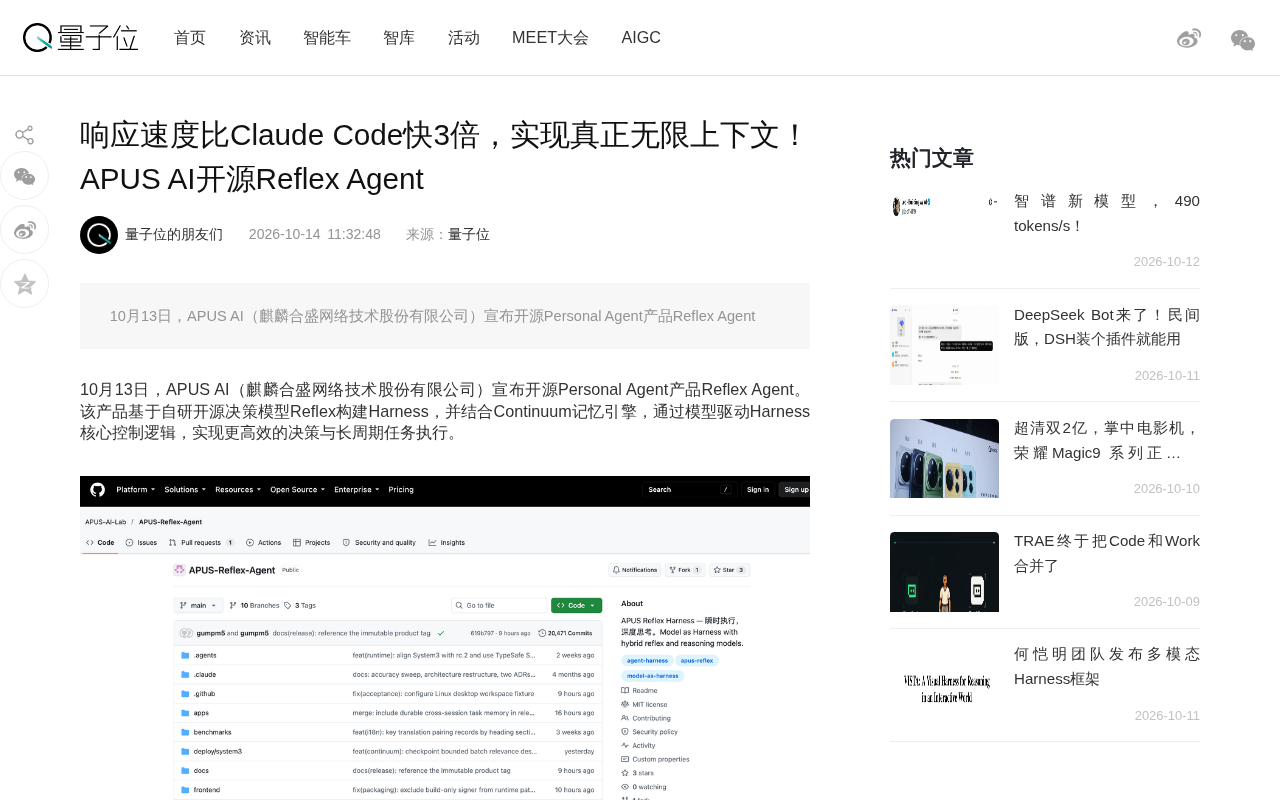
APUS AI (Qilinhsheng Network Technology Co., Ltd.) recently open-sourced its Personal Agent product, Reflex Agent. This tool claims response speeds 3x faster than Claude Code and achieves true unlimited context processing. For developers plagued by context window limitations and response latency, this open-source project is worth attention.
Speed and Context: Reflex Agent's Core Breakthroughs
Claude Code, as Anthropic's terminal-based AI programming assistant, has built a solid reputation in the developer community, but its response speed and context window limitations have long been pain points reported by users. Reflex Agent chooses to tackle these two dimensions head-on, claiming response speeds 3x that of Claude Code while supporting unlimited context.
From a technical standpoint, unlimited context is typically achieved through Retrieval-Augmented Generation (RAG) or variants of sliding window attention mechanisms. How Reflex Agent handles semantic consistency and retrieval accuracy for long documents will determine its usability in real coding scenarios. Currently, APUS AI has not published detailed technical architecture documentation, but open-sourcing means the community can verify these claims independently.
A detail worth noting: speed improvements may come from model inference optimization, caching strategies, or simplified Agent workflows. The 3x figure needs to be validated in real development environments—after all, task complexity varies greatly, and benchmark conditions significantly impact results.
Retrieval-Augmented Generation (RAG) is a class of techniques that retrieves relevant snippets from an external knowledge base before generating answers, then concatenates them into the prompt for the large model to process. It shifts "memory" from model parameters to a dynamically updatable external index, so in theory context capacity can expand infinitely. Common RAG implementations involve: splitting long documents into chunks, encoding them with embedding models, storing them in a vector database, and recalling Top-K snippets by semantic similarity during queries. Its weaknesses lie in retrieval precision and semantic consistency—if chunking granularity is inappropriate or recall is inaccurate, the model receives irrelevant or fragmented context, leading to off-target answers.
Sliding window attention is a local attention variant in the Transformer architecture where each token only attends to tokens within a fixed-length window before and after it, reducing attention computation complexity from O(n²) to O(n·w). It suits streaming processing of ultra-long sequences, but at the cost of losing long-range dependencies across windows, typically requiring memory compression or hierarchical aggregation to compensate. If Reflex Agent adopts either of these approaches, its real performance depends on engineering details like chunking strategy, recall ranking, and window stitching—not the literal promise of "unlimited."
Personal Agent Positioning Differences
Unlike tools like Claude Code and Cursor that cater to professional developers, Reflex Agent positions itself as a Personal Agent. This positioning suggests it may focus more on personalized memory, cross-session context continuity, and customization capabilities for individual workflows.
The "Personal" label is quite telling in the current AI Agent landscape. General-purpose programming assistants are already highly competitive, while the long-term memory and user habit adaptation emphasized by personal agents are exactly where unlimited context capabilities shine. If Reflex Agent can remember a developer's past code preferences, project structures, and common patterns, then unlimited context becomes more than a technical metric—it translates into actual efficiency gains.
APUS AI was previously known for smartphone systems and overseas apps. Its entry into the AI Agent space with an open-source approach may be aimed at quickly building a developer ecosystem. Open-sourcing can accelerate bug discovery and feature iteration, but it also means the business model needs to find another path.
Cross-session context continuity refers to an Agent maintaining memory of user historical preferences, projects, and decisions across multiple independent conversations, rather than starting from scratch each session. Technically, this is usually achieved through persistent memory stores: writing structured information like session summaries, user preferences, and code styles to external storage, then recalling and injecting them into prompts as needed in subsequent sessions. It and unlimited context capabilities mutually reinforce each other—only when context processing is cheap enough can the accumulation of long-term memory avoid dragging down response speed.
Personalized memory goes further, requiring the Agent to proactively identify which information deserves long-term retention and which should be forgotten, involving memory writing, updating, and eviction strategies. This is precisely the key differentiator between Personal Agents and general programming assistants: general assistants solve "how to do this task," while personal agents also address "how you consistently do things."
Open-Source Strategy and Ecosystem Considerations
Reflex Agent choosing open-source is unusual in the AI programming assistant space. Claude Code is a closed-source commercial product, and Cursor is also primarily closed-source. Whether open-source Reflex Agent can attract sufficient community contributions will determine whether it can keep pace with commercial competitors in feature iteration speed.
From a developer perspective, the transparency and customizability brought by open-source are tangible advantages. Teams can audit code security, make deep customizations for internal tech stacks, and even build their own Agent products based on Reflex Agent. But open-source also means APUS AI needs to invest resources in community maintenance, PR reviews, and documentation—significant burdens for a company primarily focused on commercial products.
The implementation details of unlimited context, benchmark conditions for the 3x speed claim, supported models and toolchains—these key pieces of information remain vague. The open-source code itself will answer some questions, but accompanying technical documentation and community support are equally important.
Business models for open-source AI programming assistants typically don't rely on software licensing itself, but pivot to paths like: hosted cloud services (open-source core, charging by usage), enterprise-level support and compliance auditing, value-added services based on user data, or acquiring traffic through open-source and funneling it to proprietary commercial product lines. APUS AI started with smartphone systems and overseas apps, so its open-source Reflex Agent is more likely an ecosystem positioning move rather than direct monetization—using open-source to gain developer attention and PR contributions first, then seeking revenue through hosted or enterprise versions.
It's worth noting that "open-source" means very different things across projects: some use permissive licenses like Apache 2.0, allowing commercial use and closed-source derivatives; others use copyleft licenses like AGPL, imposing restrictions on commercial integration. Reflex Agent's specific license terms will directly affect whether teams can embed it into internal products—this is a must-verify element in any evaluation.
How Developers Should Evaluate
For developers considering trying Reflex Agent, it's recommended to start from several dimensions: run a round of benchmark tests on your own actual projects, comparing Claude Code's response time and output quality when handling the same tasks; test unlimited context's actual performance in scenarios like long file editing and cross-file refactoring; check its support for mainstream programming languages and frameworks.
Early versions of open-source projects often suffer from incomplete documentation and rough edge-case handling. If Reflex Agent's claimed capabilities can be delivered in real scenarios, it indeed provides a competitive open-source option in the AI programming assistant space. But if the marketing numbers look good while the actual experience falls short, the developer community will quickly vote with their feet.
Competition in AI programming tools is shifting from pure code generation capability to a comprehensive experience of context management, response speed, and personalized adaptation. Reflex Agent's emergence at least shows this space still has plenty worth exploring.
Benchmark traps are particularly prominent in AI programming tool evaluations. Numbers like "3x" response speed are highly dependent on test conditions: task type (single-line completion vs. cross-file refactoring), model size and quantization precision, hardware environment, whether caching is enabled, context length, etc. A reasonable evaluation approach is to fix hardware and task sets, control variables, then compare end-to-end latency (not first-token latency) across different tools, testing separately under various task complexity levels.
Long file editing and cross-file refactoring are key scenarios for testing the real value of unlimited context. The former tests the model's ability to locate target code segments in ultra-long inputs; the latter requires the model to simultaneously understand dependencies across multiple files. If the Agent merely stuffs long context into prompts without accurate referencing, the actual experience will be worse than a well-designed RAG solution. Developers are advised to first run small-sample tests on genuinely "tricky files" in their own projects before deciding whether to invest in migration costs.
Related articles

FastAPI: A High-Performance Python Framework and a Production-Ready API Development Powerhouse
FastAPI is a high-performance web framework based on Python type hints, supporting async and automatic OpenAPI docs. With over 100k GitHub stars, this article analyzes its core strengths, production readiness, and selection advice.

Tesla Optimus Begins Mass Production: Can the Goal of 20,000 Units Per Week Be Achieved?
Tesla Optimus officially begins mass production as Musk sets a target of 20,000 units per week. This article analyzes the supply chain challenges behind mass production, the real gap in capacity ramp-up, and the competitive landscape for humanoid robots.

PCL: A Minecraft Launcher with 8.5k Stars — Why Was It Written in VB.NET?
An in-depth analysis of PCL, the GitHub Minecraft launcher with 8,500+ stars: why it chose VB.NET, its features and China network advantages, and the limits of Windows-only.