Arabic Streaming STT Cutting Off Mid-Sentence? Technical Analysis and Solutions

Arabic streaming STT misfires on sentence endings due to dialect-training data mismatch and endpointing limitations.
A developer building a multilingual real-time translation app found that their Deepgram-based streaming STT worked fine for English and Spanish but kept cutting Arabic off mid-sentence — prematurely triggering endpoints and truncating meaning. Switching to whole-utterance processing improved accuracy but added nearly two seconds of latency, hurting the real-time experience. The root cause: mainstream STT models train primarily on Modern Standard Arabic (MSA), while users speak regional dialects, creating a diglossia gap that undermines model confidence and causes frequent false endpoint triggers. Mitigation strategies include per-language silence threshold tuning, semantic-level endpointing, and incremental translation with rollback.
The Problem: Why Streaming STT Fails on Arabic
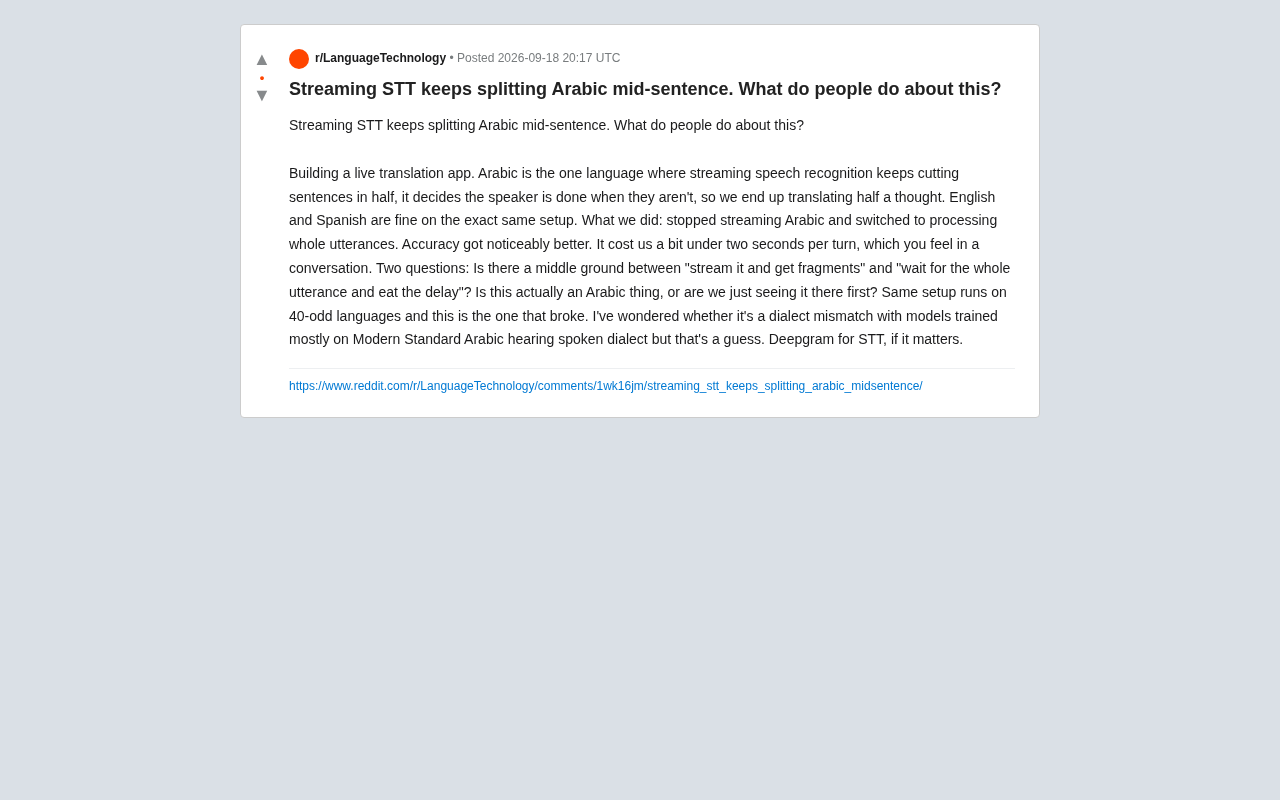
A developer building a real-time translation app posted a frustrating problem on Reddit: using the same tech stack, English and Spanish streaming speech-to-text (STT) worked fine, but Arabic kept getting cut off mid-sentence. The system would incorrectly decide the speaker had finished talking, resulting in only half the meaning being translated.
The developer was using Deepgram as the STT engine, with a system supporting over 40 languages — but Arabic was the only language showing this behavior. Their temporary fix: abandon streaming mode for Arabic entirely and switch to processing complete utterances instead. Accuracy improved noticeably, but at the cost of nearly two seconds of added latency per exchange — a very noticeable delay in real-time conversation.
The Core Tension: Latency vs. Accuracy
At its heart, this case exposes a classic engineering trade-off in streaming STT — the tension between endpointing and recognition accuracy.
Streaming STT relies on "endpointing" to determine when a sentence has ended, typically based on silence duration (VAD, or Voice Activity Detection) and language model confidence scores. When the system misinterprets silence as the end of a sentence, it submits results prematurely, slicing the meaning in half.
The developer raised a key question: Is there a middle ground between "streaming gets fragments" and "waiting for complete utterances means swallowing the latency"?
The answer is yes. Common industry trade-offs include:
- Adjusting the endpoint silence threshold: Lengthening the required silence before declaring a sentence complete reduces false triggers, at the cost of slightly more latency.
- Leveraging interim results: Output temporary transcriptions and keep refining them before final confirmation; on the translation side, use an "incremental translation + rollback" strategy.
- Semantic-level endpointing: Combine language model judgment about whether a sentence is semantically complete, rather than relying purely on silence — avoiding cuts at semantically incomplete points.
- Dynamic buffer windows: Set more lenient buffers for specific languages to balance responsiveness with completeness.
VAD (Voice Activity Detection) is the underlying component of streaming STT systems, responsible for splitting an audio stream into "speech" and "silence" segments — it's the first layer of endpointing judgment. Traditional VAD works based on signal features like energy thresholds or zero-crossing rates, making it sensitive to background noise and atypical pronunciation. Modern systems typically stack language model confidence scoring on top of VAD: only when the acoustic signal is silent and the language model also considers the current context "sentence-complete" does the system actually trigger endpoint submission. This dual mechanism works well for languages with rich training data like English and Spanish — but when the model is underfit on a language, the language model's confidence judgments become unreliable, the entire endpoint logic degrades to relying almost entirely on VAD as a fallback, and false trigger rates rise sharply.
Is This Really an "Arabic-Specific" Problem?
The developer's second question is more broadly valuable: is this an inherent characteristic of Arabic, or did it just happen to surface here first?
The developer offered a reasonable hypothesis: a mismatch between dialect and training data. Most mainstream speech models are trained heavily on Modern Standard Arabic (MSA), while people actually speak regional dialects in practice — Egyptian Arabic, Gulf Arabic, Levantine Arabic, and so on. When the model "hears" spoken dialect that differs significantly from its training data, both acoustic and language model confidence scores drop, making endpointing more error-prone.
This reasoning holds up technically. Several characteristics of Arabic may compound the problem:
At the Linguistic Structure Level
Arabic features rich intra-word pauses, pharyngeal consonants, and long vowels — acoustic features that VAD may misidentify as inter-sentence silence. Arabic word order and use of connective particles also differ significantly from English and Spanish, meaning endpoint logic developed with an English-centric bias may not carry over well.
At the Data Distribution Level
There's a "diglossia" phenomenon between MSA and spoken dialects — the written and spoken forms are nearly two separate systems. If a model's training skews toward MSA, its overall robustness when handling everyday speech suffers across the board; sentence-cutting is just the symptom that gets noticed first.
Diglossia was formally defined by linguist Charles Ferguson in 1959 to describe situations where a language community uses a high variety (H-variety) and a low variety (L-variety) side by side, each with distinct social functions. Arabic is the textbook case: Modern Standard Arabic is used in news, official documents, and formal speeches, while everyday communication uses regional dialects that differ from MSA significantly in phonology, vocabulary, and grammar. For STT models, this means that even achieving high accuracy on MSA tells you nothing about performance in conversational settings — the gap in acoustic distributions between the two can be as wide as the gap between two entirely different languages. This is also why "Arabic support" as a technical spec needs to be broken down further: which variety of Arabic the model was actually validated on determines its real-world usability.
Practical Recommendations for Similar Projects
For developers building multilingual real-time systems, this case offers several transferable lessons:
Configure differently by language. Don't apply a single set of endpoint parameters across all languages. Problem languages like Arabic should have independently tuned silence thresholds and buffering strategies, not global defaults.
Evaluate your provider's dialect coverage. When selecting an STT vendor, explicitly ask about their Arabic model's support for spoken dialects. If your target users speak a specific dialect, prioritize solutions optimized for that dialect or offering custom training options.
Choose streaming vs. whole-utterance mode by context. For latency-insensitive scenarios (like meeting transcription), whole-utterance mode can be used for accuracy; for conversational scenarios, find the sweet spot in endpoint parameters within an acceptable latency range. Nearly two seconds of latency is genuinely high for real-time dialogue — try bringing the silence threshold down to a more reasonable interval.
Build a rollback-capable translation pipeline. Allowing translation output to update when the STT result is revised can go a long way toward mitigating the semantic fragmentation caused by streaming chunks.
Summary
This real-world frustration from a developer in the field reflects a broader shortcoming in multilingual speech technology for non-English languages. Arabic's sentence-cutting problem has both linguistic roots (the MSA-dialect divide) and engineering limitations in endpointing strategy. There's no perfect silver bullet yet — but through language-specific parameter tuning, semantic-level endpoint detection, and incremental translation with rollback, developers can absolutely find a better balance between latency and accuracy.
Related articles

Chain of Thought Isn't Just for AI: How Humans Can Use CoT to Improve Thinking Quality
Chain of Thought isn't just a prompt trick for large models. Starting from a Hacker News discussion, this article analyzes why CoT works for human thinking too, breaks down actionable ways to transfer it, and highlights the key differences between human CoT and machine CoT.
Cloudflare Teams Up with OpenAI: Closi…
Cloudflare Teams Up with OpenAI: Closing the Loop from Vulnerability Discovery to Defense with AI
Cloudflare uses OpenAI Daybreak to investigate security vulnerabilities and generate reviewable remediation plans, while developers use Codex to boost coding efficiency and quality.

Orca Multi-Agent Orchestration in Practice: A Guide to Parallel Collaboration with Claude and Codex
Orca is Stable AI's free open-source agent workbench supporting 34 agents like Claude Code and Codex in parallel. Learn its Git worktree isolation, multi-model orchestration, and mobile management.