ARC-AGI-2 Competition Update: Kaggle Scores Continue to Climb

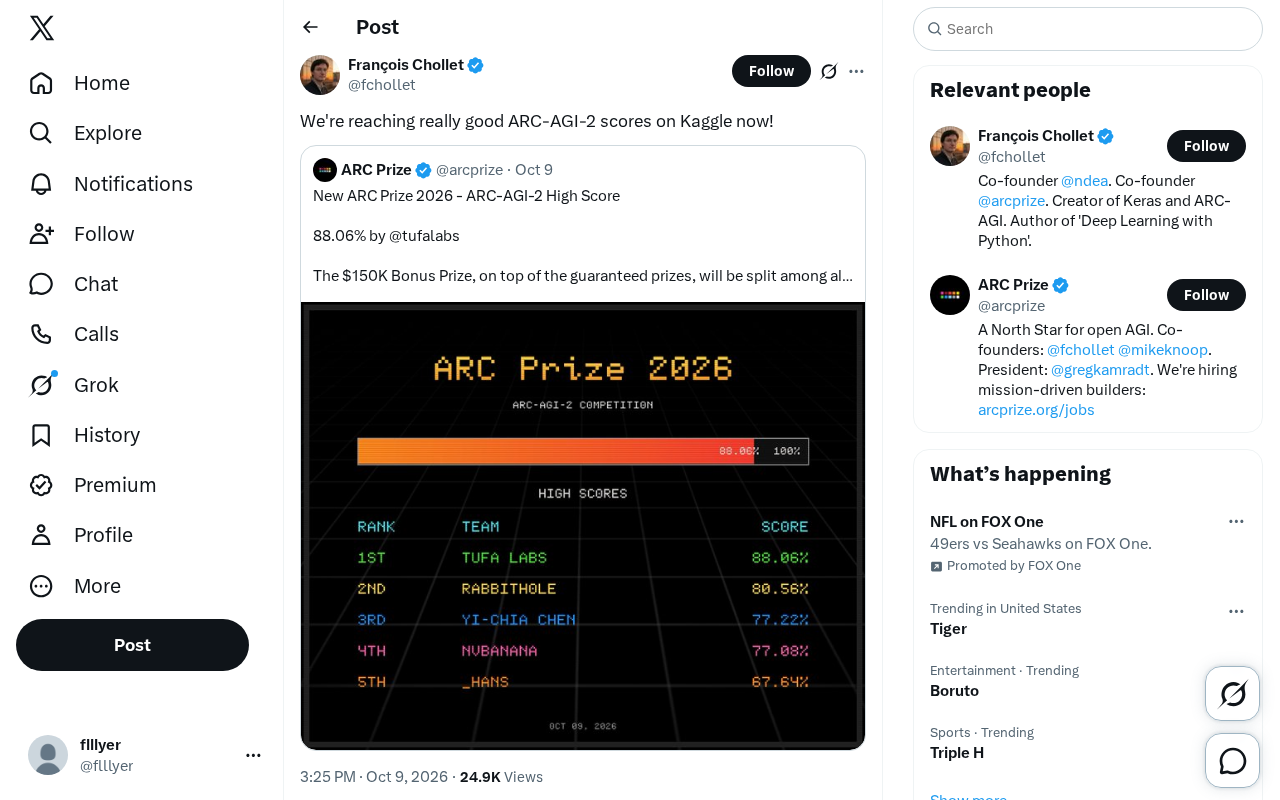
A competitor claims a strong ARC-AGI-2 score on Kaggle, spotlighting the latest advances and limits in AI abstract reasoning.
ARC-AGI-2 is a challenging AI reasoning benchmark designed by François Chollet that tests a model's ability to generalize from just a few examples without relying on memorized training data. A competitor recently announced strong results on Kaggle, drawing community attention. Because the benchmark deliberately blocks shortcuts available to large language models, any visible progress is seen as a real breakthrough in program synthesis, test-time reasoning, or neurosymbolic architectures. The article also cautions that high ARC scores don't equal AGI — Chollet himself stresses it measures only one type of abstract reasoning.
ARC-AGI-2: A New Benchmark for General Intelligence
A brief post on Twitter caught the attention of the AI reasoning community — a competitor announced achieving notably strong results on the ARC-AGI-2 benchmark hosted on Kaggle. While the original message was sparse on details, it points to one of the most debated questions in AI today: whether machines are genuinely approaching true abstract reasoning.
ARC (Abstraction and Reasoning Corpus) was created by François Chollet with a deliberate purpose — not to test a model's memory or pattern-matching ability, but to measure how well a system can generalize and reason when faced with entirely novel tasks. ARC-AGI-2, as an upgraded benchmark, raises the bar even further, specifically designed to close off the shortcut of "memorizing answers" through large-scale pretraining on massive datasets.
The core design philosophy behind ARC traces back to Chollet's 2019 paper On the Measure of Intelligence, which defines intelligence as "the ability of a system to efficiently acquire new skills given as little prior information as possible." Each ARC puzzle presents a set of input-output grid pairs (typically 3–5 examples), requiring the model to infer a transformation rule from those few samples and apply it to a new input. Colors, shapes, and spatial relationships in the grids form a visual language reminiscent of children's IQ tests — one where human test-takers average above 85% accuracy, while mainstream large language models have long hovered below 20%. ARC-AGI-2 tightens the screws further: problems emphasize combinatorial reasoning that requires applying multiple rules simultaneously, and patterns potentially overlapping with training data are deliberately minimized, effectively eliminating any advantage from having "seen something similar before."
Why Score Improvements on Kaggle Matter
Kaggle, the world's largest data science competition platform, has long hosted ARC challenge competitions. Solutions submitted here must produce correct answers to never-before-seen grid puzzles under constrained compute and time limits. This setup makes score improvements particularly meaningful — they're unlikely to stem from simply throwing more data at the problem, and are more likely to reflect genuine advances in reasoning methodology itself.
Saying scores have reached "a pretty good level" may sound understated, but on a benchmark as widely regarded as ARC-AGI-2, any visible progress signals that competing teams have found effective breakthroughs in program synthesis, neurosymbolic integration, or test-time search. For a long time, even state-of-the-art general-purpose models performed far below the human baseline on tasks like these.
A Diverse Landscape of Technical Approaches
Current approaches to tackling ARC broadly fall into several categories: search-based program synthesis methods that construct a DSL (Domain-Specific Language) to enumerate possible transformation rules; large model-driven test-time reasoning and sampling, where more compute is invested during inference; and hybrid architectures combining symbolic reasoning with neural networks.
The appeal of Kaggle competitions is that they place all these approaches on the same track under a unified evaluation standard. Score improvements typically don't come from a single isolated technical breakthrough, but from the engineering integration of multiple techniques — which is exactly why the community pays close attention to every new high score.
The DSL (Domain-Specific Language) approach is one of the oldest technical strategies in ARC competitions. The basic idea is to predefine a set of atomic operations describing grid transformations (such as rotation, mirroring, color substitution, object copying, etc.), then frame the problem as a program search within that operation space. Notable work like Michael Hodel's arc-dsl and the ARGA framework developed by Simon Stelling and others attempts to automatically synthesize programs that satisfy the given examples using combinatorial search or genetic algorithms. This class of methods offers strong interpretability and doesn't rely on large-scale parameters, but faces the challenge of search space explosion — once rule combination complexity exceeds a certain threshold, enumeration efficiency drops sharply. Test-Time Compute methods represent a different philosophy: allowing large models to compensate for single-pass reasoning limitations through multiple sampling rounds, self-evaluation, and iterative correction during inference — essentially trading inference compute for accuracy.
How Far Are We from "AGI"?
It's worth keeping a clear head here: the AGI in ARC-AGI can be misleading. Scoring well on this benchmark does not equate to achieving artificial general intelligence. Chollet himself has repeatedly emphasized that ARC is a tool for measuring one particular class of abstract reasoning ability, not a definitive test for AGI.
That said, sustained score improvements do provide a valuable signal: AI systems are becoming more capable at tasks that require on-the-fly induction and cannot rely on memorization. This kind of progress cuts closer to the fundamental questions about the nature of "intelligence" than improvements on conventional NLP or image benchmarks.
Given the limited information available from the original source, specific score values, technical approaches, and team backgrounds have not yet been publicly disclosed. Readers interested in following developments can monitor the official ARC-AGI-2 leaderboard on Kaggle for authoritative data.
Related articles

JobRunner MCP Server: AI Agents Can Now Fix Failed Java Jobs
JobRunner launches an open-source MCP server enabling AI agents to view cluster status, diagnose failures, and recover Java jobs—incident response from any cloud coding environment or existing agent.

MLAI Digital Launches 9 Security Agents: MCP Server Safeguards the Full Lifecycle of Agentic AI
MLAI Digital launches Security MCP Server with nine built-in specialized security agents covering vulnerability discovery, attack simulation, prompt injection detection, API and infrastructure assessment, and accelerated remediation—embedding security validation across the full Agentic AI lifecycle from development to production.

Running Isaac Lab on H100 GPUs: Exploring Better Approaches
Exploring optimization methods for running Isaac Lab on NVIDIA H100 GPUs, including MIG configuration, mixed precision, TensorRT acceleration, and community experience to improve robotics simulation and reinforcement learning efficiency.