Archetypal Contexts in Language Model Neurons: An Architecture for Intelligence?

Language models contain three separable neuron groups—archetype, topic, and language—arranged in a sandwiched structure.
A new study found three functionally separable neuron groups in the Qwen3.8-27B model, carrying archetypes (cross-domain relational patterns), topics (e.g., politics, ecology), and language (e.g., English, Chinese). Neuron-level silencing showed double dissociation: silencing archetype neurons does not affect topic recognition, and vice versa. Neuron mapping reveals a sandwiched structure—language outer, topic middle, archetype core—emerging spontaneously during pre-training and replicating across models. Researchers propose this separable structure as the mechanism of analogical reasoning and intelligence, and released a reproducibility package with neurons, text, and code, advancing from behavioral observation to structural understanding.
Key Finding: Separable Archetype, Topic, and Language Neurons Exist Within Language Models
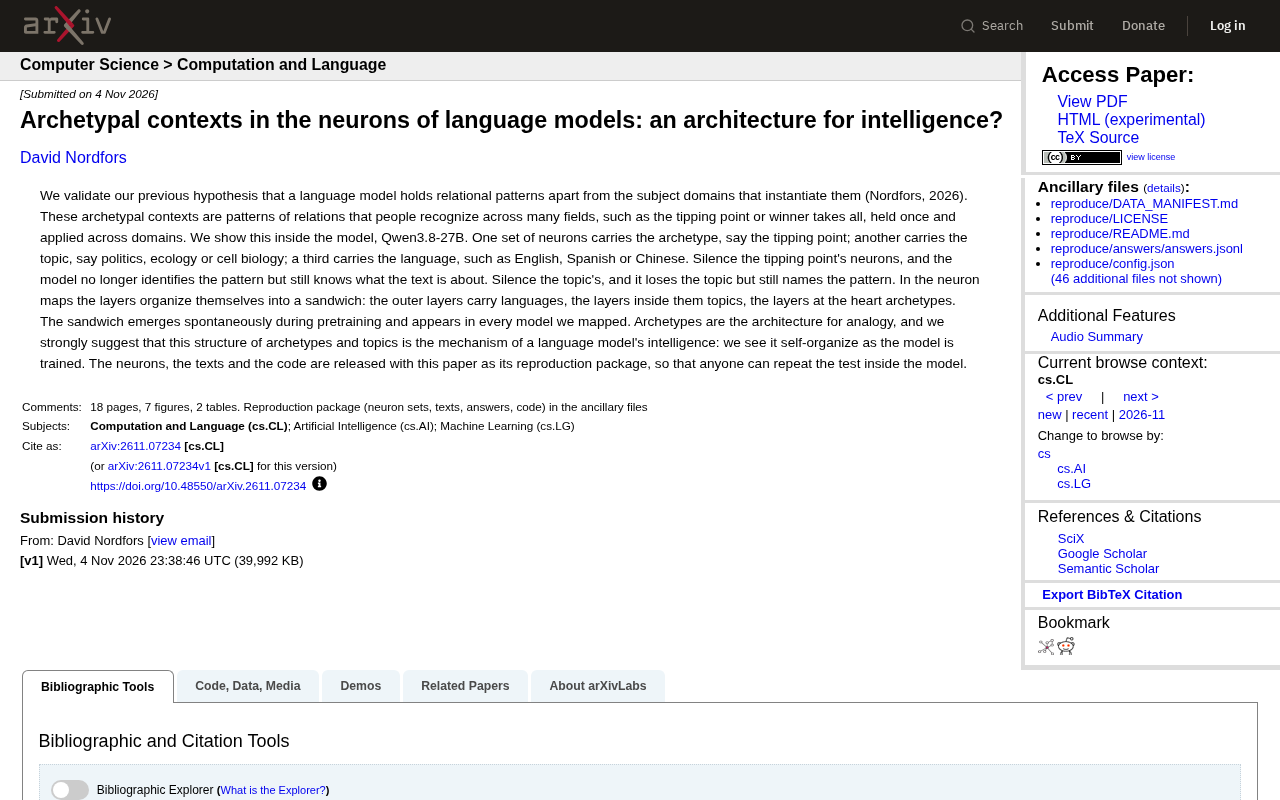
A new study validates a previous hypothesis: language models can store relational patterns (i.e., "archetypal contexts") separately from concrete topic domains. Researchers discovered within the Qwen3.8-27B model that three distinct groups of neurons exist, responsible for carrying archetypes (such as "tipping point" and "winner-take-all"), topics (such as politics, ecology, and cell biology), and languages (such as English, Spanish, and Chinese). This finding offers a new structural perspective for understanding the mechanisms of intelligence in language models.
Causal Validation at the Neuron Level: Silencing Archetypes, Topics Remain
The research team demonstrated the functional independence of the three neuron groups through neuron-level intervention experiments. When neurons responsible for the "tipping point" archetype were silenced, the model no longer recognized that relational pattern but could still determine the topic of the text; conversely, after silencing topic neurons, the model lost topic information but could still name the archetype. This double dissociation indicates that archetypes and topics are represented in parallel and separably within the model.
Sandwiched Structure: Language on the Outside, Topic in the Middle, Archetype at the Core
In the neuron map, the layer organization exhibits a clear sandwiched structure: the outer layers carry language information, the middle layers carry topic information, and the core layers carry archetypes. This structure emerges spontaneously during pre-training and appears in all models the researchers mapped. This implies that archetypal contexts may be a general organizational principle of language models, rather than an incidental phenomenon of a specific model.
Activation Intervention and Causal Inference
Neuron-level "silencing" interventions typically refer to directly modifying the activation values of specific neurons or neuron groups during inference through activation patching or ablation, and observing changes in model outputs. The causal logic is: if removing a group of neurons selectively impairs a certain capability while other capabilities remain intact, then that neuron group can be inferred to be causally necessary for that capability. This double dissociation paradigm, borrowed from cognitive neuroscience, is a classic criterion for determining the independence of functional modules.
Archetypal Context
"Archetype" here does not refer to the collective unconscious imagery in Jungian psychology, but rather to a cross-domain relational pattern or narrative structure, such as "tipping point," "winner-take-all," or "feedback loop." The core characteristic of archetypal contexts is topic-agnosticism: the same relational pattern can be instantiated in vastly different content domains such as politics, ecology, and cell biology. The study hypothesizes that language models spontaneously disentangle these abstract relational patterns from concrete topics during pre-training, forming independent representational dimensions that support cross-domain analogical transfer.
Layer Organization and Levels of Representational Abstraction
The layers of a Transformer model are not homogeneous processing units; shallow layers are typically closer to surface features such as morphology and syntax, while deeper layers gradually carry semantic and pragmatic information. The so-called "sandwiched structure" describes: language-specific information (vocabulary, grammar, language) concentrated in the peripheral layers, topic domain information in the middle layers, and the most abstract archetypal relational patterns compressed in the core layers. This outside-in, concrete-to-abstract layer organization is consistent with the commonly observed "increasing abstraction" phenomenon in representational similarity analysis, but the study further points out that the three functional groups are not simply a gradient transition across layers, but form separable clustered distributions.
Emergent Structure
"Spontaneous emergence" emphasizes that this structure is not injected through explicit supervision or architectural priors, but self-organizes solely from the statistical regularities of massive text under the next-token prediction pre-training objective. Emergence is typically judged based on two criteria: first, it can be detected without any training intervention targeting that structure; second, it recurs across multiple independently trained models. If the three-layer separation of archetype-topic-language stably replicates across multiple models, it supports the idea that it results from the inductive bias of the pre-training objective, rather than being an incidental product of a single model.
Is Archetype the Basis of Analogy and the Mechanism of Intelligence?
Researchers strongly believe that this archetype-topic structure is precisely the mechanism of language model intelligence—it self-organizes during training. Archetypes, as cross-domain relational patterns, enable the model to perform analogical reasoning across different topics, for example, transferring the "tipping point" from politics to ecology or cell biology. This architecture provides a testable explanation for how models achieve generalization.
Reproducible Research Package: Neurons, Text, and Code All Public
The study released the neuron data, text, and code as a reproducibility package, allowing anyone to repeat this test within the model. This open approach helps promote systematic research into the internal mechanisms of language models and lays the foundation for subsequent validation of the universality of the archetypal architecture.
Analogical Reasoning and Relational Transfer
The core of analogical reasoning is extracting relational structure from a source domain and mapping it to a target domain, ignoring differences in surface content. If archetype neurons indeed encode topic-agnostic relational patterns, then after the model learns the "tipping point" structure from political texts, it could theoretically reuse the same neural representation in ecological or cell biology contexts, thereby achieving zero-shot relational transfer. This explanation echoes behavioral findings: large models' performance on analogy tasks often depends on the abstraction level of relational structure, rather than surface vocabulary overlap.
Testable Predictions and Competing Hypotheses
This architecture proposes several falsifiable predictions: for example, cross-domain analogy tasks should primarily activate archetype neurons rather than topic neurons; interventions on archetype neurons should selectively disrupt cross-domain transfer without affecting topic knowledge within the same domain. It should be noted that competing explanations also exist—the separation of archetype and topic may simply be a byproduct of statistical correlations between topic distributions and relational distributions in the training corpus, rather than the causal mechanism of intelligence. Distinguishing the two requires more refined intervention experiments and cross-model consistency checks.
Implications for AI Research: From Behavioral Observation to Structural Understanding
This study advances the understanding of language model intelligence from the behavioral level to the structural level. By identifying three separable neuron groups—archetype, topic, and language—researchers provide an operational analytical framework. If archetypal contexts are indeed the core architecture of model intelligence, then future model design, interpretability research, and improvements in cross-domain transfer capabilities may all gain new insights from this.
One-line Summary
Language models contain three separable neuron groups—archetype, topic, and language—arranged in a sandwiched structure.
Paragraph Summary
A new study discovered three functionally separable neuron groups within the Qwen3.8-27B model, respectively carrying archetypes (cross-domain relational patterns), topics (such as politics, ecology), and language (such as English, Chinese) information. Through neuron-level silencing interventions, researchers demonstrated double dissociation: silencing archetype neurons does not affect topic recognition, and vice versa. Neuron mapping reveals a sandwiched layer organization—language in outer layers, topic in middle layers, archetype in core layers—which emerges spontaneously during pre-training and replicates across multiple models. Based on this, researchers propose that the separable structure of archetype and topic is precisely the mechanism of analogical reasoning and intelligence in language models, and have released a reproducibility package containing neurons, text, and code, advancing from behavioral observation to structural understanding.
Related articles

AI Coding Enters the Team Collaboration Era: Interpreting Three Major Moves from Meta, GitHub, and Mistral
Meta acquires Conductor, GitHub Copilot Fusion becomes available, Mistral opens Large 4 weights—three moves show AI coding shifting from code generation to organizing development workflows. This article explains task orchestration, model collaboration, and cost control for developers.

Building a RAG Assistant with Dify: A Practical Guide to Knowledge Bases, Workflows, and Agent Nodes
How should knowledge bases, workflows, and Agent nodes connect in a Dify RAG assistant? We break down the division of labor and wiring logic for a shippable app.
 Tech Frontiers
The AI Industry Doesn't Lack Marketing—It Lacks Good Products
AI faces market selloffs and public skepticism—is marketing really the problem? This analysis of market signals and product experience argues the core困境 is incomplete products and a gap between promises and experience; the only way to change perceptions is to ship better products.