Archify: The Viral Open-Source Tool That Lets AI Agents Generate Verifiable Architecture Diagrams

archify lets AI agents auto-generate verifiable architecture diagrams as self-contained HTML files.
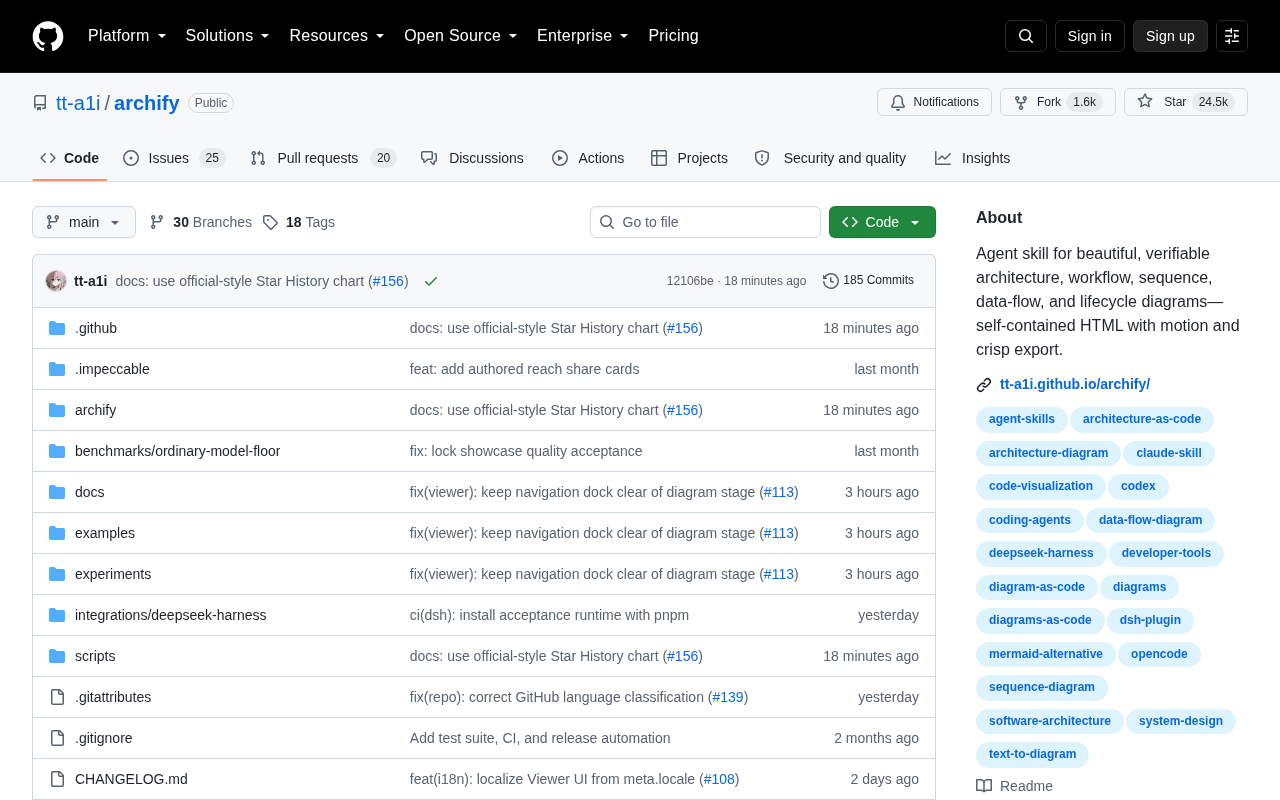
archify is a fast-rising open-source project on GitHub that functions as an AI Agent Skill for generating verifiable architecture diagrams, workflow diagrams, sequence diagrams, data-flow diagrams, and lifecycle diagrams. Its key innovations include self-contained HTML output with motion effects, emphasis on verifiability to combat AI hallucination, and seamless integration with AI agents via standardized interfaces. The project has garnered over 24,000 Stars, reflecting strong developer demand for tools that bridge the gap between code-driven maintainability and professional visual quality in technical documentation.
A Technical Diagram Generation Tool Going Viral
Recently on GitHub, a project called archify has rapidly shot to fame. Published by developer tt-a1i, the repository gained over 4,239 Stars in a single day, bringing its cumulative Star count to an impressive 24,462, with Forks exceeding 1,565. For a tool focused on technical diagram generation, this growth rate clearly shows it has hit a real pain point among developers. It's worth noting that while GitHub Stars have long been considered an important indicator of open-source project popularity, their reference value has been subtly shifting in recent years. With the viral amplification effects of platforms like Twitter/X, Hacker News, and Reddit, a project can gain thousands or even tens of thousands of Stars within 24-48 hours of being shared by a prominent developer. This kind of "pulse growth" doesn't always correlate with a project's actual maturity or production readiness. Industry observers typically look at deeper metrics to assess a project's true health: Issue response time, PR merge frequency, contributor diversity, and the proportion of Forks that lead to actual secondary development. archify's Star-to-Fork ratio sits at approximately 15.6:1, which is within the normal range for tool-type projects, indicating that a meaningful portion of users aren't just bookmarking the project but are willing to try it hands-on or modify it.
archify's positioning is crystal clear: it's an Agent Skill designed specifically for generating aesthetically pleasing and verifiable architecture diagrams, workflow diagrams, sequence diagrams, data-flow diagrams, and lifecycle diagrams. Its core selling point is that it produces self-contained HTML files with motion effects and support for crisp export.
Why Technical Diagrams Deserve to Be Reinvented
Pain Points of Traditional Diagram Tools
In software development, creating architecture diagrams and flowcharts is work that virtually every team cannot avoid. However, existing solutions each have their shortcomings:
- Manual drawing tools (e.g., draw.io, Visio): Flexible but time-consuming, and difficult to keep in sync with code;
- Text-driven solutions (e.g., Mermaid, PlantUML): Version-controllable and maintainable, but the generated diagrams tend to be visually bland and aesthetically mediocre;
- Professional design tools: Produce beautiful results, but require design skills that engineers often lack.
Among these, Mermaid and PlantUML are currently the two most mainstream "diagram-as-code" solutions, and they're worth understanding in detail. Mermaid is JavaScript-based and uses a concise Markdown-like syntax that renders directly in the browser. GitHub, GitLab, Notion, and other platforms already natively support live previews of Mermaid code blocks. PlantUML is built on Java and the Graphviz layout engine, offers more comprehensive syntax, and supports a wider range of diagram types (including the entire UML family), but requires server-side rendering. The biggest advantage of both tools is that diagram definitions exist as plain text, which can be directly incorporated into Git version control and reviewed through Pull Requests — this is precisely why they're so popular among engineering teams. However, their auto-layout algorithms are relatively simple, and when dealing with complex architectures, they often produce overlapping nodes and crossing lines. The visual expressiveness of their output falls noticeably short compared to hand-drawn or professionally designed diagrams.
archify attempts to strike a balance between these approaches — preserving the maintainability and verifiability of text/code-driven methods while producing aesthetically polished output through a carefully designed rendering engine.
"Verifiable" Is the Key Differentiator
The project description specifically emphasizes the verifiable attribute. This is particularly important in the context of AI-generated content. When an AI Agent automatically generates architecture diagrams, our biggest concern is that the diagram "looks right" but actually contains logical errors — such as missing a component or drawing incorrect data flow directions.
A critical piece of context here is AI Hallucination — the phenomenon where large language models "fabricate" information that appears plausible but is actually incorrect. In code generation, this manifests as calling non-existent APIs or library functions. In diagram generation scenarios, it's even more insidious — the model might add a non-existent microservice node out of thin air, incorrectly label database read/write directions, or depict asynchronous calls as synchronous sequences. Since diagrams are visual by nature, readers are more easily misled by a "professional-looking" appearance, overlooking logical errors at the structural level.
archify's emphasis on verifiability means that there's a structured data model behind the generated diagrams, enabling cross-validation against actual structures (such as source code, API definitions, or configuration files). This helps mitigate the risks of AI hallucination in documentation visualization — a concrete embodiment of the "Trust but Verify" principle in current AI engineering practices.
Agent Skill: A New Paradigm for Diagram Generation in the AI Era
What Is an Agent Skill
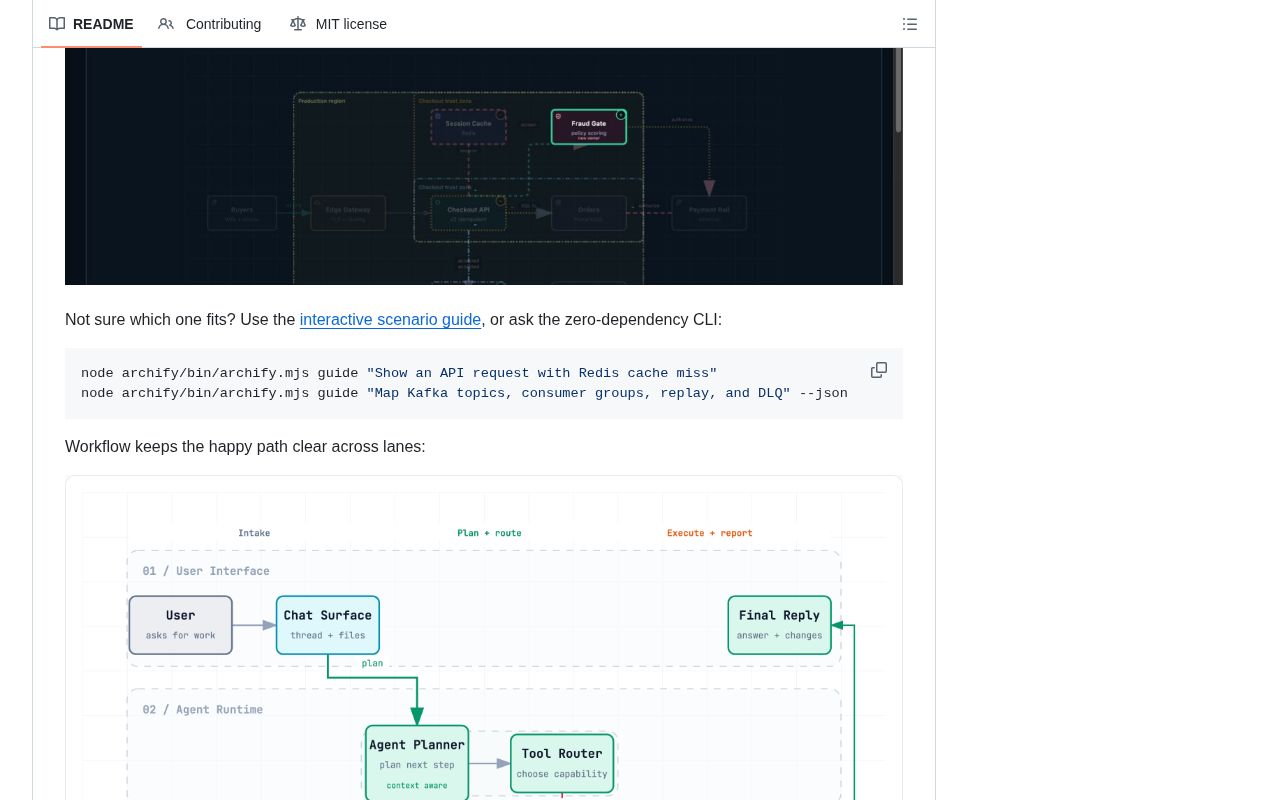
archify positions itself as an "Agent Skill," reflecting an important trend in the current AI programming ecosystem. An Agent Skill refers to a capability module that can be invoked by AI agents (such as Claude, various Coding Agents). Developers no longer need to manually operate diagram tools — instead, they use natural language instructions to have the AI automatically understand code structure or system design, and invoke archify to generate the corresponding visual diagrams.
From a technical ecosystem perspective, the concept of Agent Skills originates from the rapidly evolving AI Agent frameworks of the past two years. Take Anthropic's Claude as an example: its MCP (Model Context Protocol) allows external tools to be called by AI agents through standardized interfaces. OpenAI's GPT achieves similar capabilities through Function Calling and Plugins mechanisms. Under this framework, AI Agents are no longer closed conversational systems but can invoke various "skills" on demand to complete complex tasks — much like a programmer using command-line tools. As an Agent Skill, archify exposes standardized calling interfaces — AI Agents can translate their understanding of system architecture into input formats that archify accepts, which then automatically renders visual diagrams. This toolchain mindset is reshaping software development workflows: from AI IDEs like Cursor and Windsurf to autonomous coding agents like Devin, an increasing number of development tasks are being covered by the Agent + Skill combination.
The value of this model lies in:
- Lowering the barrier to entry: No need to learn specific diagram syntax — just describe what you need in natural language;
- Seamless integration with development workflows: AI Agents can produce matching architecture diagrams immediately after reading code;
- Continuous synchronization: When code changes, the Agent can regenerate diagrams, keeping documentation consistent with implementation.
The Design Ingenuity of Self-Contained HTML Output
archify's output of self-contained HTML is a design decision worth noting. Self-contained HTML is a technical approach that inlines all dependent resources — including CSS styles, JavaScript scripts, SVG graphics, and even font files — into a single HTML file. Implementation typically involves: inlining CSS via <style> tags, embedding JavaScript via <script> tags, and including images and icons as Base64-encoded data or inline SVGs.
This means the generated diagram files don't depend on external resources and can be independently opened, shared, and archived. In corporate intranets or secure environments, this zero-dependency characteristic is especially important. By contrast, many modern web applications rely on CDNs to load external resources and can't display properly when network access is restricted. Self-contained HTML is also naturally suited for archival scenarios — even years later when related services have gone offline, the file can still render completely. Compared to screenshots, HTML preserves interactivity and animations; compared to solutions requiring rendering services, self-contained files are easier to distribute within teams and preserve long-term.
The motion design makes complex sequence diagrams and data-flow diagrams easier to understand — dynamically showing data flow processes is often more intuitive than static arrows. And "crisp export" support ensures that diagrams can meet the high-quality requirements of documentation, presentations, and reports.
A Complete Overview of archify's Supported Diagram Types
archify covers the most commonly used diagram types in software engineering:
| Diagram Type | Typical Use Case |
|---|---|
| Architecture | Displaying system components and their relationships |
| Workflow | Describing business or processing flows |
| Sequence | Showing interaction sequences between objects |
| Data-flow | Tracking data movement through a system |
| Lifecycle | Expressing state transitions and lifecycles |
Among these, Data Flow Diagrams (DFD) deserve special attention. DFD is a core modeling tool in structured analysis methodology, first proposed by Larry Constantine and Tom DeMarco in the 1970s. It uses four basic elements — External Entity, Process, Data Store, and Data Flow — to describe information flow paths within a system. In today's world of prevalent microservice and event-driven architectures, DFD's value has been rediscovered: it can clearly show event flows in message queues, request distribution at API Gateways, and data aggregation and transformation across multiple services. In security auditing (such as the STRIDE threat modeling framework), DFD is the standard starting point for identifying trust boundaries and potential attack surfaces. archify's support for data-flow diagrams enables it to serve a broader range of scenarios, from architecture design to security reviews.
This combination essentially covers the full spectrum of visualization needs from system design and interface interactions to state management, making it capable of handling the diagramming tasks for most technical documentation.
Practical Recommendations and Future Outlook
archify's rapid rise to fame fundamentally reflects the extension of the AI programming tool ecosystem from "code generation" to "generating supporting artifacts." When AI can write code and documentation, automatically generating high-quality technical architecture diagrams is the natural next step.
However, a measured perspective is warranted. As an emerging project, archify's actual user experience, diagram accuracy, and ability to express complex systems still need more real-world validation. While 24,462 Stars is certainly impressive, GitHub popularity doesn't fully equate to production readiness. For developers eager to try it out, it's recommended to pilot it on a small scale within real projects to evaluate its generation quality and workflow compatibility.
Overall, archify represents an interesting direction: letting AI not only help us write code but also help us "draw our systems clearly." For engineering teams that have long suffered from "outdated documentation" and "hard-to-draw diagrams," the maturation of tools like this is something worth looking forward to.
Related articles

Paint.NET Officially Supports Linux: A Cross-Platform Experiment via the Wine Compatibility Layer
Paint.NET adds experimental Wine/Linux support, bringing the popular Windows image editor to Linux. We analyze its technical approach, limitations, and impact.
DoltLite: Injecting Git Version Control into SQLite with 2,000 AI Pull Requests
DoltLite is an open-source SQLite fork bringing Git-style data version control with commit, branch, merge, and diff. Built via ~2,000 AI Agent PRs.
Cache Stampede: How to Handle 50,000 Requests Penetrating at Once
Deep dive into Cache Stampede and thundering herd problems with three solutions: Mutex/Single-flight, logical expiration, and TTL jitter, plus production-grade combined strategies for reliable high-concurrency caching.