Paint.NET Officially Supports Linux: A Cross-Platform Experiment via the Wine Compatibility Layer
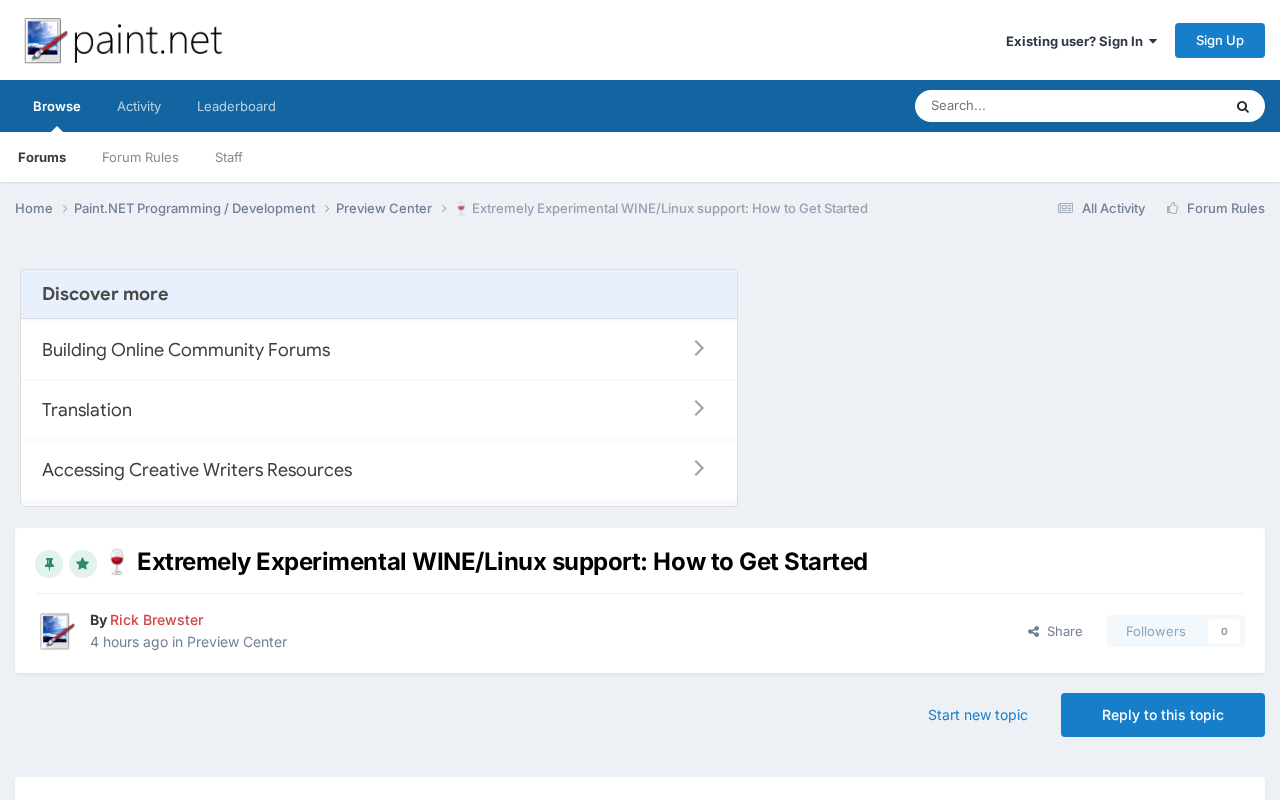
Paint.NET officially adds experimental Linux support via Wine instead of a costly native port.
Paint.NET has announced experimental Wine/Linux support, choosing the Wine compatibility layer over a native port due to its deep dependence on Windows-specific APIs. This pragmatic approach, backed by official CI testing, reflects a growing trend where desktop apps leverage Wine's maturity to reach Linux users at low cost. While still experimental, it fills a gap in Linux's image editing ecosystem between basic tools and complex editors like GIMP.
Paint.NET Takes Its First Step Toward Cross-Platform Support
Paint.NET is one of the most popular free image editing applications on Windows. With its clean, intuitive interface and powerful layer and filter capabilities, it occupies the sweet spot between the built-in Paint tool and Photoshop. The software was originally started by Washington State University student Rick Brewster in 2004 as a senior design project, initially built on .NET Framework 1.0 and GDI+. After nearly two decades of continuous iteration, Paint.NET has migrated to .NET 8 (Microsoft's latest cross-platform runtime), but its rendering pipeline still relies heavily on Windows-specific APIs like Direct2D, DirectWrite, and WIC (Windows Imaging Component). This architectural choice gives it excellent performance on Windows — particularly GPU-accelerated rendering and efficient memory management — but it also represents the core barrier to cross-platform porting. As a result, Linux users have long been forced to rely on various unofficial workarounds, with no formal support from the developers.
That has now changed. Paint.NET has officially announced experimental Wine/Linux support, with the development team acknowledging cross-platform user demand and proactively working to improve compatibility for running under Linux. While still in its early stages, this move sends an important signal.
Why Wine Instead of a Native Port
The Practical Realities of Technical Approach
Paint.NET is built on the Microsoft .NET platform and deeply dependent on the Windows graphics stack and related APIs. Developing a truly native Linux version would require rewriting large amounts of low-level code tightly coupled to the operating system — an enormous undertaking with high ongoing maintenance costs. For a project maintained by a small team, this is simply not realistic.
By contrast, leveraging Wine offers a much better return on investment. Wine (a recursive acronym for Wine Is Not an Emulator) is not a traditional emulator or virtual machine. Instead, it works by re-implementing Windows API calls on top of the Linux kernel. When a Windows application makes a system call, Wine translates it into the corresponding POSIX system calls and X11/Wayland graphics protocols, meaning the application runs directly on the host CPU at native speed with no additional instruction translation layer. The Wine project dates back to 1993, and after over thirty years of continuous development, it has implemented compatibility for tens of thousands of Windows API functions. Sub-projects like DXVK (which translates DirectX calls to Vulkan) and vkd3d-proton (DirectX 12 to Vulkan translation) have further extended its graphics compatibility capabilities. With this mature compatibility layer, developers don't need to rewrite core logic — they only need to address and optimize for compatibility issues that arise in the Wine environment to get Paint.NET running stably on Linux.
The Technical Practice of Official Wine Adaptation
Paint.NET's "official Wine adaptation" model is fundamentally different from how most applications have approached this in the past. Traditionally, Wine compatibility has primarily relied on the Wine community and users debugging issues themselves, with application developers typically giving no consideration to the Wine environment. Official adaptation means the development team incorporates Wine environment testing into their continuous integration (CI) pipeline, proactively avoids known Wine-incompatible API calls, and validates critical functionality paths before releases. There are precedents for this approach: Blizzard's Battle.net client and some of its games have quietly tested Wine compatibility; certain enterprise software has long collaborated with CodeWeavers' commercial Wine distribution, CrossOver, to optimize compatibility. Paint.NET's public stance goes further, incorporating Wine support as an officially recognized runtime configuration within the project scope. This level of transparency and commitment remains rare in the desktop application space.
What the "Experimental" Label Means
The team has labeled current support as "experimental," meaning there may be missing features, rendering anomalies, or performance inconsistencies at this stage. It's more of an officially endorsed compatibility effort than a promise of a fully functional Linux version. For everyday users, it's worth trying out, but it's not yet recommended for production environments.
Practical Significance for the Linux Desktop Ecosystem
In recent years, Valve has aggressively promoted running Windows games on Linux through the Steam Deck and Proton, significantly raising both the maturity and visibility of the Wine compatibility layer. Proton, launched by Valve in 2018, is a customized compatibility layer based on Wine, optimized specifically for Steam platform games. It integrates DXVK, vkd3d-proton, Wine-Staging patches, and multiple proprietary technical improvements from Valve, enabling over ten thousand Windows games to run directly on Linux. The 2022 launch of the Steam Deck handheld pushed this technology to the forefront of the consumer market — this device runs a customized Arch Linux system (SteamOS 3.0) and relies on Proton to run the vast majority of the Steam game library. Valve has invested substantial engineering resources back into the upstream Wine project and Mesa graphics drivers, driving a quality leap across the entire Linux graphics stack and bringing the reliability and coverage of the Wine compatibility layer to unprecedented levels. More and more desktop application developers are recognizing that Wine is now reliable enough to serve as a practical channel for reaching Linux users.
Paint.NET's move is a microcosm of this trend, reflecting a key reality: software vendors don't need to invest heavily in native ports to officially support the Linux platform at relatively low cost.
For Linux desktop users who have long lacked quality image editing options, this is welcome news. The image editing ecosystem on the Linux desktop is already quite rich but notably polarized. GIMP (GNU Image Manipulation Program), as the most well-known open-source image editor, offers a feature set approaching Photoshop's level, including advanced layer management, custom scripting, and a rich filter library — but its interface design has long been criticized for its steep learning curve. Krita, while positioned as a digital painting tool, has been steadily enhancing its photo editing capabilities in recent years. Among lightweight options, Pinta (which actually began as an open-source clone of Paint.NET) and Drawing exist but fall short of Paint.NET in feature completeness and polish. Paint.NET occupies precisely the "more powerful than basic paint tools, simpler than GIMP" middle ground — a niche that has a clear gap on the Linux platform. A diverse selection of tools always benefits users with different needs, and Paint.NET's lightweight, easy-to-learn nature fills exactly this gap for lightweight image editing on Linux.
Current Limitations and Future Outlook
This news has not yet attracted widespread attention, partly because it's still in the experimental phase and partly because Linux users already have mature alternatives for image editing.
However, from a long-term perspective, Paint.NET's official change in attitude deserves recognition. If the experimental support can gradually stabilize and continuously improve through community feedback, it has the potential to become another recommended lightweight image editing tool on the Linux platform. For users who want to use familiar Windows software on Linux, this "official adaptation + Wine compatibility layer" model is likely to become the standard cross-platform approach for an increasing number of desktop applications. As Wine itself continues to evolve, as the Wayland display protocol gains wider adoption and brings better graphics compatibility, and as industry giants like Valve continue investing in the Linux graphics stack, this model will only become more viable.
Summary
Paint.NET's experimental Wine/Linux support may be a small step, but it embodies a pragmatic approach to cross-platform strategy. Rather than pursuing a costly native rewrite, it embraces the increasingly mature Wine compatibility layer technology. For developers, this is a low-risk way to expand market reach; for Linux users, it means one more familiar and promising image editing option. Whether it can progress from "experimental" to "officially supported" will depend on continued compatibility refinement and community feedback.
Key Takeaways
Related articles

Python 3.15 New Feature: Is the sentinel Type Better Than None?
Python 3.15 adds the sentinel type, using named unique sentinel objects to replace None and bare object(), resolving confusion among missing values, explicit emptiness, and invalid input while avoiding type hint failures.

Deep Learning's Three Architectures and the Universal Approximation Theorem: A Complete Guide to MLPs, CNNs, and Transformers
Explaining the inductive bias differences among MLP, CNN, and Transformer, the existence meaning of the Universal Approximation Theorem (UAT), and the role of Taylor expansion in approximation analysis, while clearing up common misconceptions.

GitLab Emergency Patch Release: Analysis of Critical Security Fixes
GitLab releases critical patch 19.5.1, sparking 355 points of discussion on Hacker News. This article analyzes the background, upgrade steps for self-hosted instances, and verification points to help DevOps teams respond quickly to security updates.