ArcRAG: A New Paradigm for Agentic Retrieval Without Co-Design with Graph Structure

ArcRAG studies cross-construction portability of GraphRAG retrieval via inference-time query-local graph interface induction.
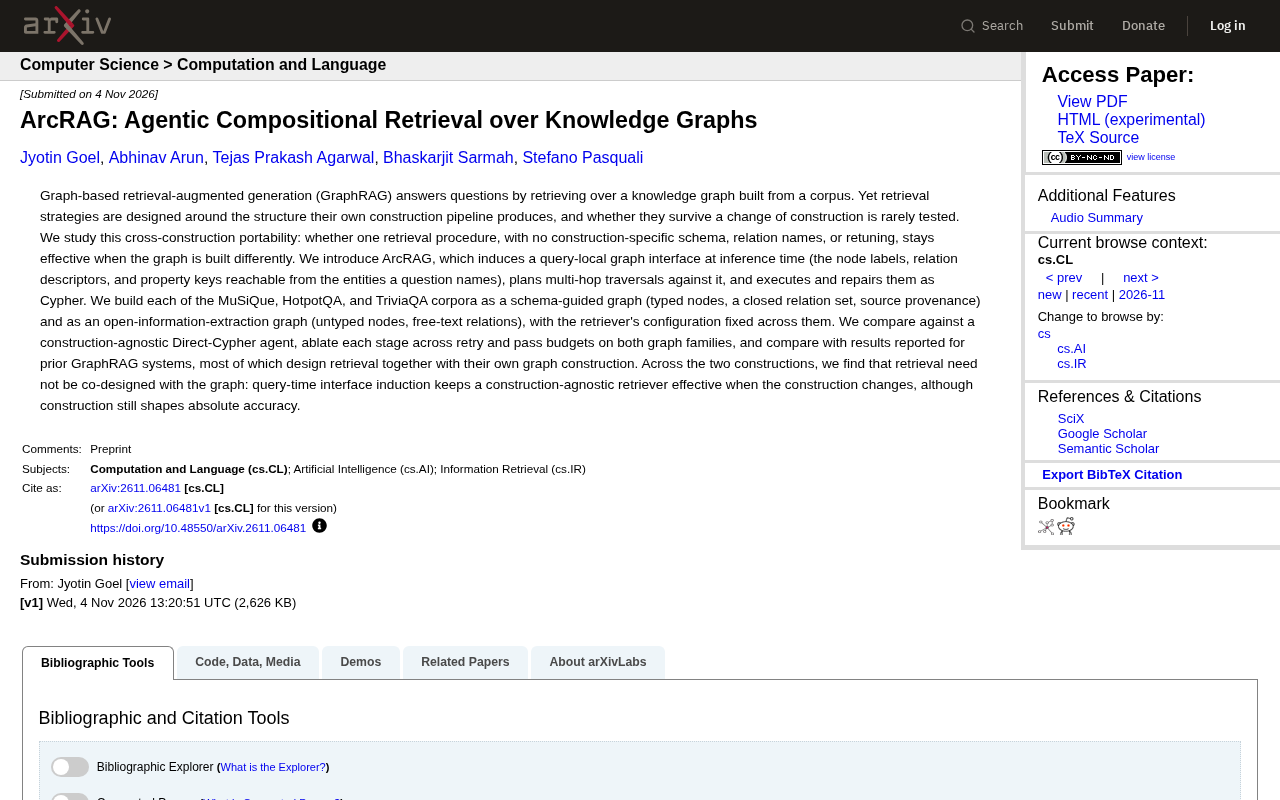
This article introduces ArcRAG, which studies the cross-construction portability of retrieval strategies in GraphRAG—whether a retrieval pipeline remains effective after changing the graph construction method. Existing retrievers are often co-designed with construction and fail when it changes. ArcRAG dynamically identifies question entities, collects reachable node labels, relation descriptors, and property keys to form a query-local graph interface, plans multi-hop traversals, and compiles them into Cypher for execution and repair. Experiments on MuSiQue, HotpotQA, and TriviaQA with schema-guided and OpenIE graphs show retrieval need not be co-designed with construction, though construction quality still affects absolute accuracy.
Graph-based retrieval-augmented generation (GraphRAG) answers questions by retrieving from a knowledge graph built from a corpus. However, existing retrieval strategies are often designed around the structures produced by their own construction pipelines, and whether these strategies remain effective when the construction method changes is rarely validated. A recent paper proposes ArcRAG, which specifically investigates this "cross-construction portability"—whether a retrieval pipeline remains effective when the graph construction method is changed without re-tuning for a specific construction schema, relation names, or parameters.
Background: The "Structural Dependency" Dilemma of GraphRAG
The core idea of GraphRAG is: first build a knowledge graph from a document collection, then perform retrieval on the graph to assist answer generation. But the problem is that different construction pipelines produce vastly different graph structures—some use strict schema constraints, where nodes have types, relations come from a closed set, and edges carry provenance information; others adopt open information extraction (OpenIE), where nodes are untyped and relations are free text.
In traditional approaches, retrieval strategies and graph construction are "co-designed": the retriever knows the relation names, node types, and property keys on its own graph. Once the construction method changes, the retriever may "fail." The key question raised by the paper is: Must retrieval be co-designed with graph construction? This directly affects the generality and reuse cost of GraphRAG systems.
Open Information Extraction (OpenIE) is an information extraction paradigm whose core feature is that it does not rely on predefined entity types and relation sets, but directly extracts triples (subject, predicate, object) from text, where entities are untyped and relations are described in free text. The advantage of OpenIE lies in its high flexibility and broad coverage, adapting to various domains and linguistic phenomena; the disadvantage is that extraction results are noisy, relation descriptions lack standardization, and graph structure quality is limited by the capability of the underlying extraction model. Using OpenIE to build knowledge graphs in GraphRAG means the retriever cannot rely on fixed schema information (such as type constraints or enumerated relation names) and must infer structure from free text and unlabeled nodes, which places higher demands on the adaptability of retrieval strategies.
Cypher query language is the declarative query language of the Neo4j graph database. Its syntax describes traversal paths of nodes and relations in a graph through pattern matching (e.g., (n:Person)-[:KNOWS]->(m)), supporting features such as filtering, aggregation, and path variables. Unlike SQL, Cypher expresses query intent with graphical ASCII patterns, making it very suitable for expressing multi-hop traversals. In GraphRAG, compiling natural language questions into Cypher queries requires accurate schema awareness—traditional methods require prior knowledge of node labels, relation types, and property keys, whereas ArcRAG induces a local interface at inference time, enabling the generated Cypher queries to dynamically adapt to unknown graph structures. This is also a key technical component of its cross-construction portability.
ArcRAG's Core Idea: Inducing a Query-Local Graph Interface at Inference Time
ArcRAG's solution is to dynamically generate a "query-local graph interface" during the inference stage. Specifically, for a user's question, the system first identifies the entities mentioned in the question, then starting from these entities, collects reachable node labels, relation descriptors, and property keys to form a local interface specific to the current query.
With this interface, ArcRAG plans multi-hop traversal paths and compiles them into Cypher query statements for execution, with the ability to repair failed executions. Throughout this process, the retriever does not need to know the global schema of the graph in advance, nor does it need to be retrained or re-tuned for different construction methods—it relies only on information "discovered on the spot" from the graph at inference time.
The ingenuity of this design lies in shifting "structural adaptation" from offline design to online inference: whether the graph is built with schema guidance or open information extraction, the retriever can adaptively understand the language of the current graph at query time.
Schema in graph databases refers to the formal definition of node types, relation types, and their property keys, similar to table structures in relational databases. Schema-guided graphs have explicit type systems and closed-set relation constraints, e.g., all nodes must belong to predefined categories (such as person, organization, location), and relations are limited to a finite set (such as works for, located in). This construction method ensures structural standardization and query efficiency, but requires domain experts to design the schema and struggles to cover long-tail relation types in open domains. In contrast, schema-less graphs or OpenIE graphs do not enforce type constraints, offering high flexibility but significant structural noise. On schema-guided graphs, retrievers can rely on type information for precise filtering and joining, whereas on schema-less graphs they must infer semantic associations from the data itself. ArcRAG's query-local interface is designed precisely to be compatible with both structural paradigms at inference time, planning traversals by dynamically discovering the "schema language" of the current graph and avoiding the fragility of hardcoding for specific schemas.
Experimental Design: Cross-Validation Under Two Construction Methods
To validate cross-construction portability, the research team built two types of graphs on three corpora: MuSiQue, HotpotQA, and TriviaQA:
- Schema-guided graphs: nodes have types, relations come from a closed set, and edges carry provenance information.
- Open information extraction graphs: nodes are untyped, and relations are free text.
The key control is that the retriever's configuration remains unchanged between the two graph types, with no special adjustments for either construction method. The comparison baseline is a construction-agnostic Direct-Cypher agent, and ablation experiments were conducted on each stage of ArcRAG under different retry and pass budgets. In addition, comparisons were made with previously reported results of GraphRAG systems—most of which design retrieval together with their own graph construction.
Main Findings: Retrieval Need Not Be Co-Designed with the Graph
The experiments yielded several important conclusions:
First, retrieval need not be co-designed with graph construction. Across both construction methods, query-time interface induction enables a construction-agnostic retriever to remain effective when the construction method changes. This means GraphRAG systems can decouple the retrieval module from the graph construction module, reducing the complexity of system integration.
Second, construction method still affects absolute accuracy. Although the retriever is portable, the quality of graph construction itself still shapes final accuracy. There are differences in absolute performance between schema-guided graphs and open information extraction graphs, indicating that optimization of the construction stage remains valuable.
Third, ablation experiments reveal the role of each stage. Under different retry and pass budgets, ArcRAG's planning, execution, and repair stages each contribute to the final results, providing directions for subsequent system optimization.
Implications for GraphRAG Practitioners
ArcRAG's research offers several reference points for teams actually building GraphRAG systems:
- Module decoupling becomes possible: if the retriever can work across construction methods, teams can more freely swap graph construction pipelines without worrying that the retrieval layer needs rewriting.
- Inference-time adaptation beats offline hardcoding: rather than hardcoding relation names and schemas in the retriever, let the retriever dynamically discover the graph's structure at query time.
- Construction quality remains foundational: portability does not mean construction is unimportant; high-quality graph construction still yields higher absolute accuracy.
This work is currently presented as a paper; specific implementation details and code availability should be referred to the original text. For developers interested in GraphRAG, agentic retrieval, and knowledge graph applications, ArcRAG offers a noteworthy "construction-agnostic" retrieval approach.
One-line Summary
ArcRAG studies cross-construction portability of GraphRAG retrieval and proposes inducing a query-local graph interface at inference time to achieve construction-agnostic retrieval.
Paragraph Summary
This article introduces the paper ArcRAG, which studies the "cross-construction portability" of retrieval strategies in GraphRAG—whether a retrieval pipeline remains effective after the graph construction method is changed. Existing retrieval strategies are mostly co-designed with graph construction, relying on specific schemas, relation names, and structures, and tend to fail when the construction method changes. ArcRAG dynamically identifies question entities at inference time, collects reachable node labels, relation descriptors, and property keys to form a query-local graph interface, plans multi-hop traversals, and compiles them into Cypher for execution and repair. Experiments build schema-guided graphs and open information extraction graphs on MuSiQue, HotpotQA, and TriviaQA for cross-validation, with the retriever configuration unchanged. Results show that retrieval need not be co-designed with graph construction, but the construction method still affects absolute accuracy; ablation experiments reveal the roles of planning, execution, and repair stages. This work provides new ideas for decoupling retrieval and construction modules in GraphRAG systems.
Related articles

RePlan-VLA: Progress-Aware Replanning Breakthrough for Long-Horizon Robotic Manipulation
The RePlan-VLA framework converts VLA models' short-horizon capabilities into reliable long-horizon execution through progress-aware adaptive replanning, improving success rates by 21.9% and 10.4% on RoboCasa365 and CALVIN, and validating real-world deployment on a Franka Research 3 robot.

Geometric Bridge Flow Matching: A New Breakthrough in Blind Rigid Motion Correction
Geometric bridge flow matching enables blind rigid motion correction in head CBCT, achieving 37.1 dB PSNR and 0.27 mm RPE on simulated data in ~9.1 minutes, outperforming existing methods.

Google Releases Gemini 4 Hydrogen: 2.5x Faster Without Sacrificing Intelligence
Google releases the lightweight Gemini 4 Hydrogen: 2.5x faster task completion, AA Intelligence Index of 54 beating its flagship sibling, 7.3s single-step on Agent Arena faster than Claude and GPT rivals, four thinking levels with pay-as-you-need pricing, now available across AI Studio and more.