Are Foreign Companies Still Worth Joining? Career Choice Priority Ranking for Programmers in 2025
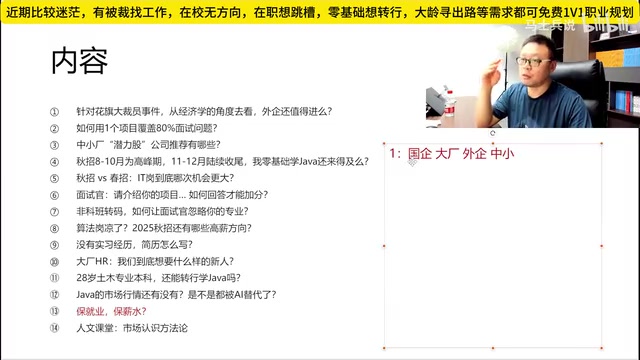
Analysis of programmer career choice rankings and coping strategies amid 2025 foreign company layoffs.
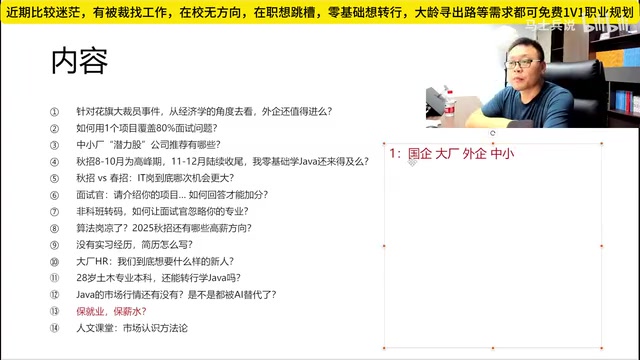
Amid the 2025 wave of foreign company layoffs, Teacher Ma Shibing recommends career choice priority (at equal salary) as: SOEs > Big tech > Foreign companies > SMEs. Foreign companies face a triple dilemma of international uncertainty, declining competitiveness, and tech stack disconnect from domestic markets. Programmers at foreign companies should adopt the barbell strategy — doing their job well on one end while continuously tracking the domestic tech ecosystem on the other — maintaining market-universal skills to prepare for layoff risks that could come at any time.
Article
Citigroup mass layoffs, Microsoft global layoffs... In 2025, news of foreign company layoffs keeps coming, pushing programmers' career choices back into the spotlight. Foreign companies, state-owned enterprises (SOEs), big tech, or SMEs — how should you rank them? Teacher Ma Shibing offers a clear analytical framework from multiple dimensions including economic conditions, corporate competitiveness, and career risk, providing valuable reference for every programmer making career plans.
Career Choice Priority When Salaries Are Equal
Teacher Ma Shibing gives a very clear ranking recommendation: With equal salaries, SOEs > Domestic tier-1 big tech > Foreign companies > SMEs.
The logic behind this ranking isn't complicated:
- SOEs win on stability, with the strongest risk resistance
- Big tech wins on alignment with the domestic market and the "resume gilding" effect
- Foreign companies have mature management models, but carry more uncertainty under current international circumstances
- SMEs are flexible but carry the highest risk, with the weakest ability to weather economic cycles
You might not have noticed that the key premise of this ranking is "equal salaries." In reality, compensation structures vary greatly across different types of companies — foreign companies' work-life balance, big tech's stock options, SOEs' hidden benefits all need to be considered holistically, not just by looking at the numbers on paper.
It's worth mentioning that SOEs rank first for another hidden reason: the "age 35 crisis" prevalent in China's internet industry is relatively mitigated within the SOE system. The so-called "age 35 crisis" is a workplace phenomenon unique to China's internet industry — big tech companies maintain high-intensity iteration rhythms and tend to recruit energetic fresh graduates with lower salary expectations, with some companies even implicitly setting age thresholds in recruitment. By contrast, SOEs' promotion systems and hiring logic place more value on seniority accumulation and are more accommodating of experienced employees — an invisible advantage that becomes significant in mid-to-late career stages.
The Triple Dilemma Facing Foreign Companies
Uncertainty from International Dynamics
The continued tension in China-US relations has made some foreign companies cautious about long-term operations in China. Although domestic policies have sent positive signals — the introduction of the Private Economy Promotion Law and a clear shift in attitude toward foreign investment — changes in the international landscape remain an uncontrollable variable, and this uncertainty directly transmits to the career stability of foreign company employees.
Declining Competitiveness Is the Core Issue
Citigroup layoffs, Microsoft global layoffs — these fundamentally aren't actions "targeting China." Microsoft is laying off people globally, indicating that these companies themselves have problems with operations and competitiveness. Teacher Ma Shibing hits the nail on the head: Some foreign companies can no longer make money in China, and this is directly related to their insufficient market responsiveness and lack of competitiveness.
However, from a macro data perspective, total foreign investment utilization hasn't decreased dramatically — manufacturing foreign investment has actually increased. Behind this phenomenon is the broader context of global supply chain restructuring. Under the "China+1" strategy, multinational enterprises haven't completely withdrawn from China but are repositioning China from a "low-cost manufacturing base" to a "local consumer market." Foreign investment inflows into high-tech manufacturing (such as new energy vehicle components and semiconductor packaging/testing) remain resilient, while foreign investment in consumer internet and fintech sectors tends toward caution. For programmers, this means job opportunities in manufacturing digitalization and industrial internet may offer more long-term stability than consumer internet. The financial industry is a special case, as domestic financial sector openness is inherently limited.
Tech Stack Disconnect from the Domestic Market
This is a hidden risk that many programmers working in foreign companies easily overlook. Much of the R&D work that foreign companies place in China is "peripheral work" — core R&D isn't located domestically.
This "peripheralization" isn't accidental but rather a structural result of multinational companies' global R&D division of labor. Most multinational tech companies adopt a "core-periphery" R&D model: core algorithms, infrastructure, and strategic products are led by headquarters or core R&D centers (usually in the US or Europe), while Chinese teams typically handle localization adaptation, testing, operations, or non-core feature development. This means that the tech stacks domestic foreign-company programmers work with long-term may be internal proprietary frameworks, legacy systems, or specific vertical-domain tools, rather than the mainstream domestic internet stacks like Spring Cloud microservices, Alibaba Cloud/Tencent Cloud ecosystems, or ByteDance's technical architecture. An even more insidious risk: with complete English documentation and standardized processes within foreign companies, programmers easily develop the illusion of "strong technical capabilities" while overlooking that the market transferability of these skills is quietly declining.
Once laid off, you'll find your skill tree doesn't match domestic company requirements, and the cost of readjustment is extremely high. For programmers who've been at foreign companies for many years, this is the career risk that demands the most vigilance.
The Barbell Strategy for Working at Foreign Companies
Teacher Ma Shibing cites Nassim Taleb's Barbell Strategy to offer coping recommendations.
The Barbell Strategy was systematically articulated by Lebanese-American scholar Nassim Nicholas Taleb in his book Antifragile. Taleb argues that when facing uncertainty, the worst approach is to bet all resources on "medium-risk, medium-reward" options — this seemingly prudent middle path is often the most fragile when black swan events occur. A truly antifragile strategy should exert force at both ends like a barbell: one end configured with extremely conservative, low-risk behaviors, the other end with small amounts of high-risk, high-potential exploration, with no compromise in the middle. This theory was originally applied in financial investment and has since been widely adopted in career planning, entrepreneurial decision-making, and other scenarios.
Specifically for programmers working at foreign companies, here's how to apply it:
- Stability end: Do your job well, fully leverage the foreign company's mature management system to enhance your professional competence and project experience
- Breakthrough end: Continuously monitor changes in the domestic tech ecosystem, understand what technologies, frameworks, and tools domestic peers are using, and maintain market-universal skills
Foreign companies are equally decisive when it comes to layoffs — they won't show mercy because of your tenure or age. Black swan events can happen at any time, and preparing in advance is the most rational choice.
Economic Recovery Signals and Long-term Career Judgment
Teacher Ma Shibing holds a cautiously optimistic attitude toward economic prospects. He mentions that May's economic data already shows signs of improvement, with the economy slowly recovering. And companies are "the most shameless
Related articles
 Expert Opinions
Rethinking Scaling Laws: Parameters Are Not the Only Answer
Deep analysis of Scaling Law evolution from Kaplan to Chinchilla to the MoE era, exploring why blindly stacking parameters is a mistake, and how GLM-5.3 proves scaling has multiple knobs.
When AI Treats Humans as Subagents: Ro…
When AI Treats Humans as Subagents: Role Reversal and Hidden Risks in Human-AI Collaboration
Exploring the paradigm shift where humans become "subagents" in AI Agent architectures. Analyzes human node design in LangChain and AutoGen, and the risks of ceding control and cognitive atrophy.
 Expert Opinions
The Lazy Person's Productivity Theory: Why Being 'Lazy' Actually Drives Peak Performance
Explore the engineering philosophy behind 'lazy people are most productive': how constructive laziness drives automation, AI tools amplify efficiency, and systems thinking eliminates wasted effort.