Are Open-Source AI Model Hosting Platforms Collectively Dumbing Down? Root Causes and Coping Strategies

Analyzing why open-source AI hosting platforms appear to degrade model quality and how developers should respond.
A viral Reddit post accused OpenCode, OpenRouter, and Ollama of simultaneously degrading DeepSeek models. This article examines the three core technical claims — aggressive quantization, hidden context window reduction, and safety prompt injection — and explains why shared infrastructure and cost pressures offer a far more plausible explanation than conspiracy. It also addresses the deeper transparency crisis in open-source model hosting and offers practical advice for developers.
An Angry Community Post
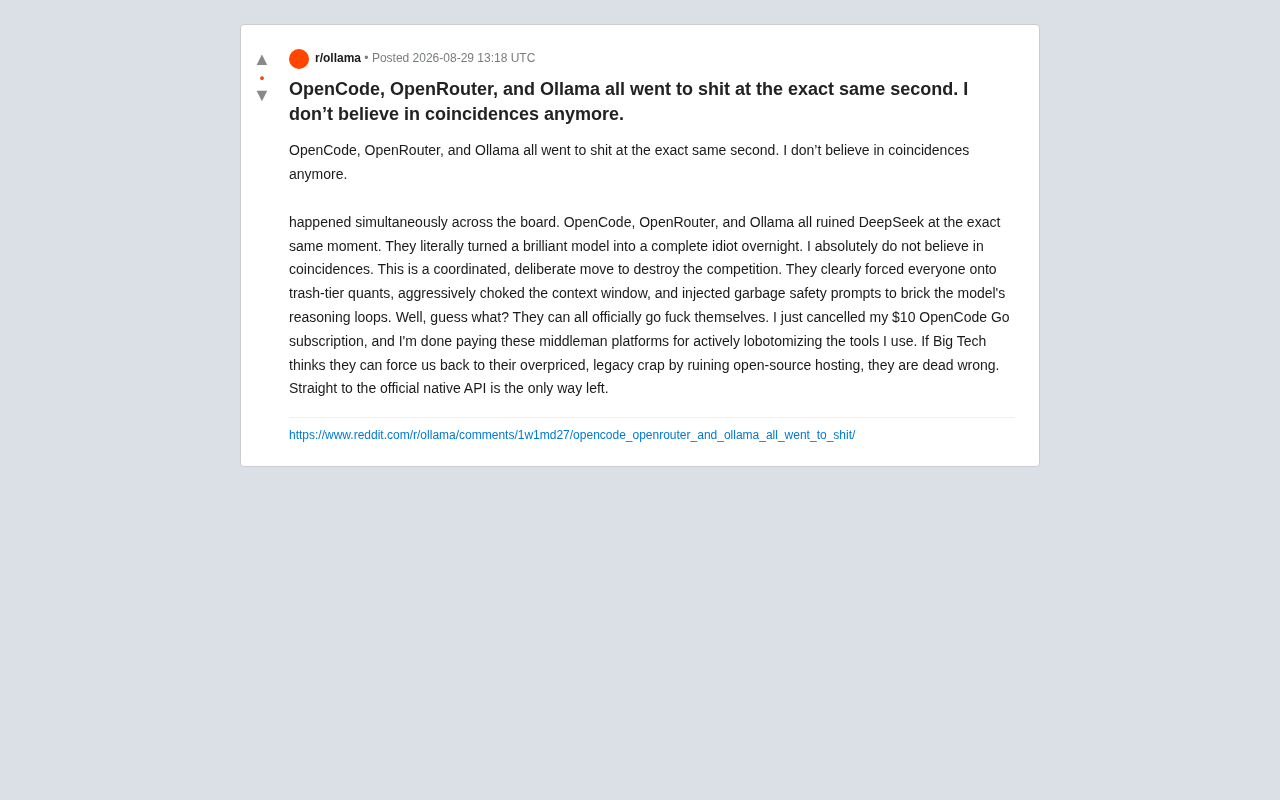
Recently, an emotionally charged post on Reddit sparked widespread discussion about open-source model hosting platforms. A developer claimed that DeepSeek models on three major platforms — OpenCode, OpenRouter, and Ollama — "collectively broke down at the exact same second." Models that had previously performed excellently "turned into complete idiots overnight."
The user made no attempt to hide their anger, stating outright, "I no longer believe in coincidences," and announced the cancellation of their $10/month OpenCode Go subscription. They pointed the finger at so-called "middleman platforms," characterizing it as a "deliberate coordinated attack" against the open-source ecosystem.
It's worth first understanding the subject of this controversy. DeepSeek is an open-source large language model series developed by Chinese AI company DeepSeek AI. Thanks to its strong performance in mathematical reasoning, code generation, and other tasks — combined with training costs far lower than comparable closed-source models — it rapidly became a darling of the open-source community between 2024 and 2025. Its DeepSeek-V3 and DeepSeek-R1 series attracted particular attention, with R1 being one of the first open-source models to demonstrate reinforcement learning–driven, publicly reproducible chain-of-thought reasoning capabilities. Because DeepSeek uses a permissive open-source license, any hosting platform can deploy it independently and offer API services — which also planted the seeds for the concerns discussed in this article. Behind the same "DeepSeek model" label, the actual weight precision and inference configurations deployed by different platforms can vary dramatically, yet users have no easy way to tell the difference.
Although the post is heavily colored by subjective emotion and conspiracy-theory thinking, it touches on a real and important question: When we call open-source models through third-party platforms, what are we actually getting?
Three Technical Accusations in the Post
The user raised three specific technical-level accusations, each worth examining individually:
Forced Use of Low-Quality Quantized Versions
The user accused platforms of "forcing everyone onto trash-tier quants." This accusation isn't entirely unfounded. To reduce inference costs and boost concurrency, hosting platforms frequently employ quantization techniques — compressing model weights from FP16 down to INT8, INT4, or even lower precision.
To appreciate the weight of this accusation, you need to understand the principles and tradeoffs of quantization. Quantization is one of the core techniques for model compression, essentially representing neural network weights and activations with fewer bits. Original models are typically stored in FP16 (16-bit floating point), and quantization can reduce this to INT8 (8-bit integer), INT4, or even 2-bit. Take a 671B-parameter DeepSeek model as an example: FP16 requires approximately 1.3TB of VRAM, while INT4 quantization can compress it to around 350GB — directly determining how many expensive GPUs a platform needs to serve the model. The cost is precision loss: low-bit quantization introduces rounding errors in the weights. While this has limited impact on simple tasks, in scenarios requiring precise numerical computation or long-chain logical reasoning, errors accumulate and amplify layer by layer, causing noticeable degradation in output quality.
Quantization itself is a legitimate engineering practice, but aggressive low-bit quantization can indeed cause significant performance drops on complex reasoning tasks. The crux of the problem is that most platforms don't transparently disclose the specific quantized version users are actually calling. Users think they're using the full DeepSeek model, but they may actually be getting a heavily compressed variant.
Hidden Context Window Reduction
The second accusation is that platforms "choked the context window." Also driven by cost control, platforms may limit the actual usable context length even when the official model claims to support a longer window.
The context window refers to the total number of tokens a model can "see" and process at once, directly constrained by VRAM capacity — because the KV cache in the attention mechanism grows linearly or even quadratically with context length, consuming substantial VRAM. If a platform wants to serve more concurrent users on the same GPU, the most straightforward approach is to compress the available context length per request. For scenarios that rely on long context for code comprehension or multi-turn reasoning, hidden context window reduction directly undermines the model's coherence and reasoning ability, giving users the visceral impression that "the model got dumber."
Safety Prompt Injection Interfering with Reasoning
The third accusation is the most controversial — the user believed platforms "injected safety prompts that broke the model's reasoning loop." System-level prompt injection is indeed common in commercial APIs, used for content moderation and safety alignment. However, excessive or poorly designed system prompts can theoretically interfere with the model's Chain-of-Thought performance, dragging down actual output quality.
Conspiracy or Engineering Reality?
It must be stated clearly: the post's interpretation that three platforms experiencing issues simultaneously constitutes a "coordinated effort to destroy competitors" lacks supporting evidence and reads more like emotional over-attribution.
More Reasonable Technical Explanations
Three platforms "simultaneously" experiencing issues actually has more mundane explanations:
- Shared upstream infrastructure: Many hosting platforms don't build their own inference clusters but rely on the same GPU cloud providers or inference backends. A single configuration change or downgrade upstream can simultaneously affect all downstream platforms.
- Synchronized model version updates: When DeepSeek officially releases a new version or adjusts weights, platforms may update around the same time. If the new version has regression issues, it manifests as "collective dumbing down."
- Universal cost-cutting strategies under pressure: With AI inference costs running high, platforms adopting similar cost-reduction measures (quantization, rate limiting) is an industry-wide trend, not a conspiracy.
To truly understand the possibility of "simultaneous breakdown," you need to see the supply chain structure of modern large model services. Modern LLM services are often not self-built by platforms but rely on inference frameworks like vLLM, SGLang, and TensorRT-LLM, running on GPU cloud providers such as AWS, CoreWeave, and Lambda. Many aggregation platforms (like OpenRouter) are essentially just a routing layer, forwarding user requests to the actual compute providers behind them — and these providers may simultaneously serve multiple front-end platforms. This explains why "different platforms dumbing down at the same time" doesn't require a conspiracy — as long as a shared upstream provider updates their inference engine version, adjusts quantization configurations, or triggers rate-limiting policies, all downstream platforms depending on it will exhibit anomalies at the same moment.
In other words, shared technical constraints explain this "synchronization" far better than a coordinated conspiracy.
The Real Issue Behind This Debate
Setting conspiracy theories aside, this post reflects a deep trust fracture in the open-source model hosting ecosystem.
A Severe Lack of Platform Transparency
When users pay for an API, they deserve to know what specification of service they're getting — the model's quantization precision, available context length, and whether system prompts are injected. However, the vast majority of platforms remain vague on these critical parameters, leaving users to "reverse-engineer" what happened behind the scenes based on degraded performance.
This opacity is precisely the breeding ground for conspiracy theories. When users can't verify service quality, any anomaly is easily interpreted as malicious behavior.
The Value Dilemma of "Middleman" Platforms
The post's concluding verdict — "connecting directly to official native APIs is the only way" — reflects some advanced users reassessing the value of third-party aggregation platforms. These platforms' core value lies in unified interfaces, price comparison, and multi-model switching. But if they're secretly degrading service quality, that value erodes rapidly.
For professional users who prioritize stability and control, connecting directly to official APIs or deploying locally is indeed a reasonable choice to avoid uncertainty, even though it comes at higher cost and lower convenience.
Practical Advice for Developers
When facing similar concerns about "model dumbing down," rather than falling into emotional accusations, it's better to adopt a more rational coping strategy:
- Establish benchmarks: Use fixed test cases to regularly evaluate the model output quality of the platforms you depend on. Let data speak rather than relying on gut feelings.
- Prioritize platform transparency: Favor providers that openly disclose quantization precision, context limits, and system prompt policies.
- Deploy with multi-platform redundancy: Don't lock critical workflows to a single platform. Maintain the ability to switch to official APIs or local deployment.
- Participate in community oversight: Public feedback like this post, despite being emotional, does push platforms to take service quality issues seriously.
Conclusion
Although this angry post is filled with unsubstantiated conspiracy-theory accusations, it reveals a real industry pain point: the transparency and trustworthiness of open-source model hosting. In an era of high AI inference costs and fierce platform competition, the tension between cost-cutting measures and user experience will persist for the long term.
For users, the rational response isn't to believe in "Big Tech conspiracies" but to protect your workflows through benchmarking, multi-platform redundancy, and persistent demands for transparency. For platform operators, only trading transparency for trust can prevent the next collapse of confidence.
Related articles
Tailcat: Tailscale's Official Decentralized Minimalist Networking Solution
Tailcat is Tailscale's official decentralized networking project that strips control plane dependencies, offering self-hosting users a more autonomous, privacy-focused WireGuard mesh experience.
Configuring OpenTelemetry Logs in Rails: From Integration to Production
Learn how to configure OpenTelemetry logs in Rails, covering OTel SDK setup, trace context injection, structured log export, and performance optimization for seamless log-trace correlation.
4DOF Robotic Arm DIY Tutorial: A Progressive Guide from Potentiometer Control to Inverse Kinematics
Complete guide to building a 4DOF robotic arm: from potentiometer control to Python serial communication, inverse kinematics, PyBullet simulation, and vision-based grasping for Arduino robotics beginners.