Are Small Models Good Enough? Benchmarking SLM Performance on Agent Micro-Tasks

Off-the-shelf SLMs fail all agent micro-task benchmarks; the gap is about size, not quantization.
This arXiv study tests whether off-the-shelf SLMs can handle agent micro-tasks like command approval and tool selection. Using a strict confidence-interval pass rule, all 16 Qwen3 configurations and 12 Llama-3.x configurations failed. Three 4-bit quantization schemes changed nothing — the eligibility gap tracks model size, not precision. The practical advice: use SLMs as an incremental layer behind a qualifying baseline, not as standalone replacements for frontier models.
When Agents Start Delegating Grunt Work to Small Models
In LLM-powered agent systems, there's a long tail of frequent but tedious "micro-tasks" to handle: auto-approving shell commands, writing to memory, selecting tools, ranking historical conversation turns. Routing all of these to frontier large models is expensive and introduces noticeable latency. A natural idea follows — can we use off-the-shelf small language models (SLMs) to absorb this low-level workload?
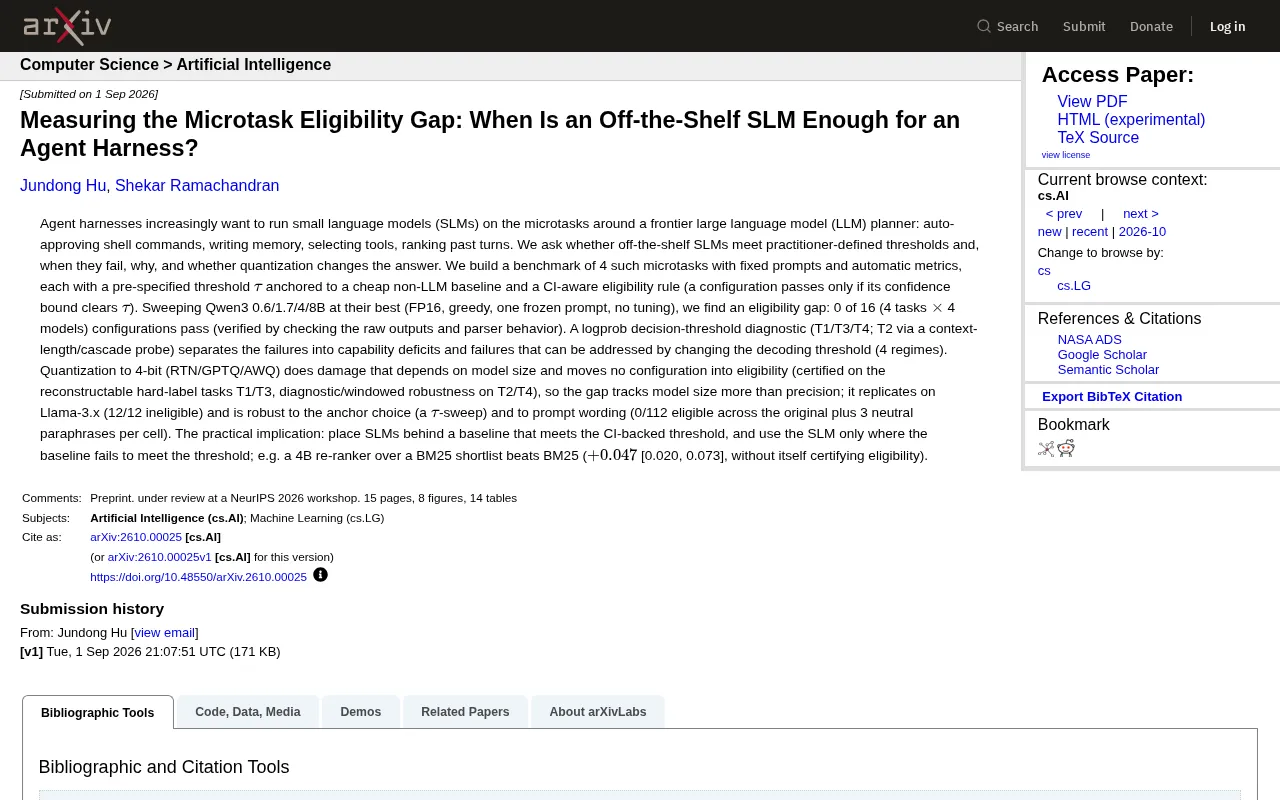
A study published on arXiv tackles this question head-on. The researchers built a benchmark around agent micro-tasks and systematically tested whether off-the-shelf SLMs are actually "good enough" — why they fail when they do, and whether quantization changes the picture. The verdict is unambiguous: under rigorous statistical criteria, off-the-shelf small models essentially fail across the board on these micro-tasks.
Benchmark Design: A Pass Threshold with Confidence Intervals
What makes this study rigorous is that it doesn't rely on vague impressions of model quality. The researchers designed 4 micro-tasks, each with a fixed prompt and automated evaluation metric, and pre-defined a threshold τ.
This threshold isn't arbitrary — it's anchored to a cheap, non-LLM baseline. In other words, a small model only adds value if it outperforms a traditional lightweight approach. More critically, the study uses a "confidence-interval-aware" pass rule: a configuration only passes if its confidence lower bound genuinely exceeds τ. This prevents random variation from falsely indicating a model has reached the bar — a methodologically sound safeguard.
What Was Tested and How
The researchers evaluated Qwen3 in four sizes — 0.6B, 1.7B, 4B, and 8B — under optimal conditions: FP16 precision, greedy decoding, a single frozen prompt, and no fine-tuning. This gave the small models the fairest possible environment, eliminating excuses like "it wasn't tuned properly."
Qwen3 is Alibaba's open-source language model family, spanning from 0.6B to 235B parameters and optimized for tasks like reasoning and instruction following. Greedy decoding selects the highest-probability token at each step — more deterministic than sampling, and ideal for reproducible evaluations. FP16 (half-precision floating point) is the standard inference format that halves memory usage compared to FP32 while preserving most model capability. This setup represents the most typical "deploy as-is" configuration in engineering practice, making the results directly actionable rather than contingent on specific tuning conditions.
The confidence-interval-aware pass rule is one of the study's core methodological contributions. Traditional evaluations typically report only point estimates (e.g., 78% accuracy) while ignoring the uncertainty inherent in a finite test set. A model scoring 80 on 100 samples might have a 95% confidence interval of [71%, 87%] — and a lower bound of 71% may still fall below the threshold. This study requires the lower bound of the confidence interval to exceed τ, essentially asserting with 95% confidence that the model is "genuinely capable" rather than "happened to pass this time." This strict standard matters especially in production: agent micro-tasks fire at high frequency, and a model whose true capability slightly undershoots the threshold will accumulate meaningful errors at scale. BM25, a classic term-frequency–inverse document frequency ranking algorithm from information retrieval, serves as the lightweight non-neural baseline — requiring no GPU and offering extremely low latency, making it a natural reference point for assessing whether using an LLM is even worthwhile.
The Eligibility Gap: 0 Out of 16 Configurations Pass
The results are sobering. Across 4 tasks × 4 models — 16 configurations in total — not a single one passed the eligibility threshold. The researchers manually verified raw outputs and parser behavior, confirming this wasn't a pipeline bug but a genuine capability shortfall.
This "eligibility gap" is a wake-up call for anyone hoping to slot small models directly into agent micro-tasks. At least out of the box and without fine-tuning, off-the-shelf SLMs don't meet the practical bar.
Dissecting the Failures
The study doesn't stop at "they failed." Using a log-probability-based decision threshold diagnostic (labeled T1/T3/T4, with T2 tested via context-length and cascade probes), failures were categorized into two types: genuine capability deficits, and issues that can be mitigated by adjusting decoding thresholds. The study further identified 4 distinct failure regimes, pointing the way toward future improvements — some failures aren't a matter of the model being "dumb," but of decoding strategy being misaligned.
Quantization Isn't the Answer: The Gap Tracks Model Size
A practical question that can't be ignored: if you quantize to 4-bit to save memory, does that make things worse? The study tested three 4-bit quantization schemes — RTN, GPTQ, and AWQ.
The conclusion is that quantization-induced degradation correlates with model size, but no configuration crossed the eligibility threshold in either direction due to quantization. In other words, models that were ineligible stayed ineligible; quantization didn't make things qualitatively worse or better. The researchers validated this using reconstructable hard-label tasks (T1/T3) and applied diagnostic and windowed robustness checks for T2/T4.
The core insight: the eligibility gap is primarily driven by model size, not precision. This is worth sitting with for resource-constrained deployments — blindly tweaking precision yields little benefit.
RTN (Round-To-Nearest), GPTQ, and AWQ are the three mainstream post-training 4-bit quantization schemes, each with a different approach: RTN is the simplest, rounding weights directly; GPTQ minimizes quantization error layer-by-layer using second-order gradient information; AWQ uses activation-aware weight scaling to protect precision-sensitive channels. The three offer similar compression ratios but increasingly better precision retention. Testing all three rules out "wrong quantization method" as an explanation — if even AWQ, which minimizes accuracy loss, can't help models pass the threshold, the bottleneck is clearly parameter count, not quantization strategy. The practical implication: without fine-tuning, hoping to "rescue" a small model by switching to a more sophisticated quantization method is not realistic.
Robustness Checks and Cross-Model Replication
To ensure the findings aren't a fluke, the study ran multiple robustness checks:
- Cross-model replication: Re-ran on the Llama-3.x family — all 12 configurations ineligible (12/12).
- Anchor robustness: Swept across values of threshold τ — conclusions held regardless of baseline anchor choice.
- Prompt robustness: Added 3 neutral paraphrases of each prompt per cell — 0 out of 112 configurations passed (0/112).
This level of cross-validation makes the eligibility gap finding quite credible. It's unlikely to be an artifact of poor prompt engineering or evaluation bias.
Practical Takeaway: Put Small Models Behind a Baseline
The most valuable part of this study isn't the pessimistic finding that "small models don't work" — it's the pragmatic architectural advice it offers:
Place SLMs behind a baseline that can reach the confidence-interval-supported threshold, and only invoke SLMs where the baseline falls short.
The paper gives a concrete example: using a 4B model to re-rank a shortlist of BM25 candidates outperforms BM25 alone (+0.047, CI [0.020, 0.073]) — even though the 4B re-ranker didn't pass eligibility on its own. This points to a layered collaboration approach: small models don't need to operate independently; they can serve as an incremental optimization layer on top of traditional baselines, adding marginal value where the baseline breaks down.
This "baseline as safety net + SLM as booster" design philosophy may be the right way to integrate small models into agent systems today. Rather than asking "can a small model replace a frontier model?", the better question is: "at which step can a small model deliver a verifiable, measurable improvement?"
One-line Summary
Off-the-shelf small models fail across the board on agent micro-tasks out of the box — the eligibility gap tracks model size, not quantization precision.
Paragraph Summary
This arXiv study systematically tests whether off-the-shelf small language models (SLMs) can handle the high-frequency micro-tasks in agent systems — command approval, memory writes, tool selection, and conversation turn ranking. Using "confidence interval lower bound exceeding a non-LLM baseline threshold" as a strict pass criterion, the researchers evaluated Qwen3 from 0.6B to 8B across four sizes. All 16 configurations failed. Three 4-bit quantization schemes (RTN/GPTQ/AWQ) changed no configuration's eligibility status, confirming the gap is driven by model size rather than precision. Findings replicated on Llama-3.x (12/12 ineligible) and across 112 prompt variants (0/112 passing). Log-probability diagnostics identified 4 failure regimes, distinguishing true capability deficits from issues fixable via decoding strategy. The practical recommendation: place SLMs behind an eligible baseline as an incremental optimization layer, rather than expecting them to independently replace frontier models.
Related articles

JobRunner MCP Server: AI Agents Can Now Fix Failed Java Jobs
JobRunner launches an open-source MCP server enabling AI agents to view cluster status, diagnose failures, and recover Java jobs—incident response from any cloud coding environment or existing agent.

MLAI Digital Launches 9 Security Agents: MCP Server Safeguards the Full Lifecycle of Agentic AI
MLAI Digital launches Security MCP Server with nine built-in specialized security agents covering vulnerability discovery, attack simulation, prompt injection detection, API and infrastructure assessment, and accelerated remediation—embedding security validation across the full Agentic AI lifecycle from development to production.

Running Isaac Lab on H100 GPUs: Exploring Better Approaches
Exploring optimization methods for running Isaac Lab on NVIDIA H100 GPUs, including MIG configuration, mixed precision, TensorRT acceleration, and community experience to improve robotics simulation and reinforcement learning efficiency.